In Pakistan, small-scale farmers have been cultivating land for generations. Today, International Monetary Fund (IMF)-driven policies are dismantling the support structures that sustained them: the government has stopped announcing wheat support prices, authorized multinational companies to control crop purchasing, and allocated vast tracts of land to corporate farming. Peasants who have farmed the same land for a century are being told to leave.
Women bear specific weight in this crisis. In rural areas, besides dealing with the control and exploitation of their land and labor, patriarchal structures control whether they can occupy public and political spaces, have access to formal education, and choose a profession. Organizing against this system is made harder by surveillance and arbitrary detention.
Saima Zia comes from a small-scale farming family based in Pakistan. She is a member of the Pakistan Kisan Rabita Committee, an alliance of 36 farmers’ organizations across the country. The organization, formed in 2003, became a member of La Via Campesina in 2018, and has been building collective responses to the conditions of peasants in the country.
In this interview, Saima talks about what it takes for peasant women to organize in Pakistan, how neoliberal agrarian policies are reshaping rural life, and how movements are resisting state repression and the advance of corporate farming.

IMF-driven neoliberal policies have deepened the agrarian crisis in Pakistan,driving up production costs, reducing farm incomes, and expanding corporate farming. How does this crisis affect rural and peasant women in specific ways?
Wheat is Pakistan’s main staple crop. For decades, the government announced a support price for wheat every year, which allowed farmers to sell at a reasonable price. The government also bought the crop directly and kept it in storage, distributing to flour mills so everyone could access wheat flour. But for the last two years, the government stopped announcing the support price. This is a direct result of IMF policies that favor an open market, which in practice means large companies can exploit small-scale farmers and small vendors.
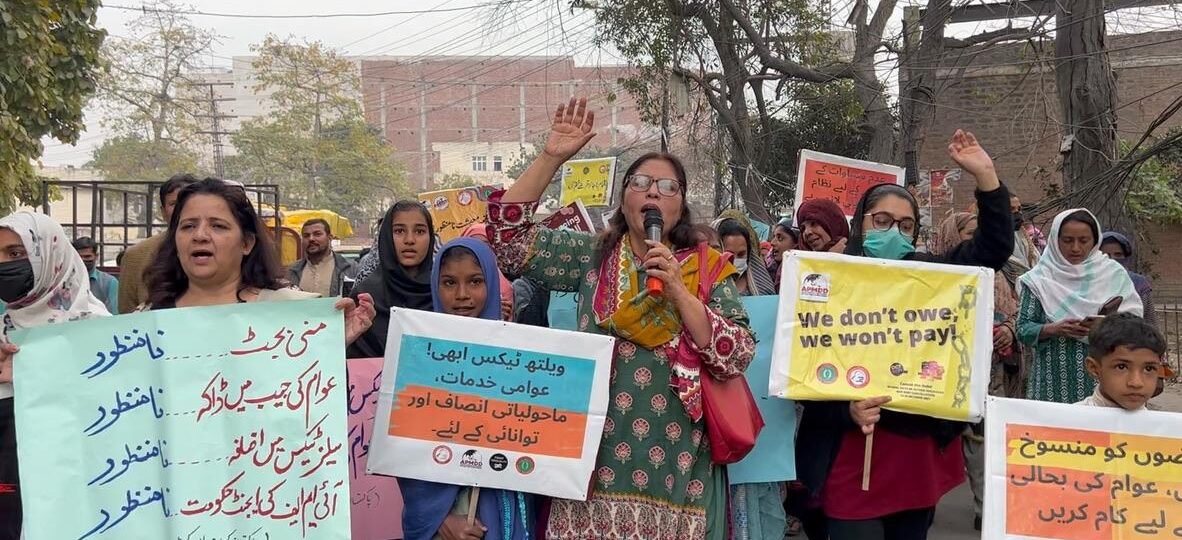
At the same time, the government is allocating large amounts of land for corporate farming, actively discouraging small-scale farmers. When farmers don’t earn enough from their land for a whole year, they face pressure to sell. Not enough money means not being able to feed children or keep food on the table. We have been protesting against this in 30 to 35 cities across Pakistan for the past two years, demanding that support prices be reinstated.
This year, the government announced a support price again, but it was insufficient. And instead of buying the crop directly from farmers, the government authorized 11 multinational companies to do it. Some are based in the United Arab Emirates. Many of them are deliberately difficult to locate. You can find a website but not a real address. These companies will buy wheat from farmers and then sell it to flour mills at very high rates, raising the price of flour for everyone.
There is also the question of land. Peasants have cultivated certain lands for more than 100 years, some since before the partition of India and Pakistan. Now the government is telling them this land is not theirs and must be handed over to companies for corporate farming. Under Pakistan’s constitution, if someone has been cultivating land for around 100 years, that land legally belongs to them. You cannot ask them to leave, but that is what is happening. Thousands of peasants are resisting this across Pakistan, and we support their movement.
Legal cases are still ongoing in the courts. The state repression is severe.
This corporate farming agenda is also connected to the China-Pakistan Economic Corridor (CPEC), the Pakistan component of China’s Belt and Road Initiative. Roads have been built through CPEC, but the full details of the contracts have never been made public, because the project is under army control. Even politicians do not know what is in the contracts. Corporate farming is part of what CPEC is implementing. We are resisting and protesting that as well.
What you’re describing is a concentration of power between government and corporations. How are rural social movements in Pakistan organizing to confront this structure?
It is increasingly difficult to organize. Whenever we plan a meeting or a gathering, we are under surveillance. Talking about these issues, especially anything that challenges the army, puts people at serious risk. Many people have been abducted from their homes and are still missing. Others have been detained, tortured, threatened, and released after one or two days.
I know one young student leader who was very active. He spoke at one of our protests. He was taken from his home, and they took his laptop too. We tried to find him. After a week, he came back. They kept his laptop, tried to access it, and demanded the password. After that, he disappeared from all activism. I met him once, and he seemed completely withdrawn. A few months later, he came to ask for an experience letter and said he was trying to leave the country. He did leave. He never told anyone what happened while he was in custody. We tried to speak with him, thinking he might need support, but he was too scared. He said, “I cannot live here. Any country, it doesn’t matter, but not here.” This is what happens to people who speak against state repression. The space is shrinking. But we are not giving up.
On April 17th, International Peasants’ Day, we celebrated in 17 cities across Pakistan. In Lahore especially, large gatherings in big cities attract mainstream media and social media attention. That makes the state more nervous, but also more visible. What we are working toward is building unity across all civil society movements, small-scale farmers, women’s organizations, and trade unions, because working in separate pockets is no longer enough. It has to be collective.
How would you describe the women’s situation within the country?
The patriarchal system is still suppressing women. It is very difficult for women to survive in this situation. The legal marriage age for women is now 18 years; that law exists. Before, girls of 10 or 11 were being given to men of 25 or 40. Women struggled enormously during the dictatorship in the 1980s. There was a law called the Hudood Ordinance. If you read it, you won’t know whether to cry or laugh; it is so dangerous and so absurd. Our comrades organized and fought during that time, and some laws were changed, but the overall perspective in society remains deeply patriarchal. There is a law allowing domestic violence victims to go to the police, but after going to the police, a woman can almost never return to her home. So the law exists, but the conditions for using it do not.
LGBTQ people in Pakistan are at very high risk. Whenever we hold the women’s march and we welcome everyone, we face accusations that the march is only happening to protect LGBTQ people. Being LGBTQ is considered to be a crime here. Religious fundamentalism grew sharply since the 1980s and has not retreated.
How grassroots women, and specifically peasant women, are organizing to dismantle these capitalist and patriarchal system within Pakistan?
For peasant women and women in rural areas, attending the march on March 8th is a major challenge. The marches happen mainly in large cities such as Lahore, Islamabad, and Karachi. Even getting to the city is difficult. And our movements are not welcomed by the patriarchal structures that organize rural life. For other kinds of marches — against corporate farming, on climate change, and around support prices for crops — women also join, including women organizing in rural areas. But even there, most of the time the protests and rallies are predominantly male. To have women present, we often have to go, mobilize, and have direct conversations with them. It is common for the men of the household to not allow them to go.
However, the women’s march in Pakistan happens every year on March 8th. All women’s organizations, civil society organizations, and larger movements, including trade unions, join. We participate in our city, Lahore. The march has always been criticized by religious fundamentalism and by the government and the establishment, but we have never stopped it.
In 2019, women were arrested just for talking about issues that affect them. The same is happening to civil society organizations across the board. We keep the momentum through solidarity. Our leaders and comrades come together and try to mobilize more people.
We don’t have money. We don’t have weapons. What we have is people’s power. That is what protects us from state repression.
When we organize and mobilize in rural areas, we work through our member organizations.
There are also women who farm independently and who can bring others with them. The struggle continues. Solidarity is what sustains it, including international solidarity. When these voices are visible internationally, in media and on social media, the state is forced to pull back, at least partially, from some of its repressive actions.