July 25, the International Afro-Latin American, Afro-Caribbean and Diaspora Women’s Day, “should be a day of celebration, but it is a day of struggle and resistance,” says Dominican peasant activist Lidia Ferrer Paredes. For the past 40 years, Lidia has been part of struggles for land and equality for rural women in the Dominican Republic. She is a member of the National Confederation of Rural Women (Conamuca), an organization that brings together federations across municipalities nationwide, and is also part of the World March of Women and CLOC–La Via Campesina.
Alongside me, there is a whole generation of sisters. We have all been part of this journey, fighting to defend women’s rights, especially the rights of rural women.
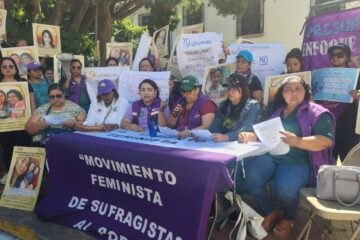
This interview with Capire was conducted on July 15, 2026, the same day members of Conamuca were delivering a letter to the National Congress demanding the approval of the three legal grounds for abortion in the country. In the interview, Lidia shares her perspectives on the current struggles of Black women in her country and across the continent. She speaks about the right to abortion, migrants’ rights, and resistance to imperialism. The advance of the far right, militarization, and pressure from the United States have intensified intervention and conflict across our territories. In the face of all this, she says, “Our struggle must be strong, and we truly need to stand together if we are to move forward.”

Could you tell us about Conamuca’s history?
We first came together through Conamuca to fight for land, access to public services, rural roads, and healthcare. Over time, the context changed and the challenges became increasingly demanding. Today, Conamuca is the organization with the greatest mobilizing capacity in the Dominican Republic. Together with other organizations, we began fighting for food sovereignty, girls’ rights, the prevention of teenage pregnancy, and an end to child marriage and early unions. We have also been active in the struggles for agrarian reform and women’s rights. Today, we coordinate a coalition for women’s health and lives in the Dominican Republic that brings together more than 80 organizations across the country.
One of our main strategies has been to bring young women into this journey. We know they need to be involved not only to ensure generational renewal, but also to carry this work and its organizing processes forward. We have always said that one swallow does not make a storm. Walking together with other women, other organizations, and broader coalitions is what has enabled Conamuca to remain on the front lines of these struggles, resisting in the streets.
Right now, we are fighting over the Penal Code and the demand for the three legal grounds for abortion. We have been engaged in this struggle for more than twenty years. Sometimes we make progress, and other times decision-makers push us backward, but we have never stopped fighting in the streets. Today, there is a demonstration outside the National Congress, and many of our federations are delivering a letter demanding that the three legal grounds be approved.
We support the full decriminalization of abortion, but at the very least we need the three legal grounds to be recognized. This is about women’s lives, because it is we, rural women, poor women, who are dying. We have a long history of building alliances with women’s organizations and with mixed organizations, both nationally and internationally. That is what allows us to build collective strength and remain steadfast in this struggle, because we know we are not alone.
The struggles of Black women across Latin America and the Caribbean are extremely diverse. From your perspective, what agendas and challenges are shared across the region?
This July 25, which should be a day of celebration, is instead a day of struggle and resistance. We say it is not a day of celebration because racism continues to grow in this country. Simply acknowledging and embracing my own reality—that I am Afro-descendant, that I am a Black woman—is, in itself, an act of resistance.
Here in the Dominican Republic, one of the most pressing issues is the ruling against our Haitian sister. We have also built alliances around this struggle. We are part of a migrant rights collective that brings together many different organizations. This is how we organize across the Caribbean, connecting Haiti, Puerto Rico, Cuba, and the Dominican Republic.
This collective has organized a range of actions demanding that the government adopt a migration policy that allows our sisters and brothers to remain in the country without persecution. Even people whose legal status has been regularized continue to be persecuted. We have seen pregnant women die in childbirth because they were too afraid to seek care at hospitals.
Social media also has a profound impact because many media outlets fuel hostility between the Dominican Republic and Haiti. They refuse to acknowledge the solidarity that exists between our peoples; instead, they incite violence. We work on human rights and social protection while building alliances with Afro-descendant organizations. In the Dominican Republic, more than 10,000 people are deported every month. Many of them were born here, they are Dominicans of Haitian descent whose nationality has been stripped away. They are left stateless, belonging neither here nor there.
We need to strengthen our alliances with organizations working on migration, both in the Dominican Republic and in Haiti. They are our allies, and they are also part of CLOC–La Via Campesina.
We are living in a context marked by the advance of the far right, militarization, and attacks by the United States across the region. How do anti-racist feminism and anti-imperialism come together in our territories?
The first thing we need to do is reclaim political education, especially for women and young people. As the saying goes, a country without education is a country that has been silenced. We need to strengthen political education within our organizations by confronting the capitalism and patriarchy that shape our lives.
As feminists, we are committed to political change, but we still have a long way to go when it comes to the left-wing parties, which remain deeply divided. Very often, our countries are not able to govern themselves; they lack real autonomy. The United States, as the world’s leading capitalist power, does not let us move our processes forward. That has always been the case, but it has become even more intense since Trump’s return. We must continue strengthening unity among organizations, among peoples, and among left-wing political parties.
Community-based and communist parties are the ones that can ensure people in their communities have opportunities to thrive and gain access to production and markets. We are not talking only about migration between countries, but also about migration from rural areas to the cities. Why should young people have to leave their communities if they want to continue their education? Through our agroecological school, we are also promoting healthy food production within communities so that young people can access education and productive opportunities where they live, instead of being forced to migrate to large cities.
How has the Trump administration affected peasant organizations across Latin America and the Caribbean?
United States policy affects the entire region through trade relations, the exchange of goods, and the imposition of what we, as peasants, are expected to grow according to the Empire’s interests. Agroecology means our right to decide what we grow, what we sell, and to whom we sell it. Many peasant women and men have lost their harvests because, if the state decides a particular crop should not exist, it will even go so far as to burn it.
As a result of this intervention, our countries have also lost much of our ancestral knowledge, the ways our grandmothers and grandfathers cultivated the land. The growing reliance on technology has all but forced us to adopt it in farming, while they also keep us under surveillance through our phones and social media. We take precautions, but that does not guarantee our safety. We have to continue organizing ourselves. We have to continue building alliances. It is true that we have made progress, but there is still a long way to go before we achieve the changes needed to guarantee women’s lives and health.
What lessons from the collective struggles of Black women inspire you and can strengthen resistance across Latin America and the Caribbean?
We take part in many World March of Women activities, where we always say: we are not alone. Even though we are spread across different countries, we know we are not alone. La Via Campesina has also given us many historic moments of shared struggle and collective life where we have reaffirmed that: we are not alone.
The same is true here in the Dominican Republic. Whenever we take part in initiatives supporting Black women, Haitian women, and migrants, we feel that same sense of sisterhood and solidarity. Those spaces fill us with strength.
Across every country, even if we are not together in our everyday lives, we know we are never alone. We carry this struggle for resistance in our blood; it is part of who we are. We are engaged in these struggles not because anyone forces us to be, but because they come from our hearts and from solidarity. The energy that comes from women standing together, surviving together across Latin America and throughout the world, is like a call to keep going. It gives us the strength to continue moving forward and making decisions.
As Conamuca, we reaffirm our commitment to continue advancing, educating, and supporting rural women in order to strengthen leadership, defend rights, and build a model of development grounded in social justice. The social justice we have fought for over so many years is rooted in equality, food sovereignty, and, above all, the sustainability of life, that means placing life at the center, not only human life, but also the life of nature and biodiversity.
I also believe that, on this International Afro-Latin American, Afro-Caribbean and Diaspora Women’s Day, we should honor those women who are no longer with us but who left us their legacy and their history, so that we may follow in their footsteps, not alone, but together, all of us. Our struggle against patriarchy and machismo is a difficult one, and we truly need to stand together if we are to move forward.