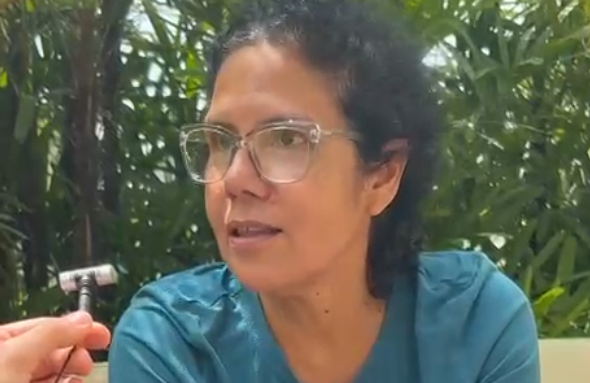
Ana Maldonado is a member of the Venezuelan organization Frente Francisco de Miranda and of ALBA Movimientos, where she works in people’s diplomacy and militant internationalism. In this conversation, held during the ALBA Communicators’ Gathering in Caracas in May 2026, Ana reflects on international solidarity efforts with Venezuela, the history of ALBA as a project of unity for Our America, and the work of women in building the country’s communes. On January 3, 2026, United States forces attacked Venezuelan military facilities and kidnapped President Nicolás Maduro and Cilia Flores, taking them to U.S. territory. Maldonado describes this event as a military aggression and explains how popular organizations have built, from their territories, a counter-narrative rooted in unity.
This interview was conducted before the earthquakes that devastated seven Venezuelan states, with their epicenter in Yaracuy and La Guaira, Caracas, and the Capital District among the hardest-hit regions. In the face of this tragedy, the Venezuelan people responded with precisely what Ana Maldonado describes throughout this interview: popular unity, people’s power, and the communes at the center of rescue and reconstruction efforts, with women sustaining life across the territories. At Capire, we are following and supporting the “Venezuela: For Life!” campaign, launched by ALBA Movimientos and popular organizations to save lives, support affected communities, and mobilize international solidarity among peoples. Contributing to this campaign means standing with the Venezuelan people’s determination to defend life and peace.
How do people’s diplomacy and internationalism take shape in everyday life across the territories? How do women participate in these processes, and how does this contribute to building peace?
People’s diplomacy for peace has always been central to the Bolivarian Revolution. From the very beginning, during the constituent process, we made it clear that new political subjects, new rights, and new ways of organizing society were being incorporated into the Constitution. Among these new political subjects were women, children and teenagers, who we would never again refer to as minors; grandmothers and grandfathers, persons with disabilities, and people living in situations of vulnerability. We also affirmed the construction of a participatory, popular, and leading political subject, the people themselves: the citizen with the capacity to participate not once every five years, but every day, in their own territory.
This vision was already recognized during the 1998 constituent process and throughout the body of Organic Laws on People’s Power. It represented official recognition of struggles that had long been taking place in our territories, particularly through the neighborhood assemblies that played such an important role during the 1980s and 1990s. That process was profoundly significant.
We are Bolivarians, and militant internationalism is part of our roots. We cannot conceive of sovereignty or the construction of People’s Power except within the broader project of the unity of Our America. As early as the 1980s, we had already concluded that it was impossible to make a revolution in a single country. There can be no independence, sovereignty, or self-determination unless they are understood as part of a continental process of unity across the Global South.
I want to mention a few initiatives of organic political coordination that were especially important. ALBA Movimientos was founded in 2007 in Tintorero, in the state of Lara, following the first ALBA-TCP Summit (Bolivarian Alliance for the Peoples of Our America–Peoples’ Trade Treaty). It was there that Commander Chávez raised a crucial concern: it was necessary to create a space where peoples committed to the principles of ALBA could come together, even if their governments were not politically aligned. We embraced that proposal together with Brazil’s Landless Workers’ Movement (MST), our comrades from Cuba’s Martin Luther King Center, and those of us who were part of the Bolivarian movement.
From there, this process joined earlier forms of coordination with trade unions and workers’ organizations, including comrades from the United States, Canada, and Europe who were active in more traditional spaces of labor and trade union organizing.
Around 2016, following the “Dilemmas of Humanity” conference, we concluded that this coordination should no longer be limited to the Americas, but should embrace all continents. That was how the International Peoples’ Assembly, bringing together organizations from Africa, Europe, and Asia, began to take shape. A particularly important milestone, not its founding, but certainly a defining moment, came in 2019, when an assembly was held here in Venezuela in solidarity with the Bolivarian Revolution during a year of tremendous external pressure. Throughout this process, women’s movements, including the World March of Women, have always played an active role. The Black movement and South-South relations between South America and Africa are also experiencing an important moment: Pan-Africanism has become increasingly part of our own political horizon.
Since January 3, we have welcomed seven international brigades. The first was organized by the Popular Unity Process of Southwestern Colombia, bringing together 57 comrades who traveled overland in a chiva (a truck). It was extraordinary. They spent several days at one of our organization’s schools and took part in a series of activities to learn about the communes and visit the sites of the bombings in La Guaira, Caracas, and Ciudad Tiuna. We shared moments of discussion, political analysis, and deep emotion. Everyone kept saying, “These people came all this way on foot.” They had walked for many days.
After that, seven more brigades arrived, each with a different profile. Most of them were able to participate in exchange activities across the territories, listening firsthand to how people had experienced the January 3 attacks and to the concerns that weigh most heavily on the Venezuelan people today.
Our greatest concern is ensuring that our people’s diplomacy and our internationalism be capable of responding to the Empire’s offensive, which seeks to divide us, demoralize us, and sow confusion. We are still in that process. We have not resolved it yet, but we are building a counter-narrative: we are united. Despite the United States’ overwhelming military and technological superiority, after 127 days of a naval blockade, which has remained in place since January 3, the Empire encountered another kind of superiority in Venezuela: our popular unity. Their agenda is one of fratricidal war. They want to see us destroy one another, just as happened in West Asia in previous decades, so that they can seize the territory more easily.
At this moment, how can international solidarity strengthen the Venezuelan people’s popular sovereignty in practical terms?
I believe this is the most important question. Today, international solidarity has acquired the strength we have always hoped to build among peoples: it is a commitment, not charity. As our political forebears used to say, it is not about giving what is left over; it is about sharing what we have. And what do we have? The same struggle, a common cause: to show that what drives us is the long journey toward building a communal society in Venezuela. That does not happen overnight. For twenty-six years, we have resisted and confronted every form of hybrid warfare imaginable.
When it comes to solidarity, communicating this process is essential. We need to strengthen both our channels and our methods of communication. Here, we have adopted the model proposed by President Nicolás Maduro: the streets, social media, the media, and the walls. We have also embraced radio bemba—that is, word of mouth. Even so, we have not yet succeeded in creating effective mechanisms to communicate to the outside world what is happening here.
One of our greatest concerns today is that, just as they tried to sow division, demoralization, and confusion in Venezuela, they are now trying to do the same in Cuba. We have launched a campaign to confront this: “Love Is Repaid with Love”. Its purpose is to ensure that material solidarity reaches Cuba.
How would you describe Venezuela’s current situation?
We have always said that we live through difficult and decisive moments, but this one is particularly complex. We were the victims of an invasion, of a military attack: 150 aircraft, hypersonic weapons reaching temperatures of 3,500 degrees, capable of dissolving human bodies. It was something atrocious, truly horrific, which culminated in the kidnapping of our president and the First Lady, and the killing of 32 Cuban comrades and 47 Venezuelans. That wound remains open. It fills us with anger and sorrow, but it also strengthens our determination to continue improving our struggle.
The United States is testing a particular form of occupation: keeping our president kidnapped and under constant threat. In a publication we released, our comrade Prabhat Patnaik discusses the modus operandi of imperialism: imposing successive sanctions through forms of hybrid warfare tailored to each country. In Venezuela’s case, the United States speaks of three phases: stabilization, recovery, and transition, but only after complete surrender. That is precisely what they have not achieved: our surrender. We continue to resist. The United Socialist Party of Venezuela (PSUV) continues governing alongside the patriotic people, and it is the communes that are opening schools, organizing gas distribution, ensuring access to food, and sustaining the means of production.
What they seek is regime change, our total surrender, so that they can seize our resources and take control of the country’s political direction, placing everything under the authority of the United States. That is why this moment is so decisive. The political leadership of the Revolution, interim President Delcy Rodríguez, the National Assembly, the ministers, and the Executive are carrying the Revolution forward under extraordinarily difficult pressure. Since President Obama’s Executive Order of March 9, 2015, our resources have been expropriated, our assets stolen, and we have been subjected to systematic economic strangulation. As a nation, we have been excluded from the international financial and legal system: we cannot operate freely in global markets. That is why, under conditions of war, we have had to develop alternative mechanisms.
Our immediate objective is to secure the release of President Nicolás Maduro and Cilia Flores, while ensuring that the revolutionary process continues with the communes at its center. We successfully held the first popular consultation on March 8, International Women’s Day, and the second has already been announced for July.
This is an extremely complex situation because imperialism seeks to appropriate everything. Yet it is not entirely new. Our reserves remain frozen in the Bank of England; CITGO, in the United States, remains under confiscatory control established during Juan Guaidó’s self-proclaimed interim government in 2019; and Monómeros, the petrochemical company in Colombia, suffered the same fate. The difference now is that they are actually extracting our oil, administering it themselves, and openly claiming the right to manage our natural resources. It is another step in the same process, but one that has been unfolding for years.
Drawing on your internationalist experience, what memory would you like to share at this historic moment?
When Commander Chávez declared “FTAA, to hell with it!” at the 2005 Summit of the Americas in Mar del Plata, and everything that decision represented, he organized several teams to work with Venezuela’s missions to the United Nations in New York and Geneva. He knew that several mid-level officials had entered into commitments on behalf of the Republic, and together with then Foreign Minister Alí Rodríguez Araque, we went to revoke the commitments Venezuela had undertaken before the United Nations in relation to the FTAA. The “A” in FTAA stood for “Area”: a Free Trade Area that would have represented the plunder of the Americas. I had the opportunity to accompany the delegation of political leaders that first traveled to New York and then to Geneva. None of them were career diplomats.
The FTAA negotiations were conducted in secret and were restricted to the governments involved. Commander Chávez’s first decision was to release the access code, making the negotiations public. Once that happened, everyone could see that much of what was being negotiated was unconstitutional under the participating countries’ own legal systems. Later, through ALBA and the Peoples’ Trade Treaty (TCP), new mechanisms began to be developed for de-dollarization, compensatory trade arrangements, and a new system of equivalencies.
At ALBA Movimientos, we have developed a handbook for peoples’ movements organized around different axes of struggle. The defense of sovereignty over our natural resources is also the axis through which we seek to deepen unity. Another axis is grassroots feminisms, because women experience multiple and intersecting forms of oppression: as mixed-race women, Black women, poor women, young women, and working women. Other axes address race, class, and different social groups, as well as communication and political education.
The Venezuelan chapter of ALBA Movimientos has grown tremendously. It began with around ten organizations; today, we are nearly seventy, representing a remarkable diversity of movements: community organizations, Indigenous organizations, workers’ organizations, sexual and gender diversity groups, youth organizations, and social workers. We meet regularly, while also working to strengthen ALBA’s national chapters throughout the continent.