By mid-2026, Honduras was under a far-right government that had intensified agrarian conflict, deepening criminalization, persecution, and violence in rural areas. On May 21, 20 peasants were killed in the village of Rigores, in Trujillo, Colón, in the Bajo Aguán region. “This tragedy brings mourning not only to Honduras, but to the entire Mesoamerican and Latin American peasant movement,” according to a report by La Via Campesina.
Two weeks later, the National Congress passed the Law for the Strengthening and Protection of the Agroindustrial Sector. Enacted as Decree 107-2026, this law declares land used for agroindustry exempt from expropriation and requires the National Police and the Public Prosecutor’s Office to take immediate action in cases of land occupation. Since the law came into effect, the peasant, Indigenous, and Garifuna movements have maintained road blockades and mobilizations across the country, demanding its repeal.
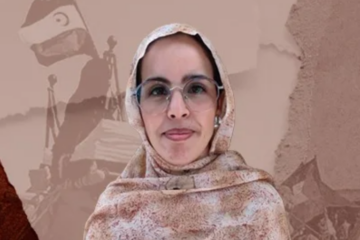
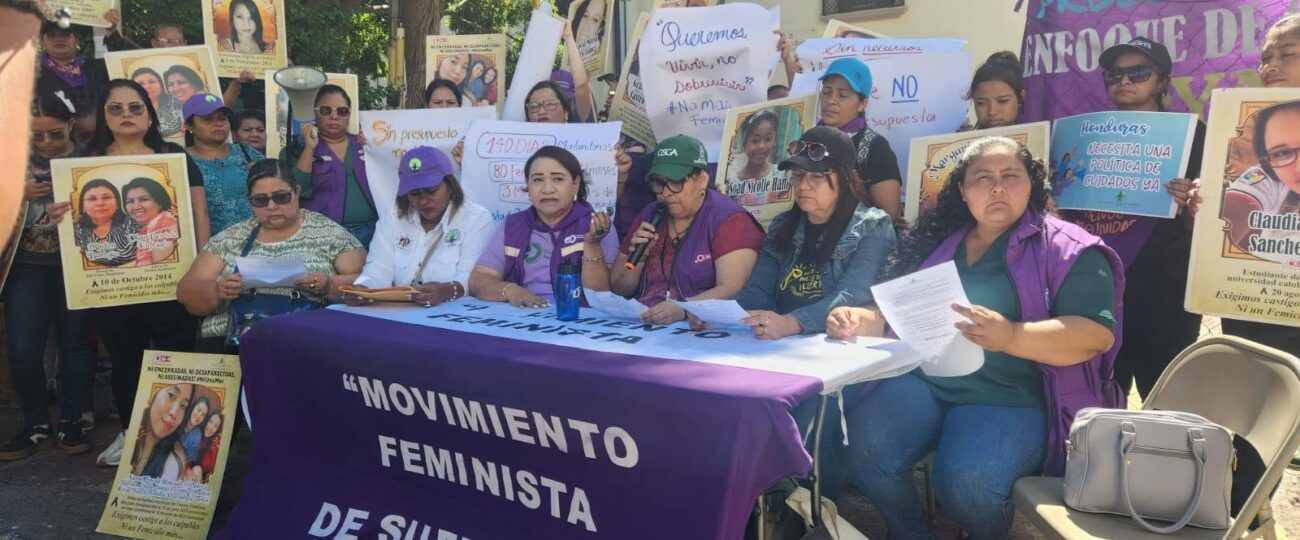
Wendy Cruz spoke to Capire about this context of attacks and resistance in Honduras. She is a member of the World March of Women and the Latin American Coordination of Rural Organizations, which is part of La Via Campesina (CLOC-LVC). Wendy is also a member of the Plataforma 25 de Noviembre [November 25 Platform], “a diverse space bringing together peasant and Indigenous women, women members of cooperatives, and domestic workers from more than 60 organizations nationwide.”

What are the main shared issues and challenges for peasant and Indigenous women across the region?
The defense of land and territory is one of the main issues for peasant and Indigenous women in the region. I believe we are facing an offensive by big capital aimed at reconcentrating land ownership and deepening extractivist models. We have just returned from a Mesoamerican gathering of CLOC-LVC women, where we discussed the advance of the far right in the region. This far right has strategic allies, such as fundamentalist religious groups, which are making women’s human rights increasingly precarious.
There is political interference in Mesoamerica driven by geopolitical interests and attempts to control the commons. There is also the tourism development they are trying to push forward in Honduras. All of this makes us more vulnerable. We must remember that ours is a region rich in natural resources, which we understand as commons. Mesoamerica is an extraordinarily rich region, and that puts us face to face with ruthless capital.
The United States government has put a price on our region. By putting a price on our commons, it is also putting a price on the lives of thousands upon thousands of families, and especially on the lives of women and children.
The Rigores massacre and the passage of the agroindustrial law have marked the past few months in Honduras. What is happening in the country, and how are rural women organizing in the face of extractivism and militarization?
There is no doubt that the shift to a far-right government, which has been in power for only six months, has led to many terrible things happening in the country. One of them was the National Congress’s passage of the law on the agroindustrial sector. For us, this law legalizes the dispossession of peasant and Indigenous communities from their territories. Around one thousand evictions have been announced under the law. At the same time, at least 60 territorial conflicts involving the defense of the environment or territory have been recorded. This keeps us on permanent alert. That is why peasant and Garifuna communities are taking action across their territories, and many people are also raising their voices in defense of the land and territory.
This law to strengthen agroindustry is not only about land dispossession. It is also about the expansion of extractivist projects linked to tourism, which has been displacing Garifuna communities for many years, as well as energy development in the country. Defending the right to water is fundamental because Honduras is facing a crisis in access to water for human consumption. Everyone wonders how there can be enough water for monoculture production, but not for people to drink.
All these extractivist and monoculture projects deepen inequalities and concentrate control over land and the commons.
Above all, we are dealing with a state that refuses to comply with the rulings of the Inter-American Court of Human Rights in cases involving the Garifuna people, which require the state to provide reparations for the harm caused.
What does it mean to provide reparations for the harm caused? It means returning the Garifuna people’s land to them. Instead, what they have faced is the constant threat of eviction.
It is also important to draw attention to the role of private security companies in the country. There are around 700 registered private security companies, with between 60,000 and 70,000 armed men. That is more than twice the size of the country’s civilian police force. Their role is a recurring concern in agrarian conflicts.
Women’s role is to be at the forefront of the struggle to defend our territories. Having access to land must be connected to other human rights, such as the right to housing, the right to produce our own food, and the right to live in a more peaceful environment. Women are the ones who remain on the front lines defending their territories when many men are repressed and detained by the National Police.
The current government controls both the National Congress, where it holds an absolute majority, and the Supreme Court of Justice. They used politically motivated legal proceedings to remove public figures who had been promoting changes in favor of the people. This has left us even more vulnerable and completely unprotected. Organizations such as the Black Fraternal Organization of Honduras (OFRANEH) have denounced the transfer of court proceedings to other cities because the authorities have shown themselves unable to respond to the demands of the Garifuna people.
We women have always played a fundamental role in defending the commons and in calling for international action from human rights bodies and social organizations. We need to join forces and continue denouncing what is happening. The lives of women and men who lead social movements are extremely vulnerable and face imminent danger from these security groups operating throughout the country without any oversight.
What strategies should we pursue, nationally and internationally, to stop the repression and ensure justice?
On July 29, 2026, a public action took place in Honduras, where the peasant and Garifuna movement delivered more than 5,000 signatures collected across the territories, calling for political proceedings against 17 members of Congress who have been pushing this law to strengthen agroindustry, particularly the president of the National Congress, Congressman Tomás Zambrano. The law is unconstitutional because our Constitution states that laws must apply to all citizens, not benefit one particular sector.
The peasant movement has remained in constant mobilization. Since April 17, 2026, the International Day of Peasant Struggles, we have been mobilizing and organizing actions nationwide. There have been road blockades in different parts of the country, and now we have submitted more than 5,000 signatures to demand political proceedings against those who have betrayed the rights of peasants in Honduras.
We have raised the alarm nationally and internationally about the vulnerability of the rights of land and territory defenders. Amid constant massacres, criminalization, and evictions, no international protocols or standards have been respected. The state is violating a fundamental principle: that dignified conditions must be guaranteed when people are displaced from their territories as a result of conflicts over land tenure.
In Honduras, we face a serious problem: around 80% of the land has unresolved legal status or title issues, according to various analyses and reports based on assessments by the Food and Agriculture Organization of the United Nations (FAO). We do not have a unified land registry that would allow us to verify property titles. In Honduras, the business sector has generally acquired land through fraudulent means, including fraudulent property titles that override preexisting ancestral land rights, such as those of Indigenous peoples. The state has no interest in formalizing land tenure for peasant and Indigenous communities, and this has made Indigenous peoples’ right to land tenure security even more vulnerable.
Until we resolve the issue of formalizing community land tenure and guarantee fundamental rights of access to land, land conflict will remain a structural problem in our country, one that most governments have had no interest in resolving.