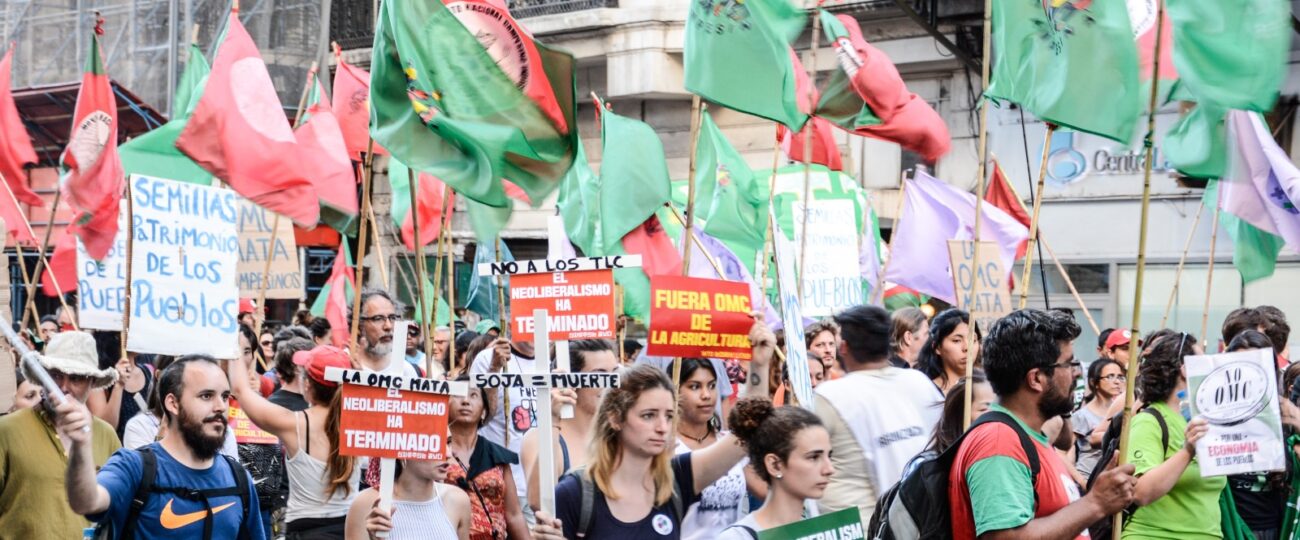
The current global food system isn’t broken; it is functioning exactly as the capitalist system intends. This system has transformed land, water, seeds, labor, and food into commodities for profit. Communities across the globe face land grabbing, debt, displacement, exploitation of labor, and resource extraction by transnational corporations. Small-scale farmers, peasants, fishers, pastoralists, Indigenous peoples, and farm workers are increasingly squeezed between rising production costs and declining returns, while agribusiness corporations consolidate power across every stage of the food system. International institutions such as the International Monetary Fund (IMF), the World Bank, and the World Trade Organization (WTO) have played a central role in this process, pushing peasants and nature to their limits. Through structural adjustment programs, trade liberalization, privatization, and deregulation, they have subordinated food systems to the demands of global capital. They have placed profit, not feeding the people, as the central driver of all agreements and negotiations.
On March 2026, La Via Campesina (LVC) convened in Yaoundé, Cameroon, to voice its opposition to the 14th Ministerial Conference of the WTO. Representatives from Africa, all the Americas and the Caribbean, Europe, Asia, and the Arab world gathered for a week-long assembly that concluded with the Yaoundé Declaration: a call for the dismantling of the current global trade system and the construction of a new international trade framework grounded in food sovereignty, human rights, and international solidarity. The movement has always refused to legitimize WTO ministerial conferences by attending, on the understanding that the institution lacks the legitimacy to govern agriculture and food systems:
No reform can transform the WTO into an institution that serves the people. The time has come to build a new system that prioritizes dignity, sovereignty, and the well-being of all peoples
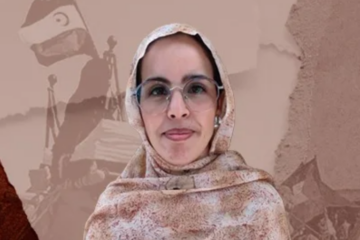
Adama Bundu, a member and youth president of the National Farmers Union (NFU) of Canada, an organization part of La Via Campesina, participated in the Yaoundé gathering. In this interview, Adama speaks on what alternatives the peasant movement is building, what the Yaoundé Declaration means for this political moment, and why women’s leadership in the movements is an important matter for the broader understanding of people’s organization to build a new world.
We understand the WTO as a capitalist mechanism. Beyond refusing to engage with these institutions, what alternatives are peasant movements and popular organizations building? How is La Via Campesina practicing and constructing trade and food systems outside and against these capitalist mechanisms?
The core principle is that food is a right, not a commodity. The WTO treats food, land, seeds, water, and even biodiversity as products to be bought, sold, and speculated on. Food sovereignty rejects this logic. It asserts that people have the right to define their own food systems and that those who produce and consume food should have democratic control over its production, distribution, and trade. That includes the recent push at the WTO to capture water as a commodity, even trying to privatize fishers’ access to their own regional waters.
Across the world, peasant movements are building alternatives rooted in collective control, democratic participation, and ecological Indigenous stewardship. These include public food reserves and stockholding programs that guarantee minimum support prices for small-scale producers. Pushing bans on agricultural dumping, restrictions against corporate agricultural and export subsidies, food commodity speculation, and protections against land grabbing and water privatization. Promoting seed sovereignty initiatives, cooperative enterprises, agrarian reform, and local and regional food systems that prioritize community needs over export-oriented production.
At their core, these initiatives challenge the neoliberal model that treats food as a commodity and agriculture as a site for capital accumulation rather than social reproduction. Instead, the moviments recognize food as a human right and position farmers, farm workers, Indigenous peoples, fishers, and rural communities as the democratic stewards of food systems. In Canada, one of the clearest examples of this alternative approach is supply management. Won through decades of agrarian organizing and collective struggle to build local and regional control of supply chains. It was designed to shield producers from the volatility of global commodity markets and build local and regional control over agricultural production. While imperfect, it demonstrates that sustainable agriculture shouldn’t be governed solely by corporate interests or international market forces.
Through collective regulation, it’s helped stabilize farm incomes and livelihoods, strengthen national food security, and maintain regional food production capacity. Regionalizing supply chains is key to resisting corporate concentration and multinational capture, helping to keep wealth, employment, and decision-making power within our communities. This also means defending agricultural land, protecting watersheds, and preventing the privatization of essential resources. Water, like food, is a common good and should never be treated as a commodity. As corporate interests increasingly seek to control freshwater resources and agricultural data, the struggle for food sovereignty must also be a struggle for democratic control over the ecological systems that sustain life itself.
Biodiversity protection is central. I come from an agroecology background, grounded in regenerative agriculture that understands production as a relationship with nature, not against it. A food forest on a ranch needs all of nature functioning for production to be sustainable. This flips the industrial model, which treats nature as an input to be extracted and optimized for short-term profit. That is not a conventional agricultural model; it is a public good framework.
The LVC framework grounds these demands in internationally recognized human rights and Indigenous rights instruments, such as the United Nations Declaration on the Rights of Indigenous Peoples (UNDRIP) and the United Nations Declaration on the Rights of Peasants and Other People Working in Rural Areas (UNDROP). It calls for relocating agricultural negotiations to inclusive multilateral bodies such as the FAO, UNCTAD, and the UN Committee on World Food Security. The question is who decides. It should not be corporate interests, financial institutions, venture capital, multinational agribusiness, or trade negotiators whose primary focus is profitability and market access. They don’t speak for anyone in the peasants’ movement: whether they are farm workers, Indigenous peoples, fishers, pastoralists, or rural communities. Democratizing food systems is not a procedural point; it is a political one.
At the recent gathering in Cameroon, organizations from all over the world issued the Yaoundé Declaration, a new trade framework grounded in food sovereignty, human rights, and international solidarity, rooted in UNDROP and UNDRIP. What is the significance of this declaration? And what are peasant women adding to this vision?
The Yaoundé Declaration is a reclamation. What we are seeing now is people waking up to the violence of neoliberalism. Understanding it not as a failed experiment but as a mechanism to supplant the decolonial projects that attempted to build projects of economic sovereignty through land reform, Indigenous self-determination, public investment, and domestic agricultural development that were built between the 1940s and the 1980s. When those projects were most alive, imperialist powers responded by pushing neoliberal market liberalization: even if countries were formally independent, the goal was to maintain economic colonial power over their market systems to prevent food sovereignty from becoming land sovereignty, from becoming true sovereignty of the people.
The WTO emerges from that political moment. From structural adjustment imposed by the IMF and World Bank and the institutionalization of market hegemony. What we have witnessed has been the concentration of wealth, the erosion of public institutions, growing food insecurity, ecological destruction, and the deepening power of multinational corporations. So the declaration is urgent now precisely because people are no longer willing to accept that neoliberalism was ever an answer. They are coming back to the movements that existed before it, carrying the wisdom and legacy of people who have been in this fight for decades. This intergenerational transmission matters.
It is also, specifically, a revolutionary feminist reclamation. It is capitalism that institutionalizes gendered oppression and violence, extracting both productive labor and reproductive labor while denying land rights, credit, and decision-making power. It is capitalism that pushes women into informal economies, into the highest-risk and precarious agricultural markets. Gender justice has to be anti-capitalist, given the material analysis of how gender minorities are made most vulnerable by global economic systems.
Peasant women and gender minorities are often those who know local food chains and market systems best. They are the ones selling at markets, producing in the fields, saving the seeds, and sustaining communities. They hold not only individual political agency but also the collective political agency of the community and of decolonial systems. What was beautiful in Cameroon was seeing that materialize. Women were not at the margins of the gathering. They were at the forefront across the world as leaders in their agricultural movements. That is the result of building a movement that actually centers the people most harmed by the system it is fighting. This is the result of conscious political work within La Via Campesina: we are building a movement that will truly be sustainable and long-lasting.
What would a trade system truly built around food sovereignty, human rights, land, seeds, water, and care for communities look like for peasant women and youth?
It would look like a system that represents the interests of peasants, Indigenous peoples, women, gender minorities, youth, and landless workers. No one should be landless. We must uphold the principle that people have the right to remain on their land and to produce food with dignity.
The core framework would be trade relations that support the sovereignty of peoples and nations — and when I say nations, I am centering Indigenous nationhood and self-determination, not colonial state frameworks. Many states have been built on genocide, land theft, and dispossession of Indigenous peoples. You can’t have food sovereignty without recognizing this. Human rights and Indigenous rights are at the center of trade, not as an addendum but as the governing principle. Trade mechanisms cannot be weaponized or liberalized into competitive extraction, but have ethical and decolonial applications.
It would protect domestic markets equally. It would not be a liberalized, concentrated global system, but one in which each market has room to thrive, where trade is done only when it serves people’s interests with equitable exchange. The markets of vulnerable island nations, Arctic communities, and the broader Global South would be nurtured, not flooded with cheap imports that destroy local producers.
With solidarity-based international cooperation, trade is an instrument of mutual benefit with equal voice in decision-making, shared prosperity, and respect for planetary limits at the foundation. We know that land and soil cannot be extracted indefinitely. Those who know this best are Indigenous peoples. They are the current stewards of most of the biodiversity we have left and the people best positioned to facilitate its restoration.
It would be a system where people can stay on their lands without dispossession, without being pushed off by flooding, drought, or heat driven by extractive industries that bear no accountability for what they destroy.It would also be based on regional food systems and agroecological practices over corporate-controlled global supply chains. Protections for small-scale producers, farmers, land stewards, fishers, pastoralists, and farm workers, not agribusiness. It should be a trade governance that centers historically colonized and marginalized communities, where women and gender-diverse people and youth are not at the margins. The people have the right to decide how the land is used. Not the agribusiness executives in corporate offices who will never face what they set in motion. That is the center of it.