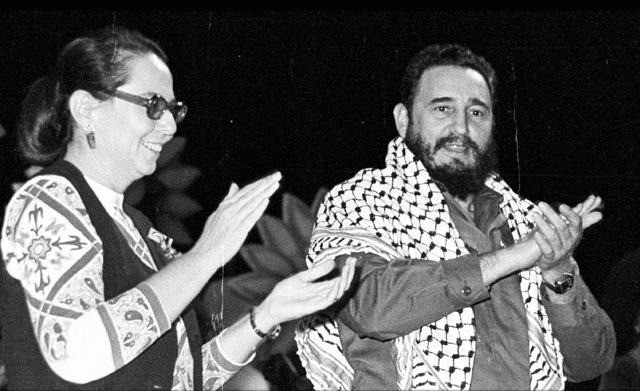
On this August 13, 2026, we celebrate with Cuban women the centennial of Fidel Castro. Among the many aspects of his legacy, today we highlight his strategic vision and commitment to the organization and emancipation of women as an integral part of the revolution.
From the very first day of this socialist revolution, on January 1st, 1959, Fidel’s political thought and leadership sought to build equality for women. Capire publishes today one of his speeches addressed to Cuban women, where shows how equality between men and women is not an automatic consequence of the revolution, but a permanent revolution in the construction of socialism, one that requires political definition and the effort of women’s self-organization. That is why, as early as 1960 and under the leadership of Vilma Espín, the Federation of Cuban Women (FMC) was founded, which today organizes millions of women.
The speech shows how the revolution drove a major mobilization to expand women’s participation in professional work, with training in all areas of society. Fidel also understood that women’s responsibility for domestic and care work was a material limit to equality. Collective laundries and canteens, as well as daycare centers, appear as a fundamental pillar of social policies to, together with the ideological battle, promote the possibility of women’s autonomy and organization.
To celebrate the life and legacy of Fidel is to defend the people of Cuba, their boldness and determination to build socialism. Solidarity, internationalism, and anti-imperialism are legacies of Fidel that remain alive in the firmness with which the Cuban people face, today, the tightening of the criminal blockade imposed by the United States for more than six decades in an unsuccessful attempt to undermine socialism. The sanctions were deepened this year, 2026, with an energy blockade that is an attack on the daily life of the people, a silent genocide affecting the most sensitive areas.
The obstruction of fuel imports forces blackouts of more than 20 hours a day. The impacts on healthcare are enormous. The blockade on technologies and supplies means that 67,000 children do not have their vaccination schedule up to date, more than 110,000 cancer patients do not have access to adequate treatment, 34,000 pregnant women do not have access to prenatal ultrasounds, and nearly 100,000 surgeries are on hold.
In this daily struggle, Cuban women sustain dignity: they walk on foot, organize food and care, and create collective strategies. The Cuban people continue practicing the principles of solidarity and internationalism that are constitutive of socialism. As we learned from Fidel, solidarity means sharing what we have, not what is left over. In every corner of Latin America, facing the advances of an internationally coordinated far right, popular organizations mobilize solidarity and bring it to Cuba, organizing donations of medicines and other forms of support.
Today we celebrate Fidel’s centennial by reinforcing our commitment to defending the Cuban people and the socialist revolution, which means the struggle to end the blockade. Below we publish one of the speeches Fidel addressed to Cuban women, taken from the book Women and Revolution, organized by Yolanda Ferrer Gómez and Carolina Aguilar Ayerra and published by the FMC in 2010.
The compilation of texts begins where the Revolution itself began: on January 1st, 1959, in Santiago de Cuba, when, during his first public address, Fidel dedicated himself to denouncing the disadvantages faced by women, affirming that the revolution would also be for the liberation of women. As Fidel also acknowledged in the speeches published in the book, without women the socialist revolution would not have been possible.
VÍDEO: https://www.youtube.com/watch?v=rgsxukSrX0M
*
Speech at the Second Congress of the Federation of Cuban Women
Havana, November 29th, 1974, Year of the 15th Anniversary of the Revolution
Dear guests,
Dear comrades of the Party and the Government,
Dear comrades of the Federation of Cuban Women,
We have reached the end of this wonderful Congress, and it is not easy to summarize such a fruitful and hopeful event.
First of all, this Congress has not been entirely our own; we have shared it extensively with a distinguished and representative delegation of revolutionary women from around the world.
The presence at this Congress of such renowned comrades, including Fanny Edelman, Valentina Tereshkova, Angela Davis, and Hortensia Bussi; the substantial participation of women from the sister nations of Latin America; the presence of Arab women, and especially the delegation from the heroic people of Palestine; the presence of women from Indochina, including those from the thousand-times heroic Vietnamese people; that of Korean women; that of women from the revolutionary and progressive peoples of Africa; that of women from our sister socialist countries; and the representation of working women from Western Europe—does this not tell us that a representation of the noblest and most just causes from around the world has gathered here?
(…) In socialist countries, women have come a long way on the path to their liberation. But if we ask ourselves about our own situation—we, who are a socialist country, who have been through nearly sixteen years of Revolution—can we truly say that Cuban women have effectively achieved full equality of rights, and that they are fully integrated into Cuban society?
We can look into some numbers, for example. Before the Revolution, 194,000 women were employed in the workforce. Of these, as noted here in a report, 70 percent were employed in domestic work. Today, we have three times as many women working. The number of women in the civilian state sector—which, as you know, accounts for the majority of productive activities, services, and administration—stands at 590,000 out of a total of 2,331,000 employed people. In other words, 25.3 percent of workers are women. However, the number of women holding leadership positions throughout this entire productive, service, and administrative apparatus is only 15 percent. In our Party, women make up 12.79 percent of our members. This is a notably low figure. And the number of women working as Party cadres and officials is only 6 percent.
But we have yet another illustrative example, related to the elections for People’s Power in the province of Matanzas. The number of women who ran for office was 7.6 percent, and the number of women elected was 3 percent (…). These numbers are truly cause for concern and should make us aware of this problem. Because in those elections, the candidates were nominated by the masses, and the masses only appointed 7.6 percent of women as candidates, even though women make up approximately 50 percent of the population. And the masses elected only 3 percent women.
(…) Of course, if we compare our current situation with the one that existed before the Revolution, the progress has been enormous. We cannot even compare the situation women faced before and the situation they face today. But the situation the Revolution encountered fully justified the creation of the Federation of Cuban Women. Because our experience teaches us that, when an underdeveloped country like ours liberates itself and begins building socialism, it requires a mass organization like this, as women must take on countless tasks within the revolutionary process. And this is why we believe that the decision to develop this women’s movement, to create this organization founded on August 23rd, 1960, was truly the right decision, as the tasks this organization has carried out could not have been accomplished through any other means.
What would the Party have done without this women’s organization? What would the Revolution have done?
(…) Suffice it to say that among those tasks were several of great importance. First, the tasks related to the defense of the Revolution and the homeland, the struggle against illiteracy, the struggle for the education of peasant girls, the struggle to provide training for domestic workers to take on productive jobs, the struggle against prostitution, the struggle to integrate women into the workforce, the struggle to establish child care centers, tasks in support of education, public health campaigns, social work, the deepening of women’s political and ideological consciousness, and the struggle to foster an internationalist spirit among Cuban women.
The Federation has worked in all these areas and has successfully fulfilled all the tasks assigned to it. And only women themselves could have carried out these activities with such efficiency.
But now, at this current stage of the Revolution, women have a fundamental task, a historic battle to wage.
And what is that task? What is that battle? Could you answer this question?
What was the focus, the center of the analyses and efforts of this Congress? The struggle for equality for women! The struggle for the full integration of Cuban women into society!
And that is truly a historic battle. And we believe that this objective constitutes precisely the focus of this Congress, because full equality for women does not yet exist in practice.
We, as revolutionaries, must understand this, and women themselves must understand it. It is not, of course, solely a task for women. It is a task for all of society!
(…) And we don’t see why anyone should be alarmed, because what we as revolutionaries should truly be alarmed by is having to admit the reality that there is still no absolute equality for women within Cuban society.
What should concern us as revolutionaries is that the work of the Revolution is not yet complete.
Of course, amid the lack of equality, amid the lack of full integration, as I said, there are objective factors and there are subjective factors. Anything that hinders women’s entry into the workforce makes this process of integration more difficult; it makes this process of achieving full equality more difficult. And you have seen that it is precisely when women enter the workforce, when they cease to perform traditional and historical roles, that these problems begin to surface.
When speaking with some of our comrades—women delegates to this Congress—they said with great satisfaction and joy that in recent days many of their partners had stayed home to care for the children so that they could attend the Congress. There is no question that if those women had not been members of the Federation and engaged in this work, if they were not militants in the Revolution, and if they were not attending this Congress, such a problem would never have arisen in their homes, and there would not even have been an opportunity for their partners to become aware of such a need and such responsibilities.
The objective factors that still make it harder for women to overcome issues and work include some that have been pointed out here, such as the lack of child care circles, sufficient all-day schools, and sufficient scholarship schools, as well as problems related to school hours;1These initiatives refer to public education policies established after the Revolution. Childcare circles are the public childcare network created in 1961, which was initially run by the Federation of Cuban Women. All-day schools are schools that provide education during the day and afternoon, while scholarship schools are boarding schools providing state-funded full scholarships. to these we can add factors such as the lack of sufficient jobs throughout the country to integrate women into the workforce and, of course, the fact that many women lack the level of qualification required for these productive jobs.
In this regard, with respect to childcare circles and education, in addition to the great efforts the Revolution has made in recent years, in the coming years—and particularly during the next five-year period, from 1976 to 1980—an even greater effort will be made, first and foremost to meet the growing educational needs of our people and, at the same time, to facilitate women’s entry into the workforce.
(…) There are other matters that were not mentioned, at least not in the Congress discussions, including issues related to laundries, and so on and so forth. But we will gradually resolve these material difficulties.
Now there remain other difficulties we referred to, of a subjective nature. And what are these subjective difficulties? The problem of an outdated culture, of old habits, of old mentalities, of old prejudices.
There are managers who, for example, whenever they can hire a man, do not hire a woman, due to a number of factors: because they start thinking about staffing issues, maternity leave, and the difficulties a woman might face in attending work. The reasons and factors are many. But the fact remains that women are discriminated against in employment opportunities.
(…) It is necessary for the regulations and policies of the Party and the mass organizations to ensure that women’s possibilities to enter the workforce are preserved and secured. First, it is a fundamental matter of justice; and second, it is an imperative for the Revolution—it is a requirement of our economic development, because at a certain point the male workforce simply isn’t enough—it isn’t enough!
And that is why we must wage a consistent struggle against this mentality of discriminating against women in employment opportunities.
You have pointed out here at the Congress other types of hardships women face, regarding the home, child rearing, and old habits. And you have proposed ways to overcome these hardships.
(…) It is worth wondering when we will have eradicated these age-old ways of thinking, when we will have overcome all these biases. Of course, we have no doubt that these biases will be overcome. The concepts of property that existed in our society before the Revolution also seemed difficult to overcome. And it was impossible to conceive of life without private property. And today it is truly impossible to conceive of life without socialist ownership of the means of production.
But many habits remain from the times when women were also considered property within society. And these ways of thinking must be eradicated. (…) I believe that all the resolutions are of great value and great importance. The resolution on working women, young women, peasant women, and homemakers, and on the role of the FMC [Federación de Mujeres Cubanas—Federation of Cuban Women] and the role of the family in socialism; the special resolution on women’s participation in physical culture, recreation, and sports; the resolution on the International Women’s Year, on solidarity, and the passionate appeal to women from Cuba, Latin America, and around the world in solidarity with Chile. All these resolutions are worthy of this Congress.
We believe that all these documents must be protected and studied. And studied not only within the Federation’s circles, but also by other mass organizations and by the Party. For these resolutions constitute a true program of work for this historic struggle, for this historic battle that lies before you, and for the fulfillment of this revolutionary duty.
Because, when our Revolution is judged in future years, one of the issues by which we will be judged will be the way in which we have resolved the issues of women in our society and in our homeland—even though this is one of the issues of the Revolution that requires the most tenacity, the most steadfastness, the most consistence, and the most effort.
As for biases, we have already recounted what happened in the Sierra Maestra when we went to organize the “Mariana Grajales” Platoon: we encountered genuine resistance to the idea of arming that unit of women, which reminds us just how much more backward we were a few years ago. Some men believed that women would not be capable of fighting.
The truth is that the unit was organized, and our women comrades fought with excellence, with as much courage as even the bravest of our male soldiers could have shown.
(…) We are pleased to see the strength that the Revolution finds in women; we are pleased to witness the revolutionary qualities of Cuban women—their self-sacrifice, discipline, enthusiasm, and passion for the Revolution, for just ideas, and for the just cause of Cuban women—thereby demonstrating virtues that—as we have said on other occasions—are the very virtues required of a revolutionary militant, and which women possess to a very high degree. That is why we believe that our Party must draw more strength from that force, that our State must draw more strength from that force, and that our productive apparatus must draw more strength from that force.
Today, the Revolution has in Cuban women a true army, an impressive political force. And that is why we say that the Revolution is, quite simply, invincible. Because when women attain that level of political awareness and revolutionary militancy, it means that the country has taken a giant political leap forward, that our people have surpassed themselves extraordinarily, and that no one can now stop our homeland’s march toward the future. It must simply keep improving more and more, advancing ever more. And that is why the Revolution is so strong: because of its mass organizations, the political consciousness of the people, and its vanguard Party.
(…) The great contemporary revolutionaries always understood the role of women: Marx, Engels, Lenin. Lenin said something that has been repeated here often: the people’s complete victory would not be achieved without the full liberation of women.
And Martí, the Apostle of our independence, held very lofty views and expressed very beautiful thoughts about women—and not only beautiful, but profound and revolutionary. As when he said that the campaigns of the people are weak only when the hearts of women are not enlisted in them; but when women are stirred to action and lend their support, when women encourage and applaud, when cultured and virtuous women anoint the cause with the honey of their affection, the work is invincible. Or when he said that a woman’s natural sustenance is the extraordinary. Or when he stated that women, by instinct, discern the truth and precede it. Or when he exclaimed that women shall live on equal footing with men as companions and not at their feet as beautiful playthings. Let us be worthy followers of the ideas of Marx, Engels, Lenin, and Martí!
And I know that your just aspirations and ideals—those of you, Cuban women—will take deep root in the hearts of the revolutionaries and in the hearts of all the people.
Homeland or Death! We shall prevail!
With feminism, we build socialism!