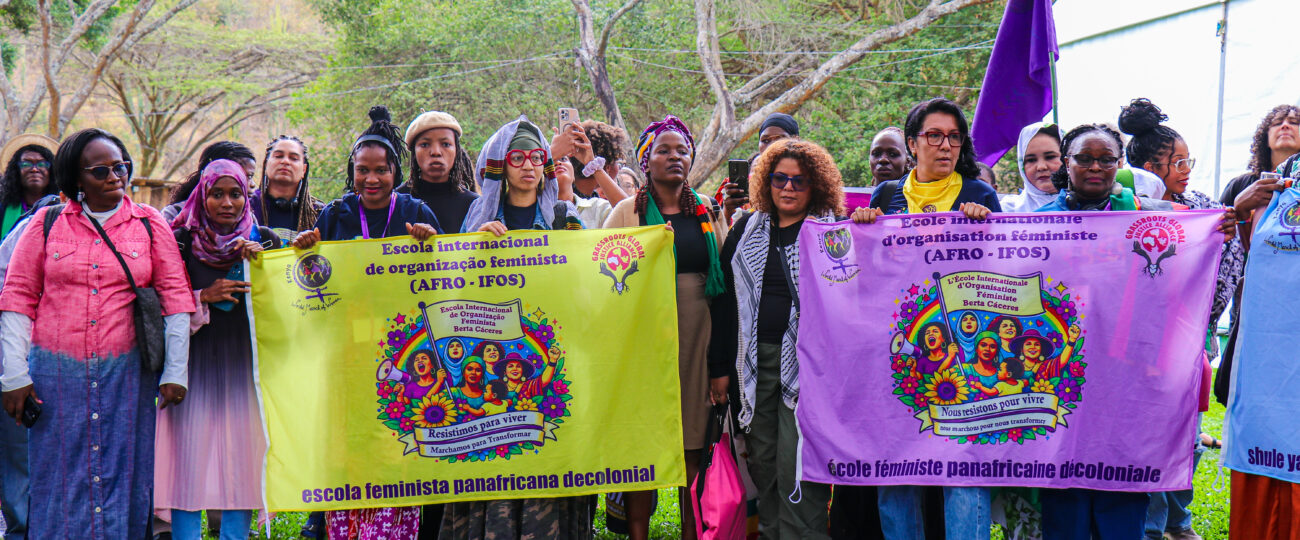
The Afro-International Feminist Organizing School (Afro IFOS) 2026 brought women from across the continent and its diaspora together for political education, skills-building, and collective strategizing, grounded in the realities women and communities actually live, not the ones written about them.
Nobody sat through this. Participants built it, session by session: every one opened with ritual, closed with reflection, and moved constantly between theory and practice, analysis and song. What follows are windows into what the School did and how it felt, the ideas it wrestled with, the movements it pulled into the room, the people who made it run.
Hosted by World March of Women Kenya and Grassroots Global Justice Alliance, the School opened the way Ubuntu demands: by building the community before filling it with material. Participants slowed down, looked around the room, and named the different histories each of them carried in. Nobody stayed a stranger for long.
Ubuntu and our herstory
Ubuntu is a philosophy that gets recited easily and interrogated rarely: a person becomes a person through other people. Afro IFOS chose to interrogate it, building the whole opening around creating the community that would carry the learning forward, rather than jumping straight into content.
The mística: beneath the Mugumo tree
The School’s political thread ran through everything: what does it mean to be a political subject, a collective that becomes aware of its own oppression and organises to transform it? Small groups worked the question from every angle, turning their reflections into concept maps presented back to the room, so ideas built on each other instead of resetting.
And every single session, without exception, opened with a mística: a ritual practice reclaimed from popular feminist organising traditions. It set the School in motion from the very first morning and never let go.
Day one, Kenyan sisters of World March of Women led a procession to the Mugumo tree, sacred to the Agikuyu as the dwelling place of Ngai, where the group opened with Wimbo wa Mapambano, the song of struggle: a protest anthem still sung at marches against extrajudicial killings and state brutality.
From there, participants moved to a second tree to pray in Kikuyu, Dholuo, and Kamba, and to invoke the spirits of departed matriarchs, Berta Cáceres and Nalu Faria among them. Tears came easily as the room remembered them together.
Then, as a closing act, each person placed something at the tree’s foot, not an offering, but an act of witness: this is what I carried in, this is what I choose to honour. Objects gathered at the roots, each one holding its own story.
When the group finally left, the altar stayed under the tree. Everyone walked out carrying less than they arrived with, and a little more of each other.
Naming the systems we’re organizing against
If the opening was about finding rhythm as a collective, what followed took the School deeper into the work: the systems of oppression shaping women’s lives across different contexts, where they come from, and how they keep reproducing themselves.
Mapping the forms of power
Power, it turns out, isn’t only what governments and institutions hold. The room mapped three forms: power over (the visible kind, exercised through laws, decisions, and force); invisible power (the kind that shapes what feels normal or even possible, absorbed so deeply it stops being questioned); and hidden power (the kind operating behind the scenes, deciding who gets to participate before the meeting even starts).
By the end, the room had more than a list. It had a shared language for talking about power: the kind that dominates, the kind that hides, and the kind participants could build together.
“Because it is one thing to say that a system is oppressive. It is another to be able to ask: where does the power sit? How is it maintained? Who gets to exercise it? And where is our own power to challenge it?”
— Field note, Afro IFOS 2026
That shift, from naming oppression to understanding how power moves through it, became one of the School’s key takeaways.
What these systems cost women
From the structural, the School moved to the lived: three linked sessions unpacking exactly how systems of oppression land on women’s bodies, on the land, and on the state itself.
Bodies and sexualities
Traced how colonialism imposed rigid gender binaries onto precolonial cultures that had once held far more diverse understandings of gender and sexuality, and what reclaiming that history means for organising today.
Defense of Mother Earth
Examined the gendered impact of extractivism, land dispossession, and the climate crisis on African communities, and the women on the frontlines of defending them.
State and democracy
Interrogated what democracy actually delivers where neocolonial economic dependency and foreign political influence still shape the room.
Feminist economics of rupture
Mainstream “economics of gender” asks how women can be included in the existing capitalist economy. Feminist economics of rupture asks a harder question: what would an economy look like if it were built to sustain life instead of accumulate capital? Participants worked through five guiding principles for putting that economy into practice.
Decentralisation
Collective negotiation over centralised control: decisions made close to the people they affect.
Use Value
Wealth measured by what sustains life, not by what can be bought and sold.
Relation
Recognising interdependence and ecodependence: we do not survive alone, and neither does the planet.
Time
Organising economic life around life’s own cycles, not the demands of production schedules.
Intersectionality
Understood through the sexual and racial division of labour, and the essential, undervalued economic practices of Black women.
Groups closed by naming their own communities’ quilombos, palenques, and maroon-style formations (the informal systems already sustaining life outside the market) and what it would take to aquilombar1To build quilombo-like forms of collective resistance: informal, community-rooted economic and social systems.: to build more of them, deliberately, together.
Growing a feminist economy
What began as a conversation about feminist economy didn’t end when the principles were named. Working in groups, participants drew trees to map a shared feminist economic proposal: roots as the causes of economic injustice (exploitation, inequality, undervalued and unpaid care work); trunk as the mechanisms for change (collective organising, redistribution of care, social protection, dignified work); leaves as the fruit (dignified living, economic security, decent work).
Participants moved between each other’s trees, building on what they saw.
It didn’t stop at presentation. Over the following days, participants cross-examined each other’s proposals, probing the assumptions, testing what it would actually take to move the ideas from paper into practice.
The Social Movements Assembly
Afro IFOS didn’t stay inside its own walls for this one either. The Social Movements Assembly, a café-style gathering, pulled more than 23 movements and organisations from across Kenya into one room for a day of rotating, direct conversation.
Small tables, each hosting a different movement, rotated participants through labour organisers, human-rights defenders, queer and disability justice organisers, climate and anti-extractivism campaigners, and more. Every table shared its mandate and its work, turning the room into a living map of Kenya’s movement landscape, told by the movements themselves.
It opened with celebration: Afro Cure, a local teen dance group, pulled the room into its routines until participants were up trying to keep the moves themselves. Local artist Kake wa Kake ran a drum circle that turned music into another language of connection. A puppet dressed in the colours of the movement and the flag of World March of Women Brazil made its way through the crowd: a small, delighted reminder that this struggle crosses borders.
Then the room turned to reflection. Archivist and researcher Njuki Githethwa spoke on Kenya’s Second Liberation2Kenya’s pro-democracy struggle, and the often unrecognised role of women within it. and the mothers of political prisoners (women who organised, protested, and demanded justice for their loved ones), placing their fight inside Kenya’s wider history of resistance. The day closed on that exchange between history and possibility: remembering those who organised before us while still imagining the economies and societies we’re fighting for.
School of Facilitators: who carries this forward?
Before the School closed, it turned the question back on itself. Two days were set aside for a School of Facilitators, because political education doesn’t spread on its own. It needs people who know how to hold a room.
The conversation started at the basics: what a facilitator actually is, and how to facilitate, not as performance, but as a practice with its own tools. Participants worked through those tools directly, then turned to the harder question underneath them: what transformation do we, as facilitators, actually want to see? What is the role of a facilitator in strengthening relationships and in building the movements and organisations we’re part of?
From there, the room got into what it means to practise feminist popular education: education built with people, not delivered to them. And because a school like this can’t stay in one room forever, participants closed by planning what it would take to replicate the School across different regions: what needs to be understood locally before it can be rebuilt somewhere else.
Until the next gathering
Afro IFOS 2026 closed the way it opened, with a mística, and with a room of women who arrived as delegations and left as a network. The concepts explored together will keep being argued over and built on; the Social Movements Assembly planted alliances that will keep talking long after the School ended; the School of Facilitators sent trainers home ready to replicate it regionally; and everything documented here becomes the record other schools, in other countries, will build from.
This is an edited version of the text originally published in the Afro IFOS 2026 newsletter, prepared by Comfort Achieng with support from the World March of Women Kenya communications team: Mya, Shishy, Patty, Mitchel, Lexy, and Stacy.