
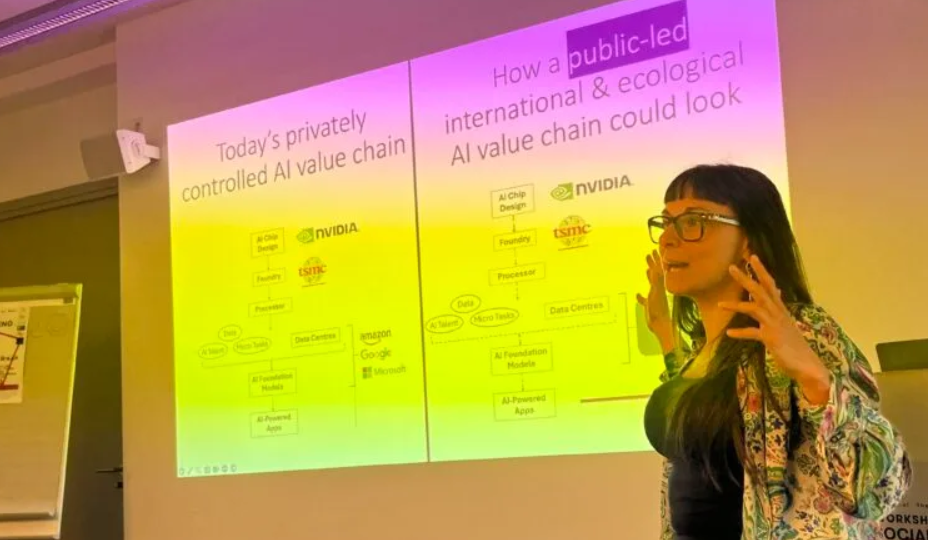
Cecilia Rikap is a professor of economics and head of research at an institute at University College London, in the United Kingdom, where she works on what she calls intellectual monopolies. Through this concept, she studies companies that sustain their power by appropriating collectively produced knowledge.
Cecilia studied economics at the University of Buenos Aires (UBA), where she was involved in political organizing for many years, first as a student and later as a lecturer. She was involved in struggles over study and working conditions, but also over what kind of knowledge universities produce, for what purpose, and for whom.
In this interview, the researcher shares her views on the power exercised by Big Tech companies and their involvement in political negotiations, economic threats, and instruments of war. Rikap examines this process through dependency theory, updated for digital capitalism.
Dependency theory is a school of thought that emerged in Latin America to explain the unequal relationship between countries at the center and those in the so-called peripheries of capitalism. While a few countries at the center grow wealthy by producing technology and capturing value, countries in the periphery remain tied to supplying them with raw materials, cheap labor, and markets, with the complicity of economic and political sectors that benefit from this arrangement. Drawing on this critical analysis, Cecilia discusses what it means to build people’s digital sovereignty.

You developed the concept of intellectual monopoly. Why does it describe what Big Tech companies do better than other concepts used in public debate?
If we think about the largest companies in the world, we find two types: companies that appropriate nature and the commons, such as oil companies, and companies that systematically appropriate knowledge and monetize it.
This appropriation can involve data that we collectively produce on platforms and social media, or scientific knowledge produced at universities and appropriated by large technology and pharmaceutical companies, for example. These companies also appropriate and construct narratives. Here we find major consumer goods companies such as Nestlé, Coca-Cola, and PepsiCo.
In all these cases, what these large companies do is control the networks of what I call “knowledge production by the many” and “appropriation and monetization by the few.” It is another form of extractivism. When we talk about the extractivism of nature, we can complement that discussion by examining the extractivism of another kind of common good: knowledge.
This appropriation involves more than a process through which knowledge held in common ceases to be collectively held and comes under the control of a few, even though it was, I insist, collectively produced. These same companies also dictate what kinds of knowledge are produced and what kinds are silenced.
The fact that we have generative artificial intelligence today, which reduces people’s ability to think critically and independently, is a result of these companies’ interest in developing this kind of technology. It is artificial intelligence used not only to replace creative tasks in the workplace, but also to exercise more tailored, more individualized control over everyone.
I want to add one more thing about how knowledge extractivism and the extractivism of nature are interconnected. All this knowledge and all these data that companies appropriate do not exist in the abstract: they have a material basis. That material basis is infrastructure, particularly data centers, and those data centers are another source of extractivism of nature.
When they are installed in our territories, they consume electricity and potable water, ultimately worsening the living conditions of the populations around them. They do not create jobs or pay taxes, but they serve to intensify data and knowledge extractivism.
The relationship between Big Tech companies and the US government became visible in the image of CEOs surrounding Trump. How does this relationship work in practice, and what does it mean for countries in the Global South?
The relationship between US Big Tech companies and the US government is long-standing. It did not begin with Trump 2.0. For years, I would even say decades, the US Department of Defense has depended on technology supplied by US Big Tech companies as black-box services. This shows the US government’s own technological dependence and how these companies have built an alliance that allows them to tilt the playing field against those seeking to regulate them.
During the Biden administration, a report commissioned by the first Trump administration and signed by Big Tech CEOs was published. It basically sets out what the US government should invest in when it comes to artificial intelligence for defense. It is an extremely long report, but it can be summed up in a few words: it repeatedly insists that China is the real threat and that the public sector must invest enormous amounts of money in artificial intelligence so that the United States remains a leader in the field. Consider ICE today, for example, a quasi-police force that targets and persecutes migrants. It is another major example: the technology that enables this kind of state control, surveillance, and persecution comes from Big Tech companies.
For Big Tech companies, it was strategic to have an ally not only in the Department of Defense, but also sitting inside the White House. The agreement meant that Big Tech companies had to make certain concessions to the government, such as moderating content even less, so that virtually anything could be posted on social media. What these companies get in return is a US government that will aggressively confront other governments attempting to introduce regulations. The message they want to send is that if those governments move forward with regulation, meaning imposing taxes on US technology companies, they will face tariff retaliation and repercussions for their economic and political relations with the United States.
Under Trump, the US government is intervening in value chains linked to digital technologies. They bought a 10 percent stake in Intel and shares in companies extracting lithium and rare minerals. This is also a way of gaining economic influence within strategic value chains, particularly in the segments where the United States is weaker, such as those linked to semiconductors.
For those of us in the rest of the world, the result is always a deepening of dependence, underdevelopment, and the extractivism of nature and knowledge. This limits our prospects for Buen Vivir [good living] and for rebuilding community ties, solidarity, and public goods in our territories.
Dependency theory is an important foundation of Latin American thought. What does it offer for understanding the current period, given the central role technology now plays in the economy?
Updating dependency theory is extremely necessary. It gives us a much richer framework than, for example, data colonialism, digital colonialism, data imperialism, or technofeudalism. These frameworks have something in common: they see only two sides. There are the bad guys, the Big Tech companies, and the rest of us would be the good guys. The problem is that this division fails to identify the semi-peripheries, the semi-centers, and the actors who are complicit in underdevelopment.
Historically, dependency theory has offered a critique of imperialism that shows how underdevelopment cannot be explained solely by the control exercised by capital from the Global North or the center over the periphery, and by its technological monopolization. It is also explained by the complicity of local economic and political actors who benefit from that structure of dependence. Updating dependency theory for the era of digital capitalism requires us to examine who these local accomplices are in our territories.
The so-called regional platforms and technology startups in our territories occupy intermediate positions within the predatory ecosystems of US Big Tech companies. They depend on Big Tech technology, but they also produce technology themselves. They use that technology not to service national development or improve living conditions for the majority, but to pursue practices that are just as extractive as those of US Big Tech companies. They reproduce those practices at an intermediate, semi-dependent level.
There is also political complicity, which often appears within progressive governments. It comes from believing the narrative that we must accept any kind of innovation because it will bring economic growth, supposedly the key to development or progress. This ideological discourse ends up placing progressive political forces in a position of complicity. These companies are not seen as appropriators of collective knowledge, but as the ones bringing the technology we are forced to adopt because otherwise we will be left out of the world, falling even further behind.
For me, dependency theory is key because it allows us to identify these local dynamics intertwined with global ones. It also allows us to understand these extractive processes and leads us to speak of extractivisms in the plural. It is not just that companies appropriate data: our knowledge and capacities end up being absorbed and integrated into these predatory ecosystems.
There is a difference from the past. When dependency theory was formulated in the 1960s, the complicit actors were the landed oligarchy, which was associated with opposition to technology. Today’s accomplices are no longer anti-technology or technologically backward: they have the capacity to produce cutting-edge technologies, and they remain complicit. I also think the center-periphery dimension matters much more today than it did in the past. The old centers of global power are being reconfigured, with Europe moving toward the periphery and China toward the center. Moreover, there are peripheries within the centers themselves. Silicon Valley is not the same as Virginia, where data centers are concentrated. Virginia’s communities are the ones most affected by the appropriation of natural resources that should instead be protected from overexploitation and, where needed, used to ensure the best possible living conditions for people.
Much of the money companies invest in building data centers goes toward importing semiconductors, so that money does not really stay in the territory. The jobs created are construction jobs. Once the data center has been built, there are 40 employees per data center, according to Microsoft itself. And if all the electricity and water are being consumed by data centers, who will want to set up a business there? Who will be able to farm? Who will be able to live around those data centers?
This is an updated version of The Open Veins of Latin America: a new form of extractivism that reproduces the same asymmetric structure within our territories, with a few who gain and many who lose, but also at the global geopolitical level. Part of the way forward is recognizing that peripheries exist in many places. Countervailing forces need to organize and grow internationally.
What role do social, trade union, and feminist movements have in relation to technology, and which grassroots struggles do you see as promising paths forward?
When I talk about digital sovereignty, I draw on the tradition of people’s power. There are some technologies we can clearly reject: we do not want technology used to control workers in the workplace; we do not want generative artificial intelligence or any kind of automated tool for defense, war, migrant control, or police repression. But we do need digital technologies to organize our daily lives, cooperatives, and workplaces. So the questions are: who will be in control? Who will decide which digital technologies are adopted and which are not? Who will develop those technologies? How will they be used? What data will we allow to be collected and analyzed? Who will analyze them, and how? How many data centers will there be in each territory? Where will they be installed? Who will manage them?
Asking these questions and demanding that the answers and debates take place within democratic frameworks is not something that will come from the top down. It has to emerge from social movements. Feminist movements have un montón de cancha, as we say in Argentina: plenty of experience fighting for people’s power, setting political agendas, and democratizing spaces of government. We need to learn collectively from those experiences so that we can demand that these technologies be governed by the public sector.
The state must be part of this, but we also need to reimagine what is public. Decisions about these technologies cannot be made behind closed doors, with control concentrated in the hands of a few companies. It is an enormous problem when the technology adopted by schools, hospitals, and the state itself is controlled by private companies. These are political decisions that must be democratized and subject to public governance.
That is why building people’s digital sovereignty is fundamental. It must be neither techno-solutionist nor techno-nationalist. Knowledge grows stronger when it is shared, and we will have many more opportunities to build different technologies if we do so through solidarity among peoples.
Democracy does not mean that we all use digital technology. Democracy means designing institutions where we can all have a voice in deciding which technologies we want, for what purpose, and for whom.
Technology alone will not bring us Buen Vivir [good living], development, or a more democratic society. These are political constructions. The best way to fight intellectual monopolies is to do the opposite of what they do: socialize our knowledge, strengthen different forms of knowledge and ways of thinking, and dare to think critically and exercise political imagination.