Since the beginning of the Bolivarian Revolution in 1999, Venezuela has been the target of threats and attacks that affect not only its economy but also the country’s sovereignty, communication processes, and the well-being of its people. This is due not only to the fact that Venezuela possesses the world’s largest oil reserves, but, above all, to the Bolivarian revolutionary popular project, which has made possible another way of organizing society, one based on popular participation. This model stands in direct opposition to the project of imperialist and neoliberal capitalism.
Latin America is experiencing an unprecedented struggle. Since August 2025, the Caribbean region has faced attacks in multiple forms. The U.S. government has deployed nuclear submarines and aircraft carriers, established centers and radar systems to control digital and air space, launched missiles against fishermen, mobilized ground troops, and occupied Puerto Rico for military training exercises. Imperialist attempts to assert control are characterized by militarization, shows of force, and a multifaceted set of coup-oriented elements. All of these elements are clearly visible in the case of Venezuela.
During the ALBA Communicators Gathering, held in Caracas in May 2026, Blanca Eekhout, president of the Simón Bolívar Institute and of Venezuela’s Communes Commission, argued that “Venezuela continues to be under attack, and it is not only a matter of the blockade, economic warfare, threats, and the kidnapping of the president. Above all, it is a matter of cognitive warfare aimed at dividing the Bolivarian Revolution, demoralizing the Venezuelan people, and, above all, further isolating Venezuela, not only on the global stage, but also from its brothers and sisters in Latin America.”
The cognitive warfare Blanca refers to “a non-conventional form of belligerence that uses cyber tools to alter cognitive processes and control the human mind, beliefs, and individual and collective behavior,” as Ecuadorian sociologist Irene León wrote in the book The Authoritarian Drifts of Capitalism [Las derivas autoritarias del capitalismo], with a foreword by Blanca.
Building Defenses Against Military, Mediaand Financial Attacks
The Venezuelan people carry vivid memories of the terror of the attacks of January 3, 2026, and mourn the one hundred people who lost their lives during the assault. Drones flew overhead, followed by more than one hundred aircraft flying at low altitude, filling the air with terrifying noise as dogs barked desperately. All of this happened without people knowing what was taking place, only that their country was under invasion.
Missiles were launched against communities, military facilities, universities, and even a mathematics laboratory located very close to a nuclear reactor. Although the reactor has been inactive for decades, it still contains radioactive material. The people understood this as a warning that the catastrophe could have been even more deadly. The toll included deaths from heart attacks, 464 damaged apartments, 11 classrooms of the Ecological School destroyed, electricity outages, and the death of all of the president’s pets.
Carolina Ortiz, a leader of the Simón Rodríguez Community, lives in the first urban communal complex built by Chávez’s government. She described her experience on the day of the attacks: “At daybreak, almost all the residents gathered together, crying, talking, and thinking about what to do. The first thing we thought of was going to Bolívar Square to see what was happening.”
In Simón Bolívar Commune, a vast complex filled with apartment buildings, colorful murals, and sports courts where children play and practice sports, we spoke with Oneyda Rosa, spokesperson for women in the commune. She shared the collective feeling of her community: “a lot of sadness and a lot of pain.” Carolina Ortiz agreed: “Today, we feel that emptiness; we miss Maduro and Cilia. Even as we continue with our daily lives, we feel sadness at not having our president with us. But we continue our work, trusting Acting President Delcy Rodríguez and hoping they will return home soon.”
The Bolivarian regime survived the January 3 attacks because of the popular organization built through communes and communities. Following the kidnapping of Cilia and Maduro, popular participation in the streets was massive. On this, Blanca Eekhout explains: “We have built paths thanks to the strength of the Bolivarian Revolution within the people. That path is called the commune, participatory and protagonist democracy, organized popular power capable of governing the territory. That is why, throughout these 27 years, despite all these aggressions, the Bolivarian Revolution remains a living revolution and, even amid these adversities, we continue to guarantee peace and governability.”
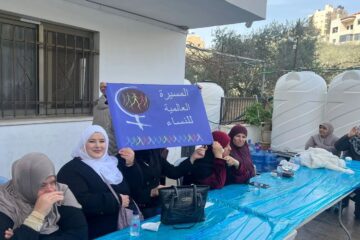
Today, the people are organizing a massive nationwide march known as the Great Pilgrimage. In this journey, Alejandra Laprea, representative for the Americas on the International Committee of the World March of Women, sees the possibility of rebuilding the political fabric from the regions. With a sense of spiritual resistance as well, the people march toward the sacred destination of freedom.
Past and Present
There are currently 1,044 active sanctions against Venezuela imposed by the United States, the United Kingdom, the European Union, and Switzerland, in addition to measures targeting countries that trade with the Caribbean nation. Ana Maldonado, coordinator of international relations for the Francisco de Miranda Front and member of ALBA Movimientos, provides a historical analysis of Venezuela’s return to the International Monetary Fund (IMF).
Venezuela was a founding member of the IMF and turned to the institution for assistance multiple times during the 1980s and 1990s, generating significant debt in the process. The crisis generated by this cycle of interventions sparked the popular uprisings that ultimately led to the Bolivarian Revolution in 1999.
Venezuela paid off its outstanding debts to the IMF and the World Bank in 2007 and severed ties with both institutions. At the time, there was hope of creating a Bank of the South headquartered in Latin America as an alternative. But before this bank could be established, a series of crises hit the region. These crises were driven by the collapse of commodity prices beginning in 2014 and by new rounds of unilateral sanctions imposed by the United States through 2018, when oil companies and transport firms were barred from doing business with Venezuela.
International banks stopped doing business with the Caribbean nation and confiscated Venezuelan assets held in their vaults, including 32 tons of gold that remain in a private bank in England. Another financial blockade concerns the IMF’s Special Drawing Rights (SDRs), of which the Venezuelan government held US$400 million in 2019. In a direct interference in the country’s politics, the IMF refused to allow Venezuela access to those funds, in violation of the spirit of international cooperation. The justification was that it did not “know who the president was,” an argument that held even through the pandemic, despite the urgent need to use those resources for public health.
In April of this year, Acting President Delcy Rodríguez readmitted Venezuela to the IMF after six years of institutional blockade. Ana Maldonado agreed that the IMF remains a pillar of imperialist plunder policies. However, Delcy argues that the goal is not to create new debt for Venezuela, but to ensure the country is recognized and able to negotiate. This step opens the way for Venezuela to recover frozen reserves and defend itself against the delegitimization campaign carried out by the Venezuelan far right.
Venezuela Moves Forward Through Grief, Work and Hope
In prison in New York, Cilia and Maduro are enduring violent and precarious conditions. The food is poor, and there is no access to healthcare. Until recently, Maduro was denied access to books. Since then, people across Latin America have since united in solidarity to strengthen the campaign for their freedom both in the streets and online. Ana Maldonado emphasized that solidarity means a commitment to share what we have, not only what is left over. This idea emerges from the alliance between the Venezuelan and Cuban peoples, bound by strong ties of solidarity expressed through healthcare. The Cuban medical brigades were fundamental in providing immediate care to the population affected by the 7.2 and 7.5 magnitude earthquakes on June 24, 2026, across hundreds of cities in the country. The tremors caused unprecedented human losses and material damage, a tragedy that counts on the solidarity of the people.
From this popular alliance comes the task of strengthening campaigns and solidarity actions with the Cuban people, who are facing the same strategies of fragmentation aimed at facilitating imperialist intervention by the Trump administration. Popular movements across the region are organizing shipments of medicines, food, and solar panels to Cuba, strengthening material, political, and communication support for both Cuba and Venezuela.
In this spirit, a new Venezuelan solidarity campaign with Cuba was launched in recent months under the name “Love Is Repaid with Love.” It is grounded in the principle that love is a concrete political commitment rather than an abstract concept, drawing on the ideas of José Martí. Considered a messenger of Cuban independence, Martí described love as sincere hope, worthiness, respect, and a transformative force.
The campaign has three phases. The first, called “Heart to Heart – Saving Lives,” focuses on collecting priority medicines. The second phase centers on energy sovereignty under the slogan “Trump Cannot Block the Sun,” with the goal of raising resources to acquire solar panels. The third phase, currently underway, is called “The Corn of the Great Homeland,” and focuses on collecting essential food supplies to send to the Cuban people.
These peoples share the same struggle to build a socialist project rooted in strong communities and popular power. Drawing on José Martí’s ideas and the experiences of Venezuelan women, who build joy as a political and organizing force, we learn that the response to imperialist attacks lies in the daily boldness of sustaining the socialist revolution.
From Venezuelan feminists, we learn how to practice another way of organizing, producing, and building feminist and anti-patriarchal communities, centered on Buen Vivir [good living]. To defend Venezuelan and Cuban sovereignty and denounce these attacks, we must also pay attention to the most beautiful aspects of these countries, strengthening networks of care and solidarity, with laughter and without letting go of each other’s hands.
Milagros Espinoza, a communard from the Simón Bolívar Socialist Commune, shares: “Here we are, day after day. We are the women of struggle, of battle, of victory. Every day we dedicate all our love. Venezuela is a country permeated by love. Venezuelan women carry a profound love for our homeland in their essence; we are deeply proud of our country. We know that this love running through our veins grows stronger every day, and we know that this beloved homeland of love and peace will always belong to us and be for us. Here, all countries are welcome, with love and peace. We will not confront them; we will embrace them, because we are sibling peoples.”
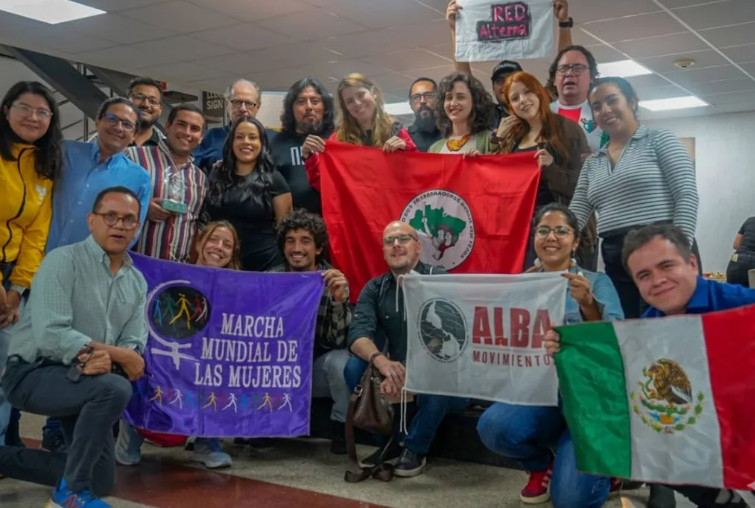
Capire was in Caracas in May 2026 during the ALBA Movimientos Communicators Gathering, participating in a collaborative reporting effort carried out in alliance with 14 media outlets from across Latin America. For one week, we listened, exchanged ideas, and contributed to the task of breaking the communication blockade against Venezuela. This article is one of the pieces produced through that collective experience.