We are living in times of resistance—as peoples, as the left. For women, these are times in which we must juggle the demands of care and sustaining life, while confronting violence against our bodies and territories, as much as against our feminist self-organization as a collective political subject.
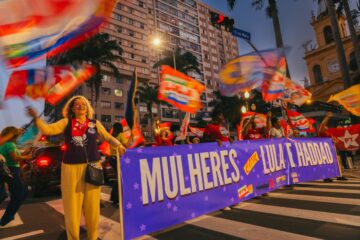
In the face of a renewed imperialist offensive over our continent, the women’s movement mobilizes and calls for expressions of resistance and solidarity. This is what we have seen since January 3, 2026, through significant mobilizations on March 8 that placed at the center of the feminist struggle the confrontation of women vs. imperialism, violence and austerity policies that generalize the precarity of life across different countries.
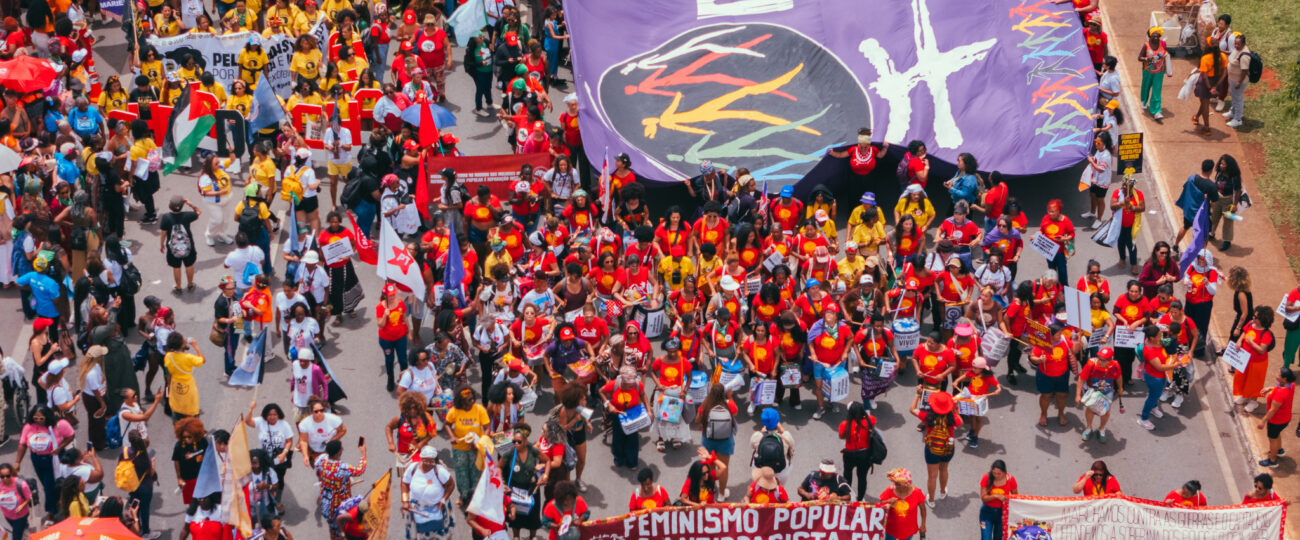
Popular feminism faces the challenge of updating its analysis of this historical moment and building organizational and struggle strategies capable of transforming solidarity and mobilization into permanent organization, in order to accumulate strength for constructing a transformative project. Affirming the struggle against capitalism and wars, and the defense of popular sovereignty and buen vivir, the achievements of the World March of Women—in its sixth international action carried out in 2025—serve as a guiding thread for the reflections systematized in this article, grounded in our experience as militants in Brazil.
Conflict Between Capital and Life
Current wars and conflicts are interconnected: an imperialism in decline becomes even more dangerous in the face of the structural crisis of capital. We analyze this crisis in its multiple dimensions, understanding the totality of the conflict of capital against life—against its very conditions of possibility. The alliance between the United States and Israel during the genocide in Palestine and, more recently, in the war in Iran and the aggression against southern Lebanon, marks the current imperialist military offensive, dragging along a subordinate Europe.
But the logic of war is not limited to battlefields in the Middle East or Africa; it also materializes in the peripheries, as in Brazil, where militarized policies turn the Black population into a constant target of violence. It is no coincidence that the discourse mobilized by right-wing Brazilian governors labels factions in the peripheries as “narco-terrorists,” aligning with the recent U.S. national security strategy that declared the political objective of controlling Latin America as a subordinate territory in all dimensions.
The defense of Venezuela and Cuba now lies at the center of women’s solidarity in Latin America. Transforming expressions of solidarity into an organized force capable of defeating imperialism is our historical task as a political generation.
A point of unity for popular feminism across different parts of the Global South has been resistance to the advance of transnational corporations. Women mobilize against the expansion of agribusiness, pollution, water privatization and mining. They also denounce the effects of green capitalism in their territories, when land use is transformed and what was once land for peasant and family agriculture becomes a base for wind and solar energy production that does not benefit local populations.
The challenge of building resistance and a terrain of struggle in the processes of reconfiguring life and the world of work in the digital era is also a central concern for women. The “platformization” of labor deepens its sexual division and reaches into the domestic sphere; the continuous extraction of data, which becomes behavioral modulation, renews processes of commodification and biomedicalization of women’s bodies. The major tech companies, which today—alongside military power—are integrated into the U.S. imperialist offensive against the Global South, are also protagonists of a distributed war against women.
Limits and Challenges of the Women’s Movement
The women’s movement has changed significantly in recent times. We must understand the achievements of feminism in the continent, as well as the traps, reactions, and current disputes (many of them in the name of women). This is a collective task. The present moment is aggravated by a limited capacity for articulation, mobilization and struggle among social movements, resulting in less organized resistance and, therefore, more women facing individually the effects of the structural crisis.
If two decades ago, in the struggle against the Free Trade Area of the Americas (FTAA), women were able to assert themselves as subjects of the economy, rejecting the neoliberal logic that sought to isolate our demands removing them from the distributive sphere and the broader political struggle, and transferring them to the social sector of targeted and compensatory policies, today that construction of a political subject—feminist and popular—takes on new forms and momentum in the trenches of social reproduction. Organized women are in community kitchens, communes, solidarity kitchens, and agroecological production territories.
To some extent, after the COVID-19 pandemic there was, a public and political recognition of care as essential for sustaining life. This recognition culminated in national care systems and policies that establish care as a right—for both those who provide care and those who receive it. However, even in contexts of progressive governments such as Brazil, Uruguay, or Mexico, what has been achieved in law clashes with disputes over public investment. In other words, these remain pilot projects without the capacity to effectively reorganize social processes of responsibility for care, in the sense of overcoming the sexual and racial division of labor.
This is undoubtedly a limitation and an expression of the limited capacity of current leftist projects, such as in Brazil, to advance structural transformations. The limitation lies in the social management of a state organized for capital. Austerity is the historical response of capital to its crises: it withdraws rights, dismantles public services, and transfers to families—and within them, to women—the cost of sustaining life. In the case of care, this materializes in solutions that few can afford in the market (private education and healthcare, fast and ultra-processed food, nannies and caregivers without rights). For the majority of working women, this means an increase in time demands and unpaid domestic and care work, which in family and community settings act as a buffer to absorb the impacts of violence and precarity on the working class.
Among young women, there is indeed a stronger sense of freedom in relation to the body and sexuality. This contrasts with the misogyny fostered among boys and young men—a defining tension of this historical moment. Moreover, there is a violent offensive that demonstrates daily that freedom and autonomy are not merely ideas that can be realized individually, but require social conditions for their collective realization.
The far right is patriarchal and racist; it contests in both scenarios: the state and everyday life, seeking to reconfigure violence and reinforce misogyny. In 2025 in Brazil, while four women were killed each day, male anti-women groups on social media multiplied, misogynistic content went viral, and was monetized. Violence in all its forms is an instrument for controlling and disciplining women’s bodies and labor. It is part of reinforcing a heteronormative family ideal far removed from the reality of working-class families: diverse and increasingly sustained by women. And this notion of family is constitutive of the patriarchal backlash that is one of the pillars of the internationally articulated far right.
Given the magnitude of capital’s power, in its fascist expression, where can we find an anchor other than the territories and the processes that produce life, and which we can control? We know that women are on the front lines defending processes of popular sovereignty on the continent, putting their bodies on the line to halt the advance of transnational corporations over common goods. This is no coincidence: women’s transformative capacity lies in collective control over the production of the conditions that make life possible. These are the flows, labors and processes we must control.
Although capital seeks to be totalizing, there are spheres where its logic is not hegemonic. Recognizing and strengthening popular experiences, organized through the daily struggle to sustain life, is a feminist and popular strategy because these actions are oriented toward the collective, in times of extreme individualism and fragmentation. They build and rebuild bonds, redefine the boundaries between private and public spaces, and occupy territories to produce biodiversity and shared life.
With the aim of projecting an economy of expanded reproduction of life that confronts the expanded reproduction of capital, a key point in shaping our political agenda is to build horizons rooted in these alternative community experiences and expand them. They are embryos of the society we fight for, but it is necessary to begin from these realities in order to project the world we want to build: socialist and feminist.
As Nalu Faria insisted: these are experiences that transform the present while also pointing toward the possibility of transformation. They are bets on expanding the boundaries of what is possible. This is a strategy for movement-building and, therefore, for building power.
Feminism as an Organized Collective Subject
Feminism has never been, nor is it now, merely a discourse, a narrative, or a behavior. It is a movement that builds strategies and struggles from a self-organized collective subject. Popular feminism confronts liberal currents by forging collective organization, with the challenge of ensuring that such organization is sustained and expanded.
In the World March of Women, we simultaneously commit to women’s self-organization and to alliances with mixed popular movements as a path toward building collective subjects capable of resisting, and above all, movements imbued with the historical task of transforming this world. The materialization of internationalism in terms of solidarity and the struggles for the sovereignty of peoples, feminist economics, agroecology, and self-organization are our tools to resist, sustain hope, and project a feminist socialism. Strengthening processes of convergence, rebellion, organization, and above all popular struggle are our commitments to forge the new syntheses needed to respond to the challenges of our time.

Ana Priscila Alves and Tica Moreno are members of the national coordination of the World March of Women in Brazil. This article was originally published in the magazine Latin America on the Move No. 560, in April 2026, by the Latin American Information Agency (ALAI).