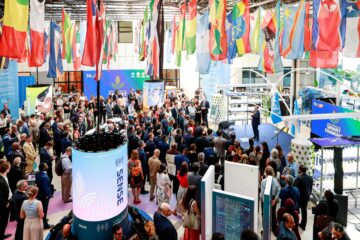
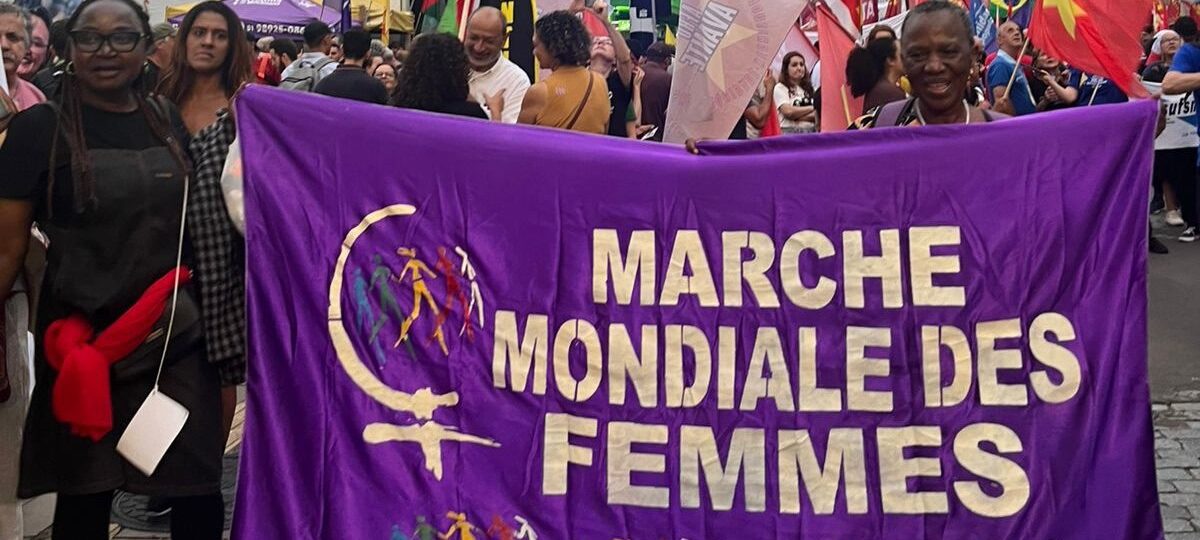
The sovereignty of peoples, regional integration, and the impacts of crises on women’s bodies and territories were at the center of discussions during the 1st International Anti-Fascist Conference, held in Porto Alegre in March 2026. The World March of Women (WMW) took part in the gathering, emphasizing that fascism and imperialism are inseparable from patriarchy, racism, and colonial exploitation, while highlighting how women’s organizing builds alternatives to this system of domination.
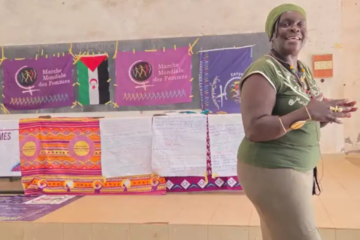
In this context, we spoke with Solange Koné, a WMW activist from Ivory Coast. Solange reflected on how situations of crisis, particularly in West Africa, are experienced by women, who suffer from daily violence, forced displacement, and the destruction of their livelihoods. Faced with the presence of terrorist groups and imperialist exploitation in the region, popular mobilization led to military coups by the population that received public support in Mali, Burkina Faso, and Niger. The three countries subsequently formed the Alliance of Sahel States, which today represents an expression of anti-imperialism on the continent.
Solange understands imperialism as something that cuts across her own territory and highlights the need for networks of solidarity among women throughout the region. She also reflects on how the rejection of French and U.S. influence should contribute to building the independence and autonomy of African nations. Drawing on the concrete experience of the WMW, she explains what it means to support women in times of crisis: sending resources, creating spaces for gathering, and ensuring that women’s voices are not silenced by isolation. Read her contribution below:

For some time now, West Africa has been facing a difficult situation. Terrorist groups coming from the Sahel have been advancing across the region, and the fight against terrorism has dragged on. Countries such as France and the United States went to Mali, and that is where the situation began to worsen. These countries said they had come to help our region fight terrorism and recover occupied areas where the population was being massacred. But instead of improving, the situation deteriorated.
The military took power. France, through countries such as Ivory Coast and Benin, then began pressuring for sanctions against Mali, Burkina Faso, and Niger. There were even threats to deploy troops against these three countries. West Africa is one region: when one member faces difficulties, it should be supported, not attacked with the assistance of external powers.
Civil society did not accept this. We denounced, wrote statements, and pressured our governments. Many things happened, but the outcome was that the three countries ended up becoming isolated. From the beginning, I have been saying that people there are facing serious hardships, and that women are suffering the most.
In this type of crisis, there is no safety for women. There are rapes and kidnappings. Women see their small businesses looted, and they can no longer work.
The situation remains severe. Terrorist groups block fuel supplies: they set fire to the trucks attempting to supply Mali, for example. Without fuel, children cannot go to school, and people cannot move around. Sometimes the situation improves slightly, but it quickly deteriorates again. The same is happening in the other two countries.
Today, the Alliance of Sahel States (AES), formed by Mali, Burkina Faso, and Niger following the military coups, presents itself as a response to imperialism.
But turning away from Europe only to turn toward Russia is not independence. Africa can chart its own path. Why should we always be tied to one power bloc or another, with the same consequences: resource plunder and domination? I agree that these three countries can serve as examples of genuine independence, of managing their own resources, and of achieving real development in the region. But replacing one dependency with another is not what we want. That is why we must continue supporting our sisters in these three countries, so they do not feel isolated.
In Ivory Coast, we continue creating a space where these women can gather at least once a year, exchange insights with sisters from their own countries and from elsewhere in the region, and make their voices heard. The pretext may be to celebrate their knowledge in agriculture or cooking, but the heart of it is that it becomes a space where women’s voices are heard within the World March of Women.
Solange Koné is an activist with the World March of Women in Ivory Coast.