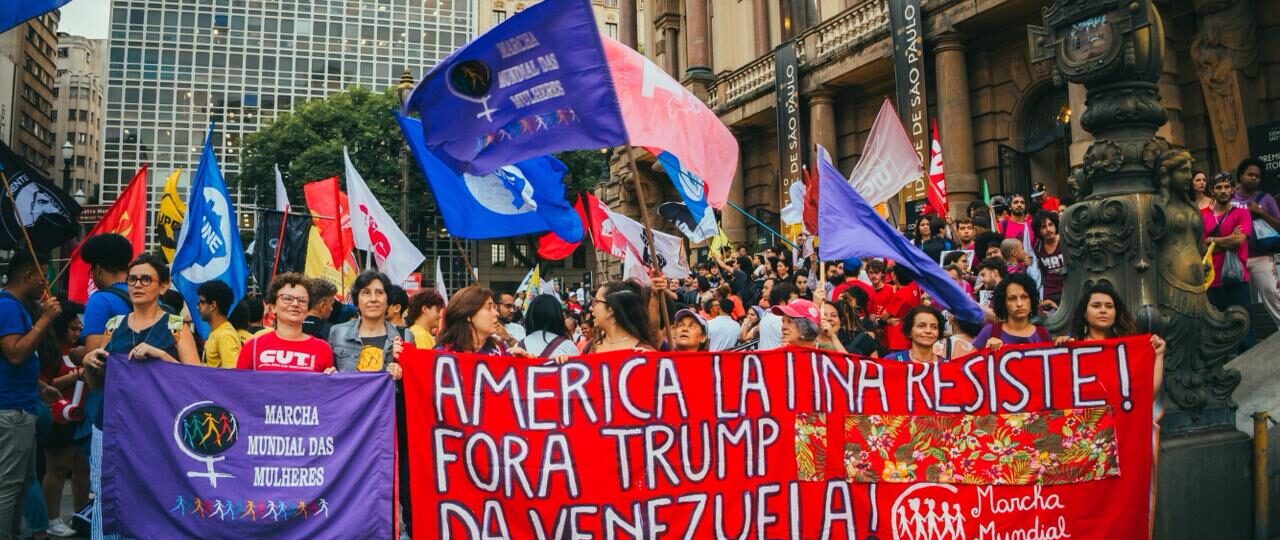
With grassroots feminist strength, women denounce the imperialist offensive perpetrated by the Trump administration and the United States against Latin America and mobilize in the streets and on social media to tackle it. The military attacks against Venezuela and the escalating threats against Cuba have exposed how the US continues to use its war machine and appropriation against the experiences of people’s socialist governments. In response, the people are demonstrating their ability to defend their self-determination and demand the release of President Nicolás Maduro and Congresswoman Cilia Flores.
Alejandra Laprea, of the World March of Women (WMW) Venezuela, recounts the terror the population of Caracas, La Guaira, and Miranda experienced in the early hours of January 3rd, 2026: “the feeling was that they were about to lose our lives, lose their city. We had no idea what the US troops were coming for, whether it was to destroy everything or what. People felt that terror here in the center of the country and in other parts as well, because even those who were not here were connected and in contact with their loved ones in Caracas.”
Alejandra denounces how Venezuela not only faces military and economic offensives, but also a full-scale media warfare aimed at delegitimize the government and demoralize grassroots organizing. She argues that “the media continues to call the legitimate president of this nation, Nicolás Maduro, a dictator, even sectors who are on our side. Even the narrative that says ‘he is a dictator, but he did not deserve this’ is painful for us, because Maduro is our president. He is our legitimate president. It is the decision of the people.”
While this imperialist control of information tries to render the presence of the people in the streets invisible and to weaken collective confidence, it encounters everyday resistance from a people who, even under attack, remains organized and mobilized by their decision to continue to be out on the streets and continue to work. As Alejandra says, after more than 25 years of the Bolivarian Revolution, the people has learned that “they may attack us in a thousand ways, but we respond with work, we respond with the streets, we continue to sustain life in our communities.” Democracy is also expressed in the continuous resistance to sanctions, economic warfare, constant threats, and military presence in the Caribbean.
“They will never take away our joy,” Alejandra says, explaining the central role of Venezuelan grassroots feminists in organizing psychological support, strengthening productive initiatives, conducting training efforts in neighborhoods, and advancing the building of feminist and anti-patriarchal communes.
Feminist Solidarity
Alejandra highlights the broad network of international solidarity that has mobilized in response to the escalating aggression against her country. These mobilizations have been fundamental in ensuring that the Venezuelan people does not feel alone in one of the most serious moments in the country’s recent history.
Recognizing Cuba’s historic role, Alejandra reaffirms the memory of solidarity built since the beginning of the Bolivarian Revolution. The Cuban people has been following the Venezuelan process from the beginning and has become a point of reference for anti-imperialist resistance.
Pınar Yüksek, from the WMW Turkey, and Daya Laxmi, from the WMW Nepal, shared their experience of international solidarity with Venezuela in the Alexandra Kollontai Feminist Solidarity Brigade organized in 2022. Pınar said that joining the brigade meant disrupting the dominant narrative spread outside the country, marked by disinformation and ideological warfare.
Daya emphasizes that international solidarity is a conscious political choice for people’s resistance. From a feminist perspective, she denounces that the war against Venezuela is not only waged by military means, but also through hunger, blockades, and fear. “This war is not a war with bombs alone. It is done with hunger, the blockade of medicine, through economic sanctions, and fear. The attacks on Venezuela are not only about democracy or human rights. They are about imperialist control over land, oil, labor, and women’s bodies. […] There is no women’s liberation without national sovereignty,” she points out.
Pınar argues that the attack on Venezuela is a warning to all peoples: “Venezuela showed the possibility of managing its own wealth and future, and that is why they are seen as a security threat for the US.” While the sanctions imposed on the country directly affect living conditions, including food, medicine, and basic services, Pınar points out that the Venezuelan people “did not tell their difficulties as a victim story—on the contrary, they talked about how they resisted.” This resistance turned the blockade into a process of building sovereignty.
US Imperialism
The current US offensive against Venezuela and Cuba is a continuation of historical US imperialism and its attempt to maintain political and economic domination over the peoples. On behalf of grassroots organizations operating within the US, Claudia de la Cruz, a member of the Party for Socialism and Liberation (PSL), reinforced the commitment to international solidarity, highlighting that these movements are mobilizing in solidarity.
Attacks on foreign countries are connected to a broad US strategy against the working class and migrants within its own territory. Claudia said “the Trump administration is not an anomaly. It is an intensification of the US response to the deep capitalist crisis, and it is represented in a two-front war—of domestic repression and imperialist aggression—to crush any sense of resistance and maintain hegemony.” As political awareness, international solidarity, and the anti-imperialist struggle rise, Claudia argues that “the administration’s escalating repression is not a sign of strength—it’s a sign of panic and it’s a sign of weakness.”
Cuban activist Llanisca Lugo, with the Martin Luther King Center, says this is not a case of disorganized imperialism, but rather a logic of domination sustained by a fascist ideology based on an idea of superiority, adding that there is a political rationale that seeks to control territories, wealth, and peoples that are deemed disposable. In this context, the attacks on Venezuela are part of a global offensive that goes beyond Latin America and the foundations of the Monroe Doctrine.
In situating this process historically, Llanisca recalls the long history of US interventions in the region, from the coups d’état of the 20th century to contemporary forms of war and occupation. She explains how “the violence of January 3rd, the way we imagine the suffering of the Venezuelan people, also brings to mind images of the bombings in Gaza and the wars in the Middle East. But that pain, those sounds that Alejandra mentioned, that memory in the people, all of this makes us realize that we are living in a unique moment in our region.”
Imperialism wants to destroy the Bolivarian Revolution because it demonstrates stability, people’s participation, and political boldness. At the same time, the war of narratives tries to erase the existence of this people of resistance, creating the image of an isolated country. In this sense, the attacks against Venezuela cannot be explained solely by economic battles, but rather by the political and organizational capacity of the country and its people. As Llanisca states, “the most daring country conceiving ways to overcome capitalism today is Venezuela.”
From the Middle East to Latin America
Ruba Odeh, of the WMW Palestine, connected the struggles of the Palestinian and Venezuelan peoples by stating that what is happening in the world today cannot be understood as a set of isolated events, but as expressions of the same system of domination. She argues, “the Palestinian cause is not a fleeting event, but rather the product of decades of settler colonialism. From Palestine to Venezuela, the cause is one and the enemy is one.” This historical enemy, which supports the Zionist occupation and attacks Venezuela, is the same enemy that seeks to erase the memory, identity, and rights of peoples through sanctions, blockades, and attacks on sovereignty.
Abeer Abu Khdeir, a member of the WMW Palestine, further developed this analysis, arguing that what Venezuela faces is “a new chapter in organized imperialist terrorism against sovereign states and against every liberation movement that refuses to submit to American dictators.” Abeer denounces that the US discourse of defending democracy is in fact “a false cover for practicing imperialist piracy to steal the wealth of the Venezuelan people, seize their oil, minerals, and natural gas, and confiscate their independent political decision-making.”
Both believe that international solidarity is not symbolic, but strategic and necessary, because the defense of Venezuelan sovereignty is part of the same battle being fought in Palestine. As Ruba states, “the struggle in Caracas is the struggle in Jerusalem, Gaza, Ramallah, and Haifa.” Abeer underscores the “inherent and inalienable right of the Venezuelan people to resist in all forms and defend their existence and national sovereignty.”
Imperialist arrogance will inevitably be shattered by the awareness and courage of free loving people.
Abeer Abu Khdeir
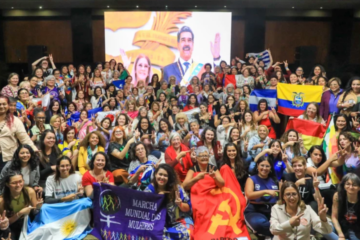
The quotes in this article originally come from the online event “Women in Defense of Venezuela: Building Feminist Solidarity Against Imperialism,” held on January 14th 2026 by Capire, the World March of Women, and the International Peoples’ Assembly.