Pernambuco, 1926–1959
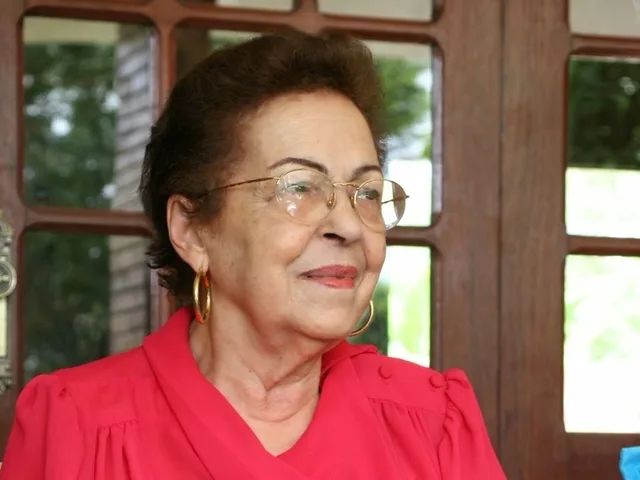
She was born in 1926 in Pernambuco, a region where sugarcane fields and mills abound, into a Catholic family that quietly admired Luís Carlos Prestes. At seventeen, she married a young lawyer eleven years her senior, Francisco Julião Arruda de Paula. Six years after their marriage, the Brazilian Communist Party, then operating underground, needed a “legal front” to host a women’s congress in Recife. Three women whose husbands were members of Congress and lent them public respectability were appointed leaders of a new organization, the Women’s Union of Pernambuco [União Feminina de Pernambuco—UFP]. Alexina, then aged twenty-three, became its first president. In her research on the UFP in Pernambuco, historian Thayana Santos would later note that Alexina “stepped into the line of fire at that moment.”
While the cover was real, so was the work. In the mid-1950s, she helped develop the Empty Plates Campaign [Campanha dos Pratos Vazios]—in which women gathered in public squares in Recife and then marched through the streets with their empty pots, going door to door—and helped found the Pernambuco Women’s Federation [Federação das Mulheres de Pernambuco] as its successor and political home.
With the outbreak of the Korean War in 1950, her organization reached out to the wider world: she led marches of mothers from Recife in solidarity with the mothers of US soldiers drafted for the invasion, demanding the immediate return of their sons, an end to the war, and an end to nuclear armament. Internationalism—at this stage, the internationalism of the early Cold War peace campaigns—was already part of her work even before the peasants from Engenho Galileia walked into her husband’s law office. In her development as a political actor, her work organizing women came first.
Internationalism as Practice, 1959–1972
The Cuban Agrarian Reform Law of May 17th, 1959, gave the Brazilian Peasant Leagues a counterpart on the continent. Between late 1961 and early 1962, after a year of escalating death threats from large landowners in the Northeast, Alexina moved her four children—Anatailde, Anatilde, Anatólio, and Anacleto—to Havana, where they enrolled at the Marte Russian School, a school built in the early years of the Cuban Revolution to house the children of fallen combatants. Their classmates were the children of fighters from the Algerian FLN, the Vietnamese resistance, and other Latin American fighters whose parents were still in hiding in the wilderness, the jungle, or the mountains.
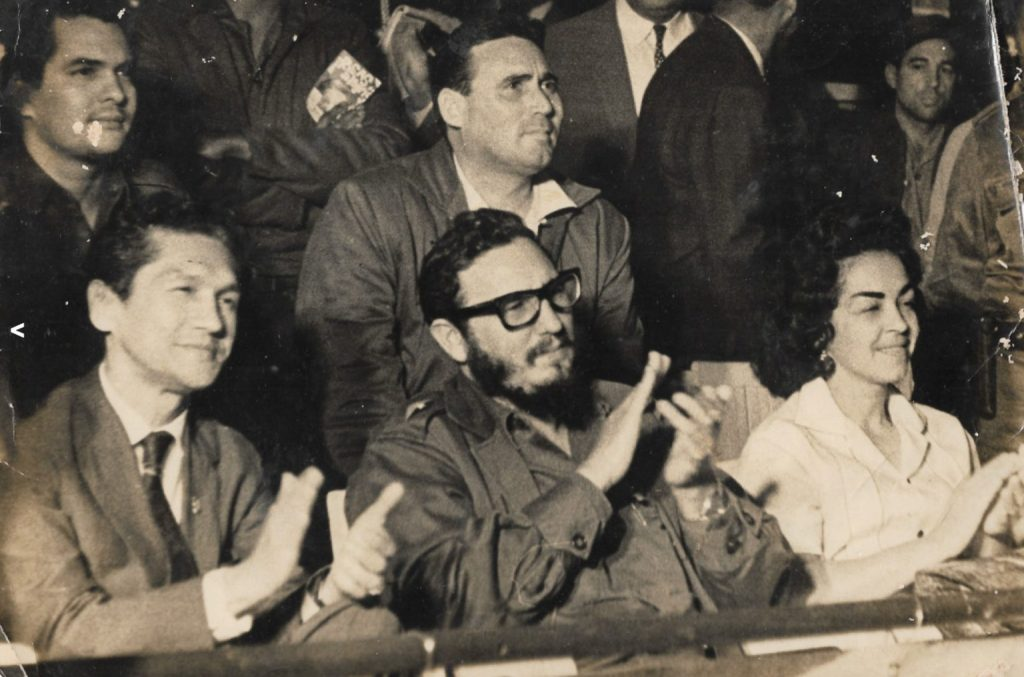
In Cuba, she trained as a guerrilla fighter and helped pass on that training to other exiled Latin American cadres—classes on mortar trajectories and the assembly and disassembly of small weapons. “It was at a shooting range. With guns, machine guns… We also had lessons on contour lines, which are used to learn how to fire a mortar.” The discussion over the map in Havana with Fidel and the meeting in Beijing with Mao took place during that same period. In addition to Fidel and Raúl Castro and Che Guevara, she came to know the Afro-Cuban revolutionary commander Juan Almeida Bosque, Celia Sánchez—Fidel’s closest personal advisor throughout the entire Revolution and one of the women of the Sierra Maestra—and Vilma Espín, founder of the Cuban Women’s Federation [Federación de Mujeres Cubanas] and one of the women who had led the 26th of July Movement underground. The Havana she traveled to was not the Havana of state diplomacy. It was the Havana of the comrades with whom she taught and trained.
In January 1966, the First Tricontinental Conference of the Peoples of Asia, Africa, and Latin America was held in Havana—the founding conference of the Organization of Solidarity of the Peoples of Africa, Asia, and Latin America [Organización de Solidaridad de los Pueblos de África, Asia y América Latina—OSPAAAL] and one of the central political moments of 20th-century revolutionary internationalism, with Salvador Allende, Amílcar Cabral, the Vietnamese FNL, and host Fidel Castro among its leading voices. According to the biographical memorial organized by her family, Alexina was invited to speak at the conference, and her two eldest daughters, Anatailde and Anatilde, staged the opening ceremony dressed in the flags of Cuba and Brazil.
According to a testimony by Clodomir Santos de Morais, her comrade in the armed wing of the Leagues, she was also the official delegate of the Peasant Leagues to the First Conference of the Latin American Solidarity Organization [Organización Latinoamericana de Solidaridad—OLAS] in Havana, from July 31st to August 10th, 1967. The continental organization for armed struggle had the motto “the duty of every revolutionary is to make the revolution” [“el deber de todo revolucionario es hacer la revolución”] and formalized the strategic horizon that the Tricontinental had opened up. Two months after the conclusion of the OLAS conference, Che Guevara was killed in Bolivia.
Two Blows Against Agrarian Reform, 1964 and 1973
She was in Havana with her four children on April 1st, 1964, when news of the coup in Brazil arrived. Julião had delivered his final speech in the Brazilian Congress the day before, telling Brazil that the agrarian issue was “the factor behind all this unrest.” He was arrested two months later under a false name and spend fourteen years in exile in Mexico. The Peasant Leagues were destroyed. The buried weapons were never unearthed. As they could not return to Brazil and Julião was imprisoned, Alexina and her four children remained in Cuba and became part of the island’s revolutionary life: they cut sugarcane at the harvest [zafra] alongside Cuban workers and other Latin American exiles, took turns on night patrols in the neighborhood, and joined the National Revolutionary Militia [Milicias Nacionales Revolucionarias], the paramilitary wing of the Cuban Revolutionary Armed Forces. Internationalism, during this period, was not a program: it was the work of getting through the next day.
In the years following the coup, she carried out missions for the Leagues to Cuba, Vietnam, the Soviet Union, the Democratic People’s Republic of Korea, and other countries of the socialist bloc, continuing the international relations work that had taken her to Beijing in 1962. Her family, having been denied renewal of their Brazilian passports by the military regime, was officially declared stateless; their identity documents were issued, under this status, by the Swiss authorities on behalf of the United Nations. In 1970, following the election of Salvador Allende in Chile, the family moved to Santiago with the intention that Alexina could eventually return to Brazil clandestinely.
On September 11th, 1973, the Chilean military overthrew Allende with US support. Her eldest daughter, Anatailde, was arrested at the door of her home in Santiago and taken to the National Stadium, where political prisoners from all over Latin America were being held and many were being tortured and killed. Alexina, who had taken refuge with her son Anacleto under Swedish diplomatic protection, managed to locate Anatailde alive at the stadium and secure her release. The family was put on a plane to Stockholm. Between September and December 1973, in Chile, 285 peasants and 31 employees of agricultural institutions were executed or disappeared—85 percent of all documented deaths from the coup during that quarter. The destruction of agrarian reform was not a side effect of the coup. It was the coup.
Alexina lived in Sweden from late 1973 until January 1980, becoming part of the community of Brazilian exiles in the country and maintaining contact with the broader diaspora. She worked to make ends meet and, in her spare time, studied theater.
The Return, 1980–2013
She returned to a country where the Peasant Leagues had not been reestablished. The peasant organization she had helped build had been destroyed by the dictatorship; what would emerge in its place—founded in Cascavel, Paraná, in January 1984 by 1,500 representatives from sixteen states—was the Landless Rural Workers’ Movement [Movimento dos Trabalhadores Rurais Sem Terra—MST], which would later cite the Peasant Leagues among its main influences. She joined the executive committee of the Brazilian Communist Party in Pernambuco and, for thirty-three years, until her death in 2013, continued the work of organizing the women’s movement and the peasant movement that she had begun in 1949.
In April 2010, at the age of eighty-three, she delivered what would be her last public political speech at a meeting of the League of Poor Peasants [Liga dos Camponeses Pobres]. She died in Recife on November 14th, 2013, of respiratory failure, at the age of eighty-seven.
Restoring Her Name Today
In 2019, the Small Farmers’ Movement [Movimento dos Pequenos Agricultores—MPA Brasil] organized the Alexina Crespo Caravan in Pernambuco, a months-long political education caravan named after her through the Agreste and Sertão regions. On November 25th, 2024, on the International Day for the Elimination of Violence against Women, the Olga Benário Women’s Movement inaugurated the Alexina Crespo Working Women’s Occupation in Suzano, in the Alto Tietê region of São Paulo—its first hub in the region. In April 2025, the 70th anniversary of the Peasant Leagues was celebrated at Engenho Galileia.
In October 2025, the Pernambuco State Legislature approved Resolution Bill No. 3020/2025, authored by State Representative Rosa Amorim—the first MST member to win a seat in the Pernambuco State Legislature, elected in 2022—which included Alexina in the Book of the Pantheon of Heroes and Heroines of Pernambuco, alongside Miguel Arraes, Dom Hélder Câmara, Fernando Santa Cruz, Zumbi dos Palmares, and Frei Caneca. “Alexina was a leading figure in the struggle of the Peasant Leagues in Pernambuco and one of the first women to hold this position,” Amorim wrote on the day of the inclusion, “reinforcing the importance of women’s leadership in the struggle for land.”
A Memorial to Agrarian Reform and the Peasant Leagues of Brazil, based at the Federal Rural University of Pernambuco and coordinated by Professor Marcília Gama, will take her family archive—photographs, letters, poems, and objects from her long life—to settlements and public spaces throughout Pernambuco as part of the centennial celebrations.
She did not undertake this work to be recognized. She did it because the circumstances and struggles of the moment made it a pressing matter. “I just did what I had to do,” she told the researchers from Pernambuco who interviewed her in 2010. What drove Alexina, throughout the long century of her life, was being a revolutionary and the internationalism that being a revolutionary in the struggles of the 20th century required. Today, that revolutionary and internationalist spirit and action are needed more than ever.
“Talking, talking, talking,” she said in 2010—“and maybe even a few punches—I can throw those, too.”

Tings Chak is a member of the Liang Jun Internationalist Brigade (China) and art director and researcher at the Tricontinental Institute for Social Research. This article is an abridged version of an article originally published in Jacobin Magazine.