In the contemporary global scenario, two antagonistic paradigms of Artificial Intelligence development compete for technological hegemony and outline radically different futures. On one side is the model concentrated in the oligopoly of Big Tech, whose domination is structured around financial control of the technological value chain, organic integration with the military-industrial complex, and private appropriation of data as a strategic commodity. This model, sustained by speculative capital and oriented toward the accumulation of geopolitical power, perpetuates relations of technological dependence that subordinate the Global South to the condition of a supplier of raw materials, precarious labor, and unpaid data, configuring what we might call digital extractivism.
In contrast, the Chinese model of ‘new qualities productive forces’ is emerging, which conceives data as a factor of production serving a people-centered modernization project led by the state under the direction of the Communist Party. While the US paradigm guides technological development through the logic of private accumulation, where AI primarily serves the interests of financial valuation, geopolitical control and profit maximization for a corporate oligopoly, the Chinese strategy subordinates technology to the goal of benefiting the population, promoting inclusion, sustainable development and national sovereignty.
As Tica Moreno, from the World March of Women, pointed out during the Global South Academic Forum in November 2025: ‘We need the people and the state to be subjects of technological development and not just users of ready-made packages, ready-made frameworks, and ready-made models of artificial intelligence. This statement sums up one of the main challenges facing the Global South: overcoming our status as mere consumers of technology to become producers of our own digital tools’.
This contradiction manifests itself with equal intensity in the agricultural field. Transnational corporations such as John Deere, BASF and Microsoft implement Internet of Things and Artificial Intelligence systems that deepen land concentration and enable the capture of data from hundreds of thousands of hectares. At the same time, the model proposed for smallholder farming boils down to low-complexity applications focused on collecting data in exchange for ‘recommendations’ that drive pesticide sales or indebtedness through fintech applications.
It is in this context that Artificial Intelligence for Agrarian Reform and Agroecology (IARAA) emerges, conceived as a tool in the struggle for the mass adoption of agroecology. Developed by the Landless Workers’ Movement (MST) and the World March of Women, and promoted by the International Association for Popular Cooperation (Baobab), the initiative is linked to other fronts of popular technological sovereignty built within the framework of Sino-Brazilian cooperation, such as mechanization adapted for family farming, large-scale production of high-quality bio-inputs, and the development of food production chains. Artificial intelligence now constitutes a new trench linked to this construction.
Collective Construction: Methodology and Principles
The IARAA construction methodology reflects the principles of popular organization that characterize the movements that developed it. While large artificial intelligence models privately appropriate and benefit from the knowledge produced by humanity, IARAA recognizes and values, as a matter of principle, the collective dimension and effort involved in producing this knowledge. The project assumes that agroecological knowledge has been developed by people, communities and grassroots organizations throughout history. Research institutions and universities are also relevant actors in the production and systematization of this knowledge. One of the greatest challenges in building IARAA is precisely to bring together all this knowledge in written form so that it can serve as a knowledge base for AI, since it is currently scattered across multiple repositories and, in some cases, exists only in oral form.
To build the technical and policy foundations, a team of agroecology experts was formed, drawn from social movements and representing all regions of Brazil. This collective worked on developing the knowledge base that feeds the tool and on developing the instructions that guide and ensure the conceptual, scientific and technical rigor of agroecology, as well as the productive, organizational and activist nature of IARAA’s responses. The ongoing collective construction of these aspects is fundamental to ensuring that the tool does not reproduce the logic of agribusiness or promote homogenizing technological packages, but rather strengthens diverse and territorially contextualized agroecological practices.
Developing a tool that incorporates these characteristics and principles requires innovative development methodologies. This process presupposes, on the one hand, the training and technical capacity building of grassroots activists, creating the conditions for them to actively participate in the design, development and validation of the tool. On the other hand, it requires programmers to deepen their understanding of the political, theoretical and practical foundations of agroecology, thus ensuring that this framework is adequately translated into functionalities, architecture, and interfaces that effectively expand the capacities for action and articulation of agroecological subjects. It is, therefore, a construction process that recognizes the inseparability between technical design and political project, rejecting hierarchies between the stages of development. In this way, the tool translates agroecological principles as it transforms itself in its implementation and use.
An AI to empower grassroots organizations
IARAA breaks with the logic of individual, passive and atomized interaction that characterizes commercial tools. Its fundamental purpose is not to be exhausted in an isolated dialogue between user and machine, but rather to act as a catalyst for grassroots organizations, strengthening their territorial struggles and the collective systematization of agroecological knowledge.
The tool aims to strengthen the process of mass adoption of agroecology, understood by popular movements as a strategic perspective for political projects and for confronting the environmental crisis imposed by agribusiness. Sharing the accumulation of agroecological knowledge is one of the fundamental tasks in this battle.
Technical architecture: RAG and open-source models
IARAA operates through a technological architecture based on Retrieval-Augmented Generation (RAG), which combines the ability to retrieve information with the generation of natural language. First, advanced language models process and interpret natural-language questions, identifying the key concepts and context of the query. Next, the system searches specialized knowledge bases—built and validated by popular movements—for technical and practical information directly related to the question presented. It then generates the actual response, in which the language model articulates the retrieved information in a fluid, understandable text. Finally, the system presents the answer combining the technical rigor of the knowledge bases with accessible and contextualized communication, according to the flow designed by the team.
Unlike commercial chatbots that simplify responses and standardize practices, IARAA is being programmed to account for the diversity of biomes, production systems, social organization and material conditions across different territories. The tool does not aim to replace existing technical and popular knowledge, but rather to amplify it and facilitate its circulation between different territories and generations.
The project envisions IARAA responding to the specific needs of those who consult it. If a farming family faces a pest problem in their bean crop in the semi-arid northeast, the tool will not offer a generic recipe based on pesticides but will consider viable agroecological alternatives for that specific context, drawing on experiences from other territories with similar conditions and connecting with technical knowledge validated by popular practice.
Current phase and implementations
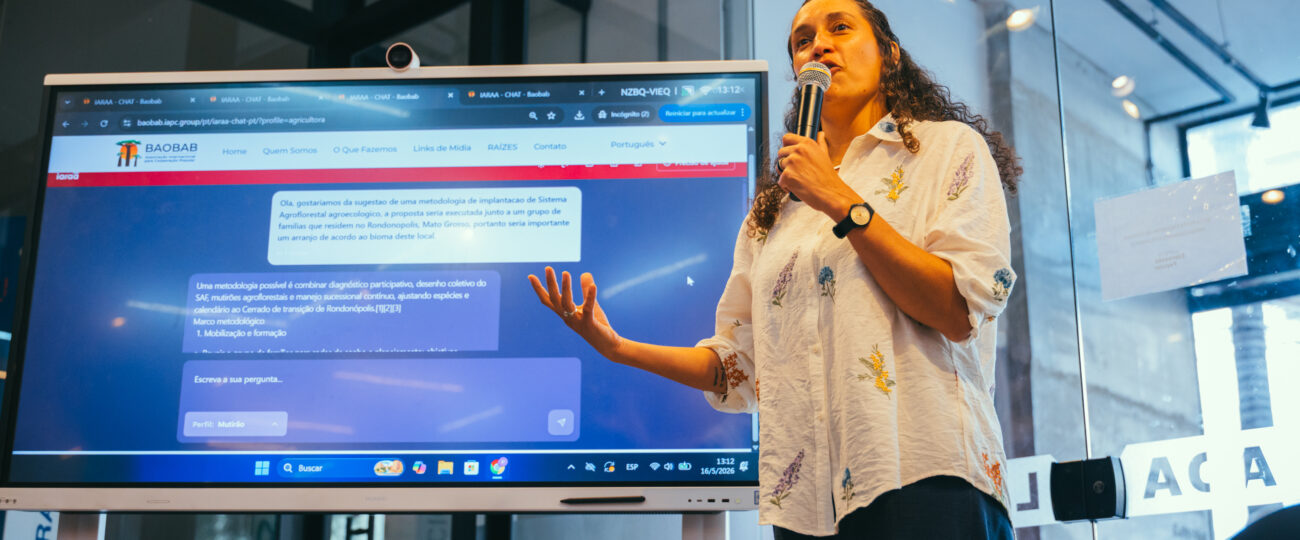
In its current phase (beta), IARAA offers three search profiles—Sowing, Collective Effort, and Productive Backyard—each designed to meet the distinct needs of agroecological subjects.
The Semeadura (Sowing) profile was designed for those who work in the field and seek information on everyday farming practices. The Mutirão (Collective Effort) profile, on the other hand, focuses on technical assistance, participatory methodologies, and group work. Both profiles offer more robust answers to agronomic questions, such as agroecological soil management, pest and disease management and ecological restoration—areas chosen by the movements’ agroecology experts as those of greatest interest in the territories. The Quintal Produtivo (Productive Backyard) profile, in turn, is designed for study and research, covering searches on concepts, political foundations of agroecology, and theoretical deepening.
From a technical standpoint, Semeadura and Mutirão operate with the RAGFlow architecture—an open-source mechanism focused on deep understanding of documents—integrated with Anthropic’s Claude language model. Quintal Produtivo operates with Meta-RAG, an experimental architecture developed exclusively for IARAA, which employs multiple automation agents working in conjunction with the MiniMax M2.1 and GLM-4.7 models. The latter two are open source and developed in China.
The plan for the future includes expanding IARAA’s capabilities into other areas of knowledge, focusing not only on answering individual questions but also on supporting collective processes such as cooperative production planning, facilitating technical training in agroecology schools, systematizing experiences from different territories, and contributing to the development of educational materials.
In this way, AI does not become an instrument for the individualization of knowledge, but rather a technology that strengthens community ties and popular organization. Building alliances with public research institutions, universities committed to rural extension, and international cooperation agencies will be essential to ensure the continued development of IARAA.
Prospects and challenges
IARAA represents an important step in the construction of technological alternatives from the popular movements of the Global South. However, it faces challenges. Developing and maintaining AI systems requires significant computing power. South-South cooperation, particularly with China, can play a strategic role in this field.
There is also the challenge of social appropriation of digital technologies, which requires continuous grassroots training within the popular movements. In addition, progress in the battle for digital sovereignty must be accompanied by struggles and victories across the entire agenda of the movements. As Maria Gomes, an MST activist warned, mechanization and artificial intelligence will only have a real impact if they are accompanied by training, income generation, access to water, and improved living conditions. Technology is neither neutral nor sufficient in itself: it is part of a broader political project of achieving and transforming the lives of the working class.
IARAA is part of this strategic horizon, demonstrating that it is not only possible but necessary for popular movements to occupy the space of technological development—not as passive recipients of other people’s innovations, but as historical subjects capable of forging their own tools of liberation.

Natália Lobo is a militant of the World March of Women (WMW) in Brazil. Paula Veliz is a researcher at the International Association for Popular Cooperation (Baobab) and a militant of the Rural Federation for Production and Rootedness in Argentina. Carolina Cruz is part of the MST’s Information Technology Front. This text was originally published in the magazine Latin America On The Move, no. 559, February 2026, by the Latin American Information Agency (ALAI) and the Latin American Geopolitics Observatory.