Through his second term as president, Trump and his cronies have been sprinting towards authoritarianism. After losing the presidency in 2020, while Trump insisted that the election was “stolen” from him, the machinery of the extreme right in the U.S. went to work on developing a playbook to implement its agenda, known as Project 2025, for the next time they had power. The policies developed in this compendium include increasing the power of the executive branch, attacking voting rights, targeting journalists, repressing the LGBTQ community, facilitating mass deportations, and dismantling government agencies and the social state. Since his election, the administration has enacted strategies from the Project, line by line.
Internationally, during his first term, Trump practiced an “America First” approach that focused on coercive economic tactics such as renegotiating trade agreements like the North American Free Trade Agreement (NAFTA) to further favor the U.S., enacting tariffs, especially on China, and increasing sanctions on Iran and Venezuela. This approach did not include full-scale ground warfare, however, as he explicitly campaigned on an anti-interventionist platform against “forever wars.” His position is reversing in real time now that we are in his second term.
During this past year alone, the U.S. has escalated military action in multiple areas of the world, from the bombing in Nigeria to carrying out attacks on ships in the Caribbean to kidnapping a sitting president in Venezuela and now starting outright war with Iran.
Movements have tried to keep up, but the Trump administration is moving quickly. While millions of people demonstrated in solidarity with Palestine and against the genocide in Gaza, we are still working on how to capture that energy into a broader organized anti-war movement. As a result, the voices against military action have ranged from anti-war veterans and the progressive and left forces to far-right factions of Trump’s coalition who feel betrayed by his sudden shift to support war. As an alliance that stands against militarization and aims to connect social movements in the U.S. and globally, we see the cohering of grassroots left movements to stop the U.S.’s imperialist aggression as essential in this moment.
The Expansion of ICE
While the risk of a generational war in Iran escalates, there has also been a sharp uptick in the militarization of law enforcement here in the U.S., especially of the U.S. Immigration and Customs Enforcement (ICE) agency. The most significant piece of legislation passed by the U.S. Congress last year was a budget bill named by Trump the “One Big Beautiful Bill Act.” This bill included a 300% increase in ICE’s budget, which is now up to $75 billion.
As a result, ICE is scaling up their number of enforcement officers with very little oversight. They are offering $50,000 signing bonuses, lowering the minimum age to join to 18, and have been caught skipping the background checks. A journalist who went through the application process was rapidly approved and described interviewers saying they wanted people on the streets as fast as possible, by 6 months, with guns.
Trump is pursuing this build-out to grow a personal army for the executive branch because ICE is only accountable to the Department of Homeland Security (DHS), which has leadership appointed by Trump, and to the federal courts, where the few judges who have stood in the path of illegal deportations have been fired recently.
ICE is separating families, detaining citizens and non-citizens alike, and invoking fear in a way that is reminiscent of the roving gangs seen in many fascist projects, including the historic slave patrols in the U.S. South. Tactics like night raids, racial profiling, and demanding to see “your papers” all have deep roots in these patrols and in the white supremacist ideology still guiding many to join the agency today.
Minnesota
In early 2026, the Trump administration deployed around 2,000 ICE agents to Minneapolis as part of a racist attack on the Somali community in Minnesota, which had been targeted since news broke of a fraud scandal that involved a very small number of its members. Trump picked up this news story, and despite the fact that most Somali immigrants are U.S. citizens, he decided to send ICE in order to respond to the crisis he created. The flood of ICE agents kidnapped mostly Latin people off the streets and at traffic stops based on their last name or appearance, sending them to detention out of state and speeding up their deportation proceedings.
Minneapolis is not a large city, so ICE’s presence was very visible and generated a lot of fear and anger. The civilian response was immediate: everyday people organized neighborhood protection networks. People blew whistles when ICE agents appeared, groups tracked license plates of verified ICE vehicles, and communities took care of their neighbors through mutual aid, like delivering food to vulnerable populations.
While neighbors were finding hope and power in standing up for one another, the unthinkable happened Not three weeks later, Alex Pretti, an Intensive care unit nurse, was murdered in execution style by an agent while trying to help his fellow community member who’d been thrown to the ground by ICE. These deaths sparked a movement in Minnesota. Many realized the intensity of fascist escalation.
The second uprising for Black Lives began in Minneapolis after the murder of George Floyd in 2020, so there is recent experience with mass mobilization and organizing infrastructure that has been built out across faith, labor, and grassroots sectors. People of the city took mass disruptive action swiftly and decisively, shutting down the airport first and then carrying out a general strike a few weeks later in subzero temperatures.
The national outcry at the murder of protestors, whom Trump and his team tried unsuccessfully in the court of public opinion to label “domestic terrorists,” led to significant media coverage and the eventual firing of the former head of the Department of Homeland Security, Kristi Noem. Even with her removal, the mandate for mass deportations has not shifted, while the tactics of ICE have moved to be more covert and precise in kidnapping people, such as using traffic stops as the main site of checking immigration status.
Other Deployments
From Los Angeles to New York City, ICE has deployed agents to ramp up enforcement. Everywhere we have seen ICE, community members have resisted their presence. Residents have blocked streets, sent agents on wild goose chases, publicly shamed officers trying to detain people until they left, and otherwise diverted and deterred them. In Chicago and Washington D.C., another branch of the armed forces, the National Guard, was deployed alongside ICE, supposedly in immigration enforcement operations. In response, communities set up defense networks to track and defend against agents; mutual aid networks set up resources for those who couldn’t work; groups led Know Your Rights trainings; and people engaged in disruptive direct actions.
In the case of National Guard officers, active duty service members were also a target for broadening resistance. One of GGJ’s member organizations, About Face: Veterans Against the War, developed the Right to Refuse campaign to persuade National Guard officers to defect, since it is a reserve force more frequently called upon in the event of emergencies and national disasters than for other military service.
The campaign asserted to service members: you can refuse illegal orders. And if you join About Face, you will have a community to back you up. There are historic precedents for refusal of orders, especially around the use of force against civilians.
National Struggle
In this period we have also witnessed some of the largest mobilizations in the country’s history. No Kings Day is a national mobilization that has occurred multiple times in the last year. One of the early actions in this cycle was among the largest protests in U.S. history, though it didn’t receive significant media coverage.
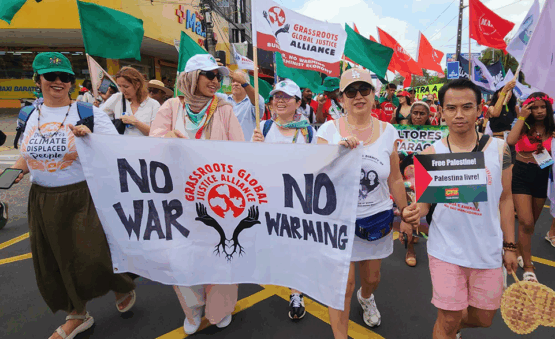
Our movements and grassroots forces are integrating demands for “No ICE” and “No war” alongside “No kings,” because the problem isn’t only Trump’s authoritarian actions but also the institutions he is building up to enforce U.S. domination internationally and repress our people and social movements domestically.
Movement organizations have also been training organizers and movement leaders in tactics of noncooperation or disruption in big and small ways to create economic or political consequences for decision-makers. For example, people boycotted Spotify when they began running ads for ICE recruitment, which resulted in Spotify letting their contract with ICE expire. In Minnesota, airport shutdowns and a general strike created the highly visible public pressure for the administration to rein in ICE operations there.
May Day this year is expected to be a significant mobilization to this end because it will involve labor as part of a build-up to the 2028 elections, and it will be a test of the capacity for working-class people and movement forces to engage in action that eventually may lead to a general strike, an event that has not occurred nationally in about a century.
GGJ is also providing our movements political education on militarism, particularly focusing on the connection between war at home and war abroad. And member organizations have ongoing campaigns, with major targets: the Palestinian Youth Movement, for example, has the Mask Off Maersk campaign, focused on a weapons and transportation company connected to Palestine. Other organizations have been part of mobilizations around Palantir, a surveillance technology company. We believe it is important that we start the process of aligning as movements now on how we want to respond so that we are prepared.
The Fight for Democracy
In the approach of the 2026 congressional elections, the Trump administration is currently trying to get a massive voter suppression bill named The SAVE Act passed. The bill would require all registrations in person, even if you are registered now, and for the applicant to have their birth certificate or a cost-prohibitive passport with them. This could potentially disenfranchise many rural voters who live many hours from a voter registration site; anyone who has changed their name, including millions of women who changed their names after marriage; people who don’t have the time or finances to purchase a passport and register in person; and the list goes on.
Currently, Republicans control the House, the Senate, the presidency, and the courts—they are in power in all three branches of the federal government. Trump is trying to ram through this legislation this year because if his party loses even one side of the legislature in 2026, it would enable us to use more tools to stunt the right-wing agenda, including allowing for investigations, challenges, and other obstructions.
On top of the potential for the SAVE act, there’s anticipation of heavy ICE presence at election sites and other forms of voter intimidation. In 2020, we organized election protection teams at polling locations. This time around, we may need more.
Lessons
Movements in the U.S. are adapting to stanch the bleeding and destruction of the Trump administration at home and abroad. Social movements here are getting aligned on how to fight together again given that our opponents have consolidated, developed a shared agenda, and are now implementing it. We need tactics that can both exact financial or political pain on our targets while building the community networks that will be necessary to sustain any resistance.
With the shift toward military aggression abroad, it is more critical than ever that U.S. social movements are connecting across borders and that we rebuild the anti-war movement domestically and internationally.

Margaret Kwateng is the campaign director at Grassroots Global Justice Alliance (GGJ). She is based in Brooklyn, New York, and works on popular organizing in response to internal militarization, immigration repression, and electoral disputes in the United States.