I got my names when I gave back the slave owner their names. I changed them by deed poll.1Deed poll is the legal procedure through which a person changes their name in the United Kingdom. Nzinga is after the warrior queen in Angola who fought the Portuguese when they came to steal the land. My second name is after Assata Shakur, one of the leading women in the Black Panther movement in the United States. She was exiled in Cuba and has passed away recently. Barack Obama, a Black man, put a million dollar bounty on her head when he came into power.
I’ve been very involved in reparations since 2001. In 2002, a group of 96 of us from the United Kingdom (UK), along with 200 from Canada and the United States of America, others from the Caribbean, and Africans from the entire world, met in Christ Church, Barbados. There we formed the Global Afrikan Congress (GAC), a reparations organization. The aim was to have branches of Africans fighting for reparations across the entire African world. That was the start, and the GAC is continuing that work today.
Here in the UK we hold 21 days with Brazil against racism. For 21 days we have activities interacting with the country. We also invite a speaker over from Brazil to come and speak at the reparations conference organized by Brother Glenroy, secretary of the National Union of Rail, Maritime and Transport Workers (RMT). The RMT sponsors a reparations conference in England every year.
On an international scale, the GAC will be having a family conference in the Gambia from 6 October 2026. Over the years we’ve gone to Suriname, to the Gambia, to Ghana, to Zanzibar, spreading this word around reparations.
The Reparations Agenda
Bernie Grant, one of the first ever Black Member of Parliament in this country, coordinated a group of Africans in the 90s. They met in Nigeria and formed the reparations agenda. The booklet is called The Facts on Reparations to Africa and Africans in the Diaspora, and it was created by the Group of Eminent Persons on Reparations. Those were all African leaders. There was Professor Dudley Thompson, who was the ambassador to Nigeria from Jamaica.
They did a phenomenal amount of work, highlighting what we all need to be doing across the world to demand reparatory justice for the damage that has been inflicted on African people. We’re all over the world, as opposed to being on the continent of Africa. How did that come about? Who is responsible? We need to make those responsible accountable.
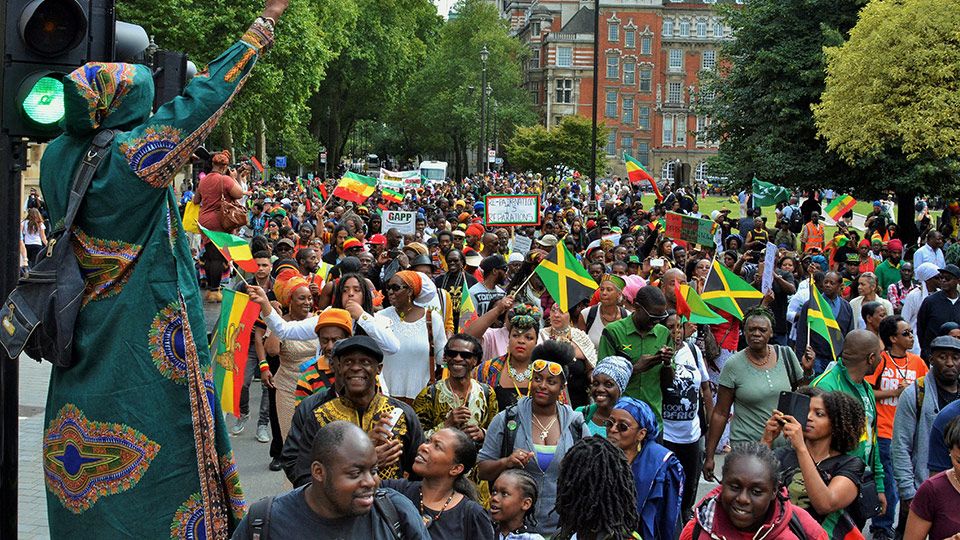
We’ve also got Stop the Maangamizi2Maangamizi is a Kiswahili word used by the reparations movement in Britain to name the genocide and ecocide committed against African people through enslavement, colonization, and their continuing effects. The campaign’s full name is “Stop the Maangamizi: We Charge Genocide/Ecocide!” (SMWeCGEC).and the Afrikan Emancipation Day Reparations March, which takes place on 1 August every year. What happens there is the coming together of people across the whole of England to highlight the work that has been ongoing around reparations. We also end with a march from Brixton, Windrush Square,3Windrush Square, in Brixton, south London, is named after the ship that in 1948 brought the first large group of Caribbean workers invited to rebuild post-war Britain. Their children and grandchildren, born in the country, were later stripped of documents and deported. to the UK Parliament. In the beginning, they used to hand in a petition of signatories, demanding that they come to a conclusion about reparatory justice.
The Durban Declaration and the crime against humanity
In 2009, we organized a reparations symposium in Clapham, and we were able to get the United Nations to donate to us 50 copies of the Durban Declaration and Programme of Action. It highlights the damage that has been done. There are 219 points in it.
One of them was that slavery should always have been a crime against humanity. As you know, Ghana recently had it passed at the United Nations as an accepted norm that the enslavement of Africans was always an egregious crime, one of the worst crimes against humanity. We now have that as a stepping stone to take reparations forward. As a result of that, we recently had a talk from the Secretary General of the African Union, who came to the UK Parliament.
Sisters leading the fight inside Parliament
Bell Ribeiro-Addy is one of the leading parliamentarians on reparations now, and every October she coordinates, along with other reparations activists, a reparations conference at Friends House in Euston. It is called the All-Party Parliamentary Group for Afrikan Reparations. We have a warrior sister called Esther Stanford-Xosei. She’s a lawyer, and she has been one of the leading drivers, doing programs on television and on radio and attending many of the discussions on reparations.
CARICOM’s demand and a center in Jamaica
We do have an awful lot of work going on here in the UK. In July, the Caribbean Community (CARICOM)4CARICOM, the Caribbean Community, set up its Reparations Commission in 2013 and adopted a ten-point plan in 2014, addressed to the European states that profited from enslavement and native genocide. The plan demands a full formal apology, a repatriation program, a development program for indigenous peoples and cultural institutions, action on the public health crisis, the eradication of illiteracy, an African knowledge program, psychological rehabilitation, technology transfer, and debt cancellation. The United Kingdom is one of the states addressed, and Charles III remains head of state in several Caribbean countries, which is why the delegation takes the demand to him and not only to the British government. came to present their 10-point plan and demands to the Parliament. And then on 6 September, the full reparations group from the Caribbean will be coming to speak to Charles. I don’t call him a king because he’s no king of mine, but that’s his title.
They will be coming to put their demand for reparations to Charles and the royal family of this country. There is now established in Jamaica a reparations center at the University of the West Indies that is coordinating the work in Jamaica around reparations. Professor Verene Shepherd is one of the leading coordinators of that center.
This is our work, and I want to share the African Pledge with you:
“We will remember the glory of our ancestors and honor the fight of our elders. We will strive to bring new values and new life to our people. We will have peace and harmony amongst us. We will be loving, sharing, creative. We will study and listen, listen so we may learn, learn so we may teach. We will cultivate self-reliance. We will fight to resurrect and unify our homeland, Africa. We will raise many children for our nation. We will have discipline, patience, devotion, and courage. We will live as models to provide a new direction for our people. We will be free and self-determining. We are an African people. We will fight and we will win.”

Nzinga Assata is a pan-Africanist militant in the United Kingdom, where she is part of the Global African Congress (GAC). This text is an edition of her public speech at the webinar “Grassroots Anti-Racist Feminism for Reparation and Good Living,” organized by the WMW, Capire, and ALBA Movements, on 26 July 2026.