The sun was already high when we arrived at Vimukti Peasant Women’s Collective in the village of Hingurakgoda. This is located in the Polonnaruwa district of the North Central Province, a drier region with paddy fields and farms that are mostly fed by an extensive network of irrigation canals and reservoirs. The Vimukthi women welcomed us with big smiles and kindness, Strelitzia flowers, and delicious local food on a long table full of bananas, local brown rice, and jackfruit.
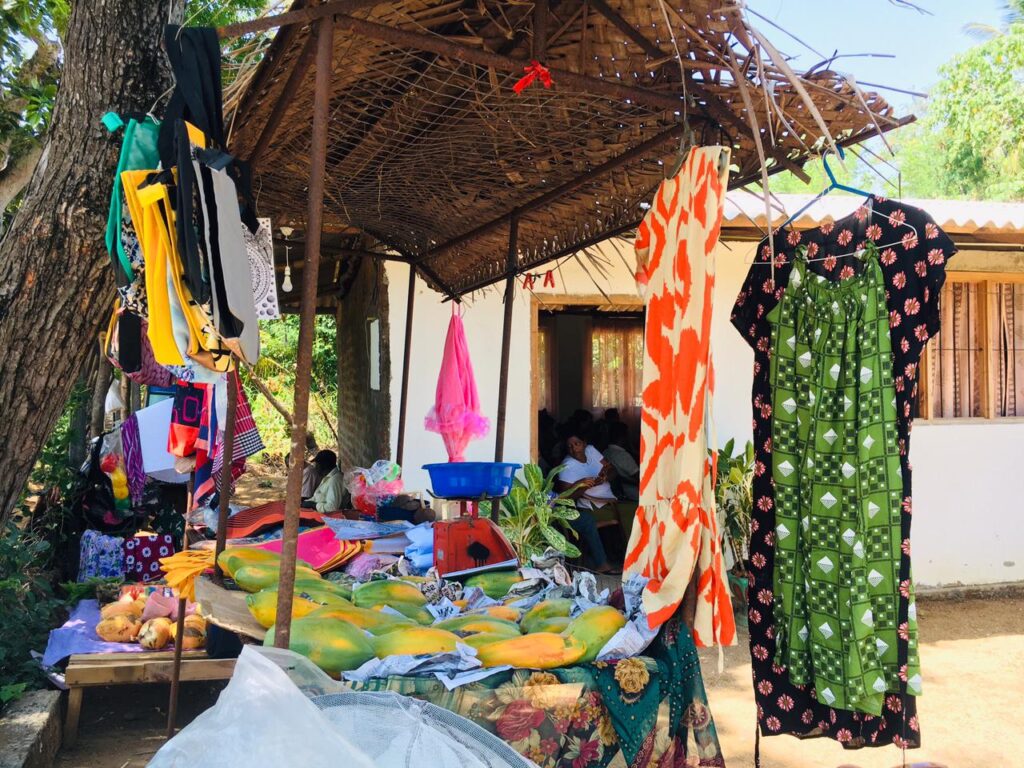
There was a tent at the entrance with papayas, coconuts, cakes, colorful clothes, and cloths to sell. Podimenike, the president of the group, told us that the women of the collective are mostly farmers and have to constantly find new ways to generate income due to the vicious cycle of debt they are stuck in and the imbalances brought by climate change. One of the ways they found is by preparing food to sell for events, such as the snacks in the Nyléléni Global Forum. The deliciously sweet halapa, for example, was prepared by them with a local millet and served wrapped in a kanda (parasol/macaranga) leaf.
Another way they found to generate income is by selling products in a market every Saturday morning that takes place in the village. Peasant women controlled the village market, which they call ‘Pola’, a strategy to overcome the lack of sovereignty over how they produce and distribute and also the inability to determine prices for their crops. At the same time, they fight to transition to agroecology, but this is difficult because their land is contaminated by chemicals, and they rely on financing by loans to microfinance companies from the moment of sowing the seeds.
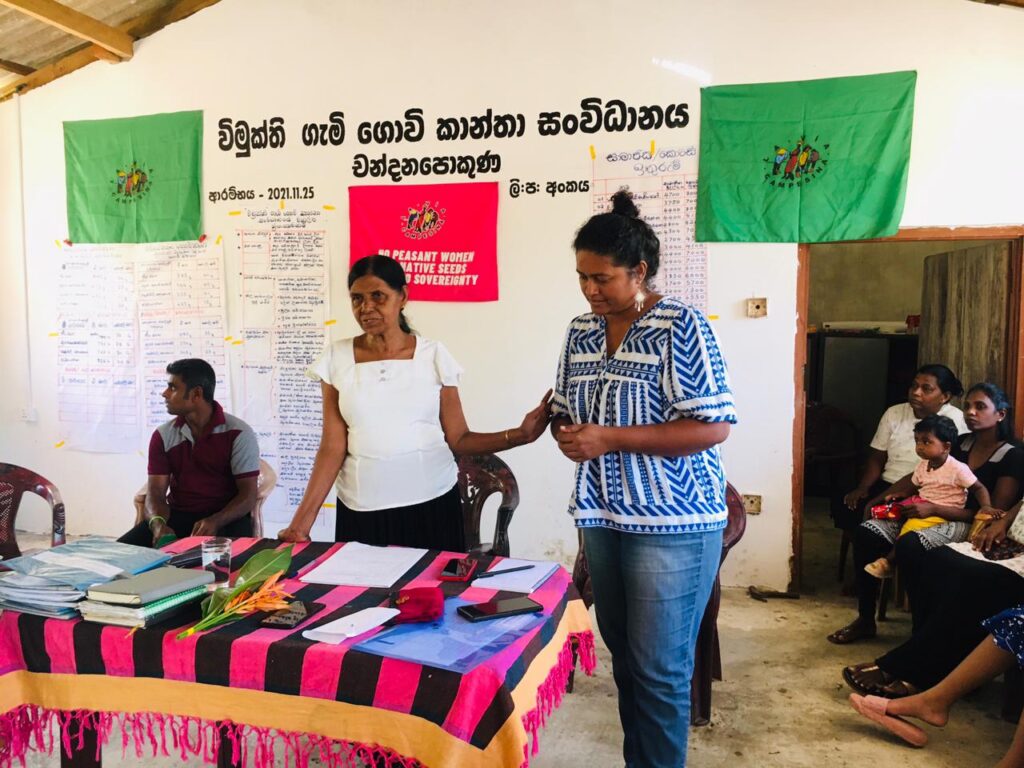
When we entered the building where their meetings are held and meals are shared, charts in Sinhala script covering the walls caught our eyes. They were detailing each member’s contribution to the solidarity economy model the group organized to overcome scarcity. Through this system of exchange, the members of the collective are able to decommodify food by exchanging whatever they can donate at the end of the month, which is then gathered and given to one person per month in rotation. Apart from the paddy fields, the women cultivate banana, mango, papaya, maize, chilies, lentils, flowers, and so much more in their home gardens, which is fundamental for the community’s subsistence.
The Vimukthi Peasant Women’s Collective was formed in the aftermath of the Satyāgraha protests that happened in 2021, a peaceful form of sit-in protest that occurred with the participation of peasant women victimized by predatory microfinance in Hingurakgoda. Satyagraha was the culmination of protests against illegitimate loans imposed by microcredit companies in Sri Lanka.
Despite all the organizing and protesting, not much has changed in the past six years since the protests occurred. Before being elected, the last four governments promised to cancel the debt, but this was never put into practice. Since most members of the collective are farmers who have used agrochemicals for more than 20 years, the whole ecosystem is contaminated, and it’s now difficult to rely on natural compost. That’s why they still buy the seeds, fertilizers, and agrochemicals from private companies.
The 2021 Satyāgraha took place around 10 km from where we are meeting. For 55 days and nights, the women and their allies sat, marched, educated visitors, and built solidarity for their cause. Their protest had to come to an end with the onset of the COVID-19 pandemic. As Podimenike told us:
A lot of people supported us in Polonnaruwa. Also from other parts of Sri Lanka, many groups came in solidarity, sat with us, or gave us food to sustain a 24-hour protest for 55 days. But we couldn’t get any of our five demands, which were: Debt cancellation, followed by a debt audit (so the overaccumulation through interest rates is also canceled); alternative credit mechanisms, creating cooperatives or strengthening the community-led mechanisms; more regulations; our names off the lists of ‘bad borrowers’ within the Central Bank; and stopping the litigation against the villagers by the companies.
Not only these demands were not met, but new legislation in the country has been applied, which will increase the burden on women and weaken community-based lending networks.
Microfinance: Between the Narrative and the Reality
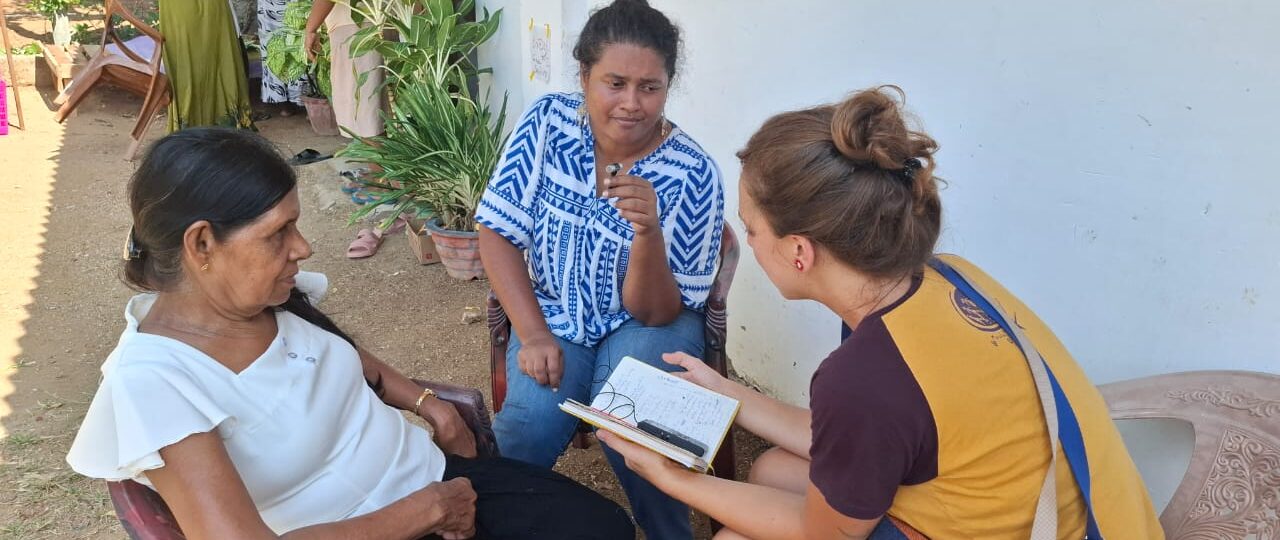
The microfinance market in Sri Lanka expanded drastically following two major crises: the tsunami in 2004 and the end of the Civil War in 2009 (which lasted 36 years!). People began borrowing from multiple microfinance lenders, which multiplied as people’s debt began to be a profitable business project in Sri Lanka while the larger economy was struggling to recover. The women of Vimukthi Collective were also affected by widespread poverty and the multiplication of loans. We were sitting in a small circle in plastic chairs outside the building. We asked Podimenike how these companies arrive in the village to convince the women to borrow these loans:
Usually microfinance company officers come to the village and choose a poor woman in a leadership position who can influence other people to form groups to lend loans. They say that if you take a loan, you can empower yourself and improve your livelihood. A lot of us are farmers, and we take these loans to help with farming. But there are times when the cultivation of our paddy fields gets damaged by floods, droughts, or pest attacks, and we can’t have a proper income because we have to pay the debt. Then you have to borrow another loan to put food on the table, and then another, and it becomes a cycle of debt. Many women in our community have around five loans right now.
Today, the crises of debt and food are spreading, intertwined around the world. Both are shaped by neoliberal policies that prioritize profits over people’s well-being. We’re talking about a debt that is illegitimate and odious and impoverishes the population, feeding solely the profits of companies and lenders, while farmers don’t have enough to eat. The crisis of food is caused by a trade system dominated by monoculture and large agribusiness, whereas food producers who have fed communities for generations are losing their rights and territories. Today, 3.3 billion people live in countries that spend more on debt payments than on health and education.
Sri Lanka is one of those countries. In 2022, a people’s uprising known as Aragalaya (the Sinhala word for ‘struggle’) removed the authoritarian neoliberal government that led the country into a severe debt crisis of US$57 billion external debt — of which more than half is owed to multilateral financial institutions such as the World Bank, Asian Development Bank, or the International Monetary Fund. Like this, a quarter of the government’s revenue is spent repaying the debt, which imposes conditions of privatization of public services and commodification of land and natural resources. Debt cancellation is necessary to prioritize the people and communities, focusing on agroecology, care, and food sovereignty.
The Vimukti Peasant Women’s Collective has 37 active members, and everyone is in debt to various microfinance companies. In Sri Lanka, around 80% of the people who take microcredit loans are women, especially mothers, who borrow money for basic daily consumption, such as children’s education and medical costs, not to start or run a business as it was meant to be.
A significant proportion of microfinance borrowers are also elderly women. Another important number is that around 90% of the loans are paid back, which shows the women’s commitment to finding ways to repay, even if it involves accumulating more loans or even eating less food and going through a complex system of violence — domestic, financial, and community.
Their resistance has been going on for years. The 2021 Satyāgraha resisted the inaction of the government towards the microfinance debt crisis. The sit-in protest happened in Hingurakgoda, Polonnaruwa, to demand all loans and legal action against debt victims to be canceled and the creation of another type of credit mechanism that is centered around the well-being of the community. Podimenike continues:
These loans are from multiple companies, which come to the village to sell them. When we have difficulties to repay, there’s a lot of pressure on household expenses, and problems between husband and wife happen when they can’t provide food for their children. When these things escalated, we decided to stage the sit-in protest, the Satyāgraha, to pressure the government. But it didn’t bring any answer to our problems. Also, some women from the village have migrated to work in the Middle East or Central Europe to get money, leaving their children here with the family.
Since most of the loan takers are women, the increase of debts leads even to domestic violence perpetrated by husbands, as well as to sexual abuse and violence by loan officers in cases of non-payment. Podimenike explains:
Many men claim they don’t know that their wives are in debt and take these loans. The microfinance companies asked the women to get their husbands’ signatures, but some women don’t want to tell their husbands they’re borrowing. They take other men’s signatures. The debt collectors are really harsh. When they come in the morning, sometimes they’ll sit in the house until you pay the installments. They wait from 8am to 5pm until they pay back the loan and are really scolding us with filthy words. So many women under pressure escape the house, close the doors and windows, and leave their homes. Sometimes they hide in the forests during the daytime to avoid loan officers.
Planting Seeds of Transformation
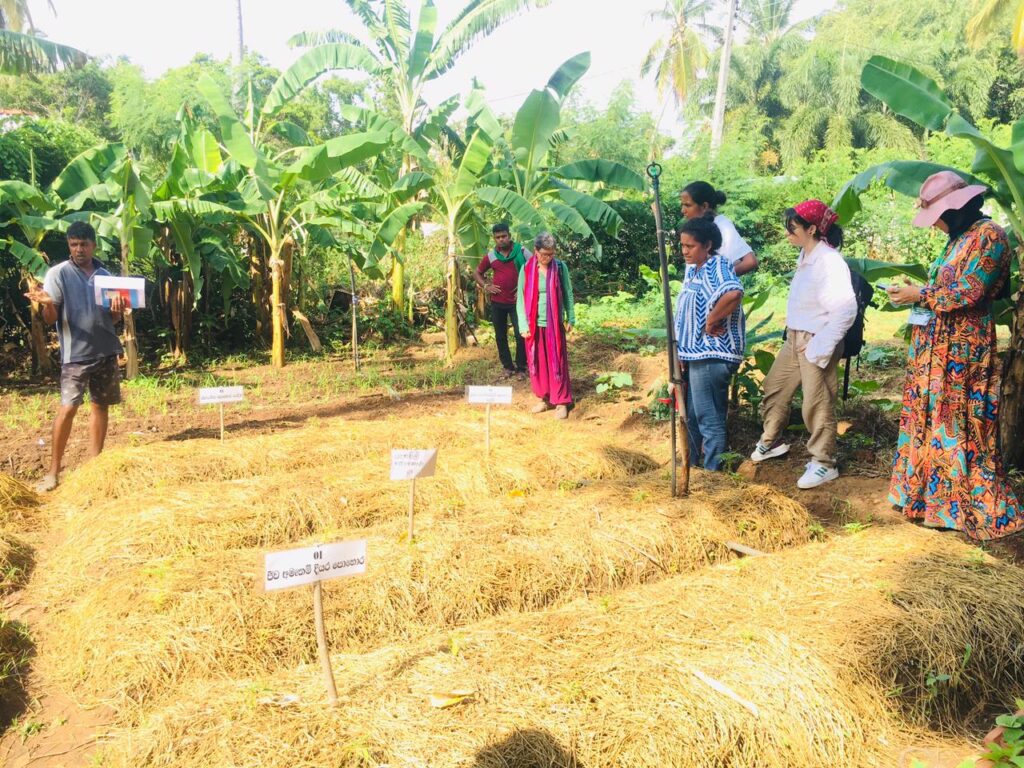
Podimenike told us that “after meeting with the Movement for Land and Agricultural Reform (MONLAR), we got more familiar with the alternative economies, agroecology, and how to practice it.” This leads to more autonomy, the possibility of imagining better futures, and transforming their relation to their territory.
To resist the contamination of the water and land as well as to overcome the debt crisis, members of the collective are doing what they can to transition to agroecological practices and transform their lives. Beyond the circular solidarity economy model, they’re planning to build a collective farming space where they can cultivate plants, herbs, and fruit trees together. They are also carrying out compost tests in small pieces of land to calculate the crop production using different ones: worms, two other natural composts, and another with chemicals. Up to now, the worm compost is giving not only more output but especially tastier and heavier food!
The women of Vimukthi Collective want their land back, the debt canceled, the litigation to stop, and to be able to practice agroecology and decontaminate their land. The way forward is a bumpy road, with complications accumulated like debts. Despite the indebtedness and poverty, small farmers and fishers contribute to 80% of the total agricultural production in Sri Lanka. This shows their strength and how, with legislation canceling their debts, more quantity and quality food will be produced. After all, it should be in everyone’s interest that those who produce the food we eat can live better lives.
This article is based on accounts gathered during a field visit that was part of the program of the 3rd Nyéléni Global Forum in September 2025. The conversations between Clarice Rangel, from the World March of Women, and the interviewees took place in Sinhala, with consecutive interpretation provided by Amali Wedagedara, who led the group alongside Amalini De Sayrah, the article’s co-author.