The Kandy Declaration, adopted at the 3rd Nyéléni Global Forum in Sri Lanka in September 2025, commits the movements to counteract the privatization and commercialization of health systems and to defend social protection, including ancestral medicines. From that mandate comes Health Over Profit Everywhere (HOPE), the campaign of campaigns that the People’s Health Movement (PHM) proposes to build with the Nyéléni network.
Asha Kilaru has been part of PHM since 2004 and is one of the voices of the campaign. She works in Karnataka, in southern India, with Jan Swasthya Abhiyan, the PHM in India, and with a state-level platform for universal health care. In this interview with Capire, she describes how governments hand health over to corporations, what that costs women, and the resistance being built from the local to the international level.
PHM officially began at the First People’s Health Assembly held in Savar (near Dhaka), Bangladesh, where 1,453 delegates from 92 countries gathered. PHM is a global network with a global steering committee, and the overwhelming majority of people in the movement are involved in their country’s teams and circles. The movement’s commitment is to health for all — which includes comprehensive primary health care — and to address the economic and social determinants of health. Without specific attention to those determinants, we cannot progress to health for all.
What is the HOPE campaign, and how did it come out of Kandy?
The Health Over Profits Everywhere (HOPE) campaign as an idea was discussed and ratified at the Nyéléni Global Forum in Kandy in 2025. A number of proposals were put forward there, and we discussed this one in our organizations and in our regions. We were very happy when there was consensus that it should be one of the campaigns to emerge from the forum. It calls upon all the participating organizations and movements in the Nyeleni Global Forum to integrate this campaign in our resistance against market-led policies that are depriving people around the world of access to livelihoods, community self-determination, and a shrinking natural environment as natural resources are increasingly controlled by corporate entities that are large and transnational. As wonderful as those nine days of the NGF were, if we don’t turn them into an energetic collaboration and action, they will just be a memory.
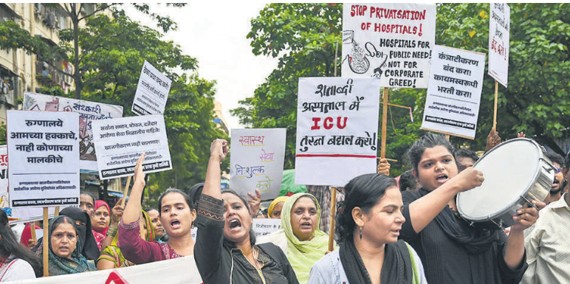
Countering privatization, which means countering financialization and corporatization, especially transnational corporatization, has long been part of PHM’s agenda, and many groups are already working on it. We didn’t have the specific name of HOPE for it, but the struggle already existed.
What we did more recently was to think through how the anti-privatization struggle in, for example, Karnataka might look different from how it happens in Brazil, while the fundamentals are the same. HOPE is not merely a slogan to be repeated. It has to be rooted in what is happening to the health system where you are and in how these economic and political forces operate: capital investment, takeovers, private equity, and the reduction of government spending on health.
How did that retreat of the state happen in India?
Much earlier in my working life I worked on several government committees. We would give critical feedback, which was a common problem across social welfare: there isn’t enough funding, and services lack quality and coverage. In those years government officials were always defensive: “Yes, yes, but we now have this new policy, this new scheme, and we will improve things.”
Somewhere along the way they stopped saying that. They said, “No, we can’t do it, and we’re not really even going to try. We’re going to let the private sector do this.” The government no longer feels it is a fundamental obligation and responsibility to provide affordable (let alone free) health care for people.
In many places it starts as a public-private partnership (PPP), where the government is still somewhat involved and it appears to be setting the terms and conditions. The research on PPPs is very strong: they don’t work. It is hard to keep the bigger principles intact, because profit will always take priority. Years ago we analyzed PPP contracts in this state, and they all have several loopholes. They are designed that way; otherwise, the private sector probably wouldn’t get involved. But the dismantling we are seeing now is almost making PPPs look benign, which of course they are not.
The World Health Organization recommends a base level of 5% of GDP for public health care. Countries like India are nowhere near it: we hover between 1.4% and 1.9%, and that needle isn’t moving, not at the central government and not in the states. The universal health care that health movements demanded, from the Alma-Ata Declaration and even before, has lost so much ground, so much negotiating space. In a country like India, there is also a lot of corruption: politicians and officials get payoffs and sell or lease highly subsidized land to the private sector, keep enforcement deliberately weak, don’t regulate pricing of procedures, treatments, and medicines, and use poorly functioning insurance companies that are experts at structuring coverage to earn high profits. India has also neglected developing preventive care and adequate primary care.
The weight of privatization falls hardest on workers, peasants, and Indigenous Peoples, and especially on women. How is it affecting women and the work of care?
It is affecting women and socially/economically marginalized people most severely. Privatization and the rise of large corporate health care have increased the cost of care dramatically. Affording health care was always a problem, but it is worse now that we mostly have private options, because public facilities are not expanding. The ones that exist are under so much pressure with high patient volumes and waiting times that more and more people are forced to seek private care.
Pregnancy and birth are among the few times women seek care. Otherwise, unless they are really sick, they won’t. There is very little preventive care of any kind, and there is zero health education in the system. Nobody seems to recognize this right to health education. They want people to stay uninformed and struggle for their day-to-day existence.
What we see now is women facing a very complex burden. Health care is very expensive, so they have to think twice, three times about getting it. Noncommunicable diseases have really risen among the poor. Twenty-five years ago I rarely saw a woman with a metabolic disorder in pregnancy among lower-income populations. I don’t think I saw a single case of gestational diabetes, and now it is common and fast rising. The government schemes that combine central government and state health coverage in the country are hard to access: there is paperwork, you probably have to bribe people, and there are barriers at every step, including disrespect and discrimination.
We are seeing real health consequences. Neonatal mortality has come down, but not to the level we would expect. We have high rates of low birth weight, which in many cases permanently affects a person’s health throughout their entire life. We have very high rates of malnutrition, mostly evident in stunting and anemia. Nutrition is very poor: we are flooded with industrialized and highly processed food, and it is not just the well-to-do eating processed burgers — a lot of local food is highly processed now and costs less than healthier, whole foods. Anything that affects women will affect babies, children, and the entire family.
The campaign says that as the movement resists privatization, it is also reclaiming public services and building alternatives. What is the role of public production of medicines, community health, and traditional knowledge?
It is very central to what we talk about and bring attention to. That is why Nyéléni was such a great fit with PHM. What is food sovereignty? For food sovereignty, communities need access to and power over the very resources that give us life: food, land, air, and water. That includes all the knowledge, historical and current, embedded in those systems.
There are a lot of allopathic medical people in PHM, and also a lot of people who aren’t. It welcomes people from other systems of medicine and people who are not from medicine at all. We respect indigenous and local knowledge systems. We promote an understanding of health care that is based on social justice and rights. This right, when centered in policy and protected by law and enforced by the economic structures we create, will encourage processes by which traditional knowledge in health, lifestyle, growing and preparation of food, and even understandings of traditional medicines and treatments could find legitimate expression and a more equitable relationship with allopathic medicine for a more whole-person approach to health.
In our framework, health is social, it is historical, it is our connection to community, it is the level of agency we have over our livelihoods and over the spaces where we live.
We are certainly not pushing for over-medicalization: that is what the private sector is pushing, let’s not forget. Coming back to women, C-section rates in private hospitals in India are 70% to 80%, and in government hospitals, they are as high as 40% to 50%. That is a perfect indicator of over-medicalization and of a loss of autonomy, a loss of connection, and a loss of the family as a very important part of caring. Women in India aren’t even allowed to have home births anymore: the state has said it won’t issue a birth certificate if a woman gives birth at home. This system has no place for people to understand their own health, their own bodies, and their own minds. It doesn’t want us to do that.
How can Nyéléni be a space for strengthening this struggle?
The same forces that are causing people to lose their land are at work in health: land grabbing, forest grabbing, and fishing communities losing their rights. It is the same massive corporate power. We have never seen this level of accumulation of private capital and private equity. It is unprecedented, and it has to be challenged. And it is being challenged.
What I see in this campaign is people expanding the narrative of their resistance to include health. About 50 kilometers from where I live, there is a farmers’ struggle in a very agriculturally rich area, where the government has decided it wants to build an artificial intelligence park with big private companies involved. Once people start looking a little left and right, they say, “It is not only land that we have been losing. Our government hospital has been shrinking, its budget doesn’t increase, and we don’t have any improved coverage. Everything is being eroded.”
As much as we hope that in the HOPE campaign other networks and movements will talk about health and the damage privatization is doing, PHM groups are going to reciprocate: we are going to talk about how privatization is affecting all kinds of resources, not just health care, because ultimately, it’s all health. It’s all one health.