
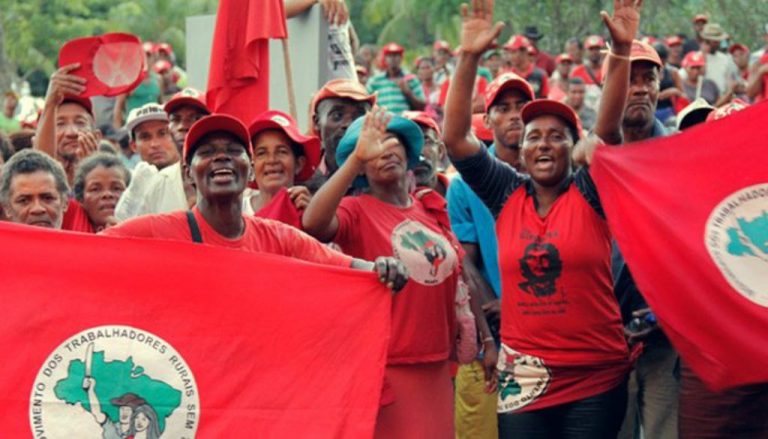
We Black women know how capitalism and imperialism adapt to reproduce their systems of domination. As important as each act of resilience and resistance in our territories may be, we need to build networks of support, solidarity, and ongoing dialogue to create the world we want, dream of, and need.
We need to forge bonds that transcend the borders drawn by capitalism. And it is this same capital that deprives us of the conditions we need to fully develop as human beings, because it concentrates wealth, promotes inequality and war, and destroys our bodies and subjectivities. It destroys our sense of being sisters and brothers.
Defending grassroots, anti-racist feminism is to defend this unconditional bond that we build among ourselves and with the working class as a whole. We have always been there. We women are at the bottom of the social pyramid. We Black women are the ones who rebuild the social fabric in the face of disasters and epidemics. We are the ones who sustain life when our oppressors—the agents of capital—offer no alternative to pull us out of the very crises they seek to plunge us into.
We are the ones who know how to create social technologies that allow us to sustain ourselves and continue defending life and the right to live. And that is why, if we are the ones who build everything and sustain social life and the working class, we will no longer tolerate any form of violence against us, against women, anywhere in the world.
Confronting Violence and the Far Right
In Brazil, we need to denounce the scale and severity of violence against women. Femicide has risen alarmingly: in the first three months of 2026, cases increased by more than 7%. A woman dies every five hours in this country.
The state of São Paulo, the richest in the country, is also the state where the most women are killed. It is governed by the far right, which recently welcomed Milei in an effort to strengthen the far-right network in Latin America. This poses a threat to Black women because we know how the far right sees us: as people who know nothing about politics and should have no part in it, who should return home, retreat into private life, and serve their husbands and men, including in churches.
That is why we cannot lose sight of what far-right governments are working to achieve. They see Latin America as a space for reorganizing power around financial capitalism, neoliberalism, and extremely conservative governments whose policies are devastating for women.
I also want to denounce the serious risks our girls are facing: cases of violence in schools have increased. This is happening in the very same state that prevents discussions about gender relations and different worldviews in schools. There is a project of death underway. They want to take away our freedom in order to subjugate our bodies and our peoples. A culture of violence is being cultivated and reinforced throughout Latin America and the Caribbean.
Feminism is a target for them because it is how we organize ourselves, understand ourselves as political subjects, and put forward a different, transformative project for society. It is a project that includes historical reparation and affirms that we need to live well, with quality of life and safety. We need to be able to move freely and safely, without fear in public spaces and without experiencing violence in either the public or domestic spheres.
Agrarian Reform, Reparation, and Struggle
The Landless Rural Workers’ Movement (MST) has a Popular Agrarian Reform program. We are telling Brazilian society that we need to radicalize democracy in our country. Without democratizing access to land, without guaranteeing the right to produce healthy food and to have housing, work, education, and abundant life, we will not democratize Brazilian society.
We will not build this agrarian program alone. We are in constant dialogue with grassroots movements in Brazil and around the world. We want to build this program for Popular Agrarian Reform together with peoples of the countryside and the cities. We were not the ones who separated the countryside from the city. Capitalism did that because it seeks to divide and fragment us.
We stand with the Black movement, with grassroots movements of the countryside, forests, and waters, with Quilombola peoples and Indigenous peoples. These are the peoples who have been resisting for 500 years.
Agrarian reform is historical reparation. It is not only about economic restitution, although that is also important. We want the right to access land to be guaranteed. We want to build territories free from patriarchy, oppression, LGBTphobia, sexism, and misogyny. We want to build healthy relationships: with nature, through agroecology, and among ourselves through the reorganization of labor, which must be collective and operate according to a different framework, one that is not based on exploitation.
That is why we defend Popular Agrarian Reform as historical reparation in our country and as a fundamental condition for deepening democracy in our society. We are struggling against imperialism and capitalism, and for abundant life for us women.

Simone Magalhães is an activist with the Terra, Raça e Classe [Land, Race, and Class] Collective of the Landless Rural Workers’ Movement (MST). This text is an edited version of her remarks at the webinar “Grassroots and Anti-Racist Feminism for Reparation and Buen Vivir [good living],” organized by the World March of Women on July 25, 2026.