Around 700 people from social and grassroots movements around the world gathered in Kandy, Sri Lanka, for the 3rd Nyéléni Global Forum, held in September 2025. The outcome of this convergence, built on years of accumulated political processes, is the Common Political Action Agenda (CPAA). United by the struggle for systemic transformation, these movements and organizations spent months working on a document that could give expression to this convergence, identifying shared horizons and organizing the struggle for the long term.
In 2018, during an assembly of the International Planning Committee for Food Sovereignty (IPC) in Cape Town, South Africa, movements that had been organizing around food sovereignty and agroecology since the 1990s began reflecting on shifts in the global political landscape.
As multiple crises deepened, the movements developed an analysis connecting the many factors making life increasingly precarious for working-class and grassroots communities. Food sovereignty is only possible through a broad transformation of systems of oppression. Organizing a third Nyéléni gathering around a common agenda therefore required bringing together local and international movements and organizations, peoples of the forests, waters, countryside, and cities, as well as an immense diversity of political subjects.
Paula Gioia, from La Via Campesina’s European coordination, explains that the result is a powerful agenda precisely because of its breadth and complexity. “We invited these movements to take part in the process because we wanted to build a convergence that was here to stay,” she explains. The result, Paula says, is an agenda that has been “enriched by the perspectives of the other movements and sectors that joined it.”
Alliances and common struggles
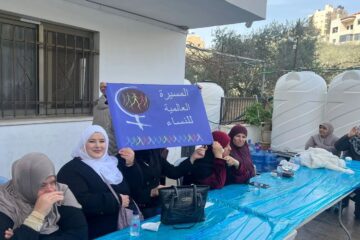
The historic alliance between the World March of Women (WMW), La Via Campesina (LVC), and Friends of the Earth International (FOEI), reflected throughout this process, was described as a web by Sophie Dowlar of the WMW in Kenya. Considering women’s contributions to building food sovereignty and agroecology over decades, she argues that their struggles offer simultaneous responses to both the climate crisis and the food crisis. As Sophie puts it, “food sovereignty is the number one feminist alternative, and the connection among us is essential to continue building movement and strategy.”
One of the developments that broadened the struggle for food sovereignty was a wider perspective on the economic models that exist within the capitalist, racist, and heteropatriarchal system, and on how movements bring forward feminist economy and solidarity economy approaches as alternatives. This alternative is rooted in the idea of a people’s economy that places people and life at the center, rejecting a model that puts profit above everything else.
Sophie spoke at the launch of the CPAA, held in June 2026. For her, “corporate power has captured many aspects of our economies, putting profit before people and the planet. That is why it is so important for our vision to be rooted in social and solidarity economy and feminist economy approaches, which place life, care, communities, and people’s well-being at the center of socioeconomic activity.” This alliance is reflected in the CPAA itself, which describes how the movements coming together through this process embrace “the values of cooperation, reciprocity, and self-management, remembering that reproduction and care are the very foundations of economic life.”
Looking at the forms of oppression experienced by peoples around the world, Paula explains that homophobia and transphobia are produced by the same system of oppression that sustains misogyny, racism, and caste discrimination. She recalls that recognizing this required broadening the horizons of feminism within the struggle for food sovereignty. “Until then, the food sovereignty movement itself had been very silent when it came to this more holistic understanding of gender and sexuality,” Paula acknowledges. The response was to turn the very process of building the agenda into a form of political education at the grassroots level.
In the CPAA, LGBT+ issues appear in relation to everything from the historically denied right to access land to the importance of recognizing their specific needs in situations where survival itself is at stake. Paula asks what happens to LGBT+ people during conflicts, climate crises, and displacement when humanitarian systems deal only with the bare minimum: “These issues may not seem like the most relevant ones to a system, but they are relevant to the people experiencing them. Collective liberation also depends on the liberation of each and every one of us.”
Language justice as a starting point
Developing this shared platform for struggle required creating and strengthening spaces for language justice. The entire 3rd Nyéléni Global Forum provided translation and interpretation in at least 18 languages. The efforts involved in political coordination and in collectively drafting the CPAA were themselves part of the political commitment to convergence, despite the challenges involved. A team of more than 70 interpreters from the Collective for the Self-Management of Interpretation Technologies (COATI) was present throughout the spaces and meetings that made up the Agenda-building process. These people are among the political subjects listed in the first section of the CPAA, which affirms that language justice goes beyond the technical provision of interpretation and translation services because it is what makes genuine, plural, and transformative participation possible.
“One of the most important issues we brought to the table was how the possibility of expressing yourself in your own language transforms participation,” COATI explains. “Language justice allows people who are often excluded because they do not speak the dominant languages, especially English, to organize politically, share their ideas, intervene in debates, and make their voices heard on equal terms.”
But language is not only about building bridges and creating possibilities for connection and exchange. It is also a terrain of political struggle for movements. Paula denounces the way gender binarism has gained ground in spaces that erase the specific realities of LGBT+ people: “Whenever we have any process related to gender at the United Nations, what some states immediately do is remove the word gender and replace it with the word woman.”
Sophie also points to the way neoliberal actors have historically co-opted important terms from feminist struggles. She warns: “People enter our spaces. They use the same language, they talk about agroecology, food sovereignty, feminism, sustainability, because for them it is only language. Ours goes beyond language.”
The road so far and the next steps
The CPAA was finalized after months of synthesis work grounded in a commitment to convergence. The document outlines several shared horizons: developing campaigns, building political education processes, organizing mobilizations, bringing the agenda into the development of public policies that are coherent with the movements’ work, and investing in popular communication. All of this is intended to unfold from the local to the global level, while taking into account the specific contexts of each region and movement.
These paths are already being followed. In November 2025, social and grassroots movements organized the People’s Summit in the context of COP30. The Summit was also a meeting space for movements involved in the Nyéléni process and hosted the launch of the Kandy Declaration. In February 2026, the 2nd International Conference on Agrarian Reform and Rural Development (ICARRD+20) took place in Cartagena, Colombia. Participation in the conference was one of the Nyéléni commitments set out in the CPAA. It became a space for convergence and for the defense of Integral and Popular Agrarian Reform.
These commitments continue to take shape through the 17th World Social Forum in Cotonou, Benin, held from August 6 to 9, 2026, where global and local movements are debating decolonization and peoples’ sovereignty, gender equality, and climate justice. They are also being carried forward through the World Pastoralist Assembly, held on August 15 and 16 in Ulaanbaatar, Mongolia. The gathering centered the agenda of pastoralist peoples during the International Year of Rangelands and Pastoralists, bringing together pastoralist leaders, women, and youth, as well as allies from the Nyéléni process.
Across these spaces, Sophie stresses the role of every movement and organization involved: “A people’s economy will not emerge on its own. It will require deliberate action, collective commitment, and sustained organizing. Together, we must ensure that the Common Political Action Agenda becomes a lived reality.” Along the same lines, Paula says: “The agenda becomes a real instrument for unity in action when the movements that took part in the process make it their own, incorporating what is in the CPAA into their own agendas as movements and also taking responsibility for its implementation.”