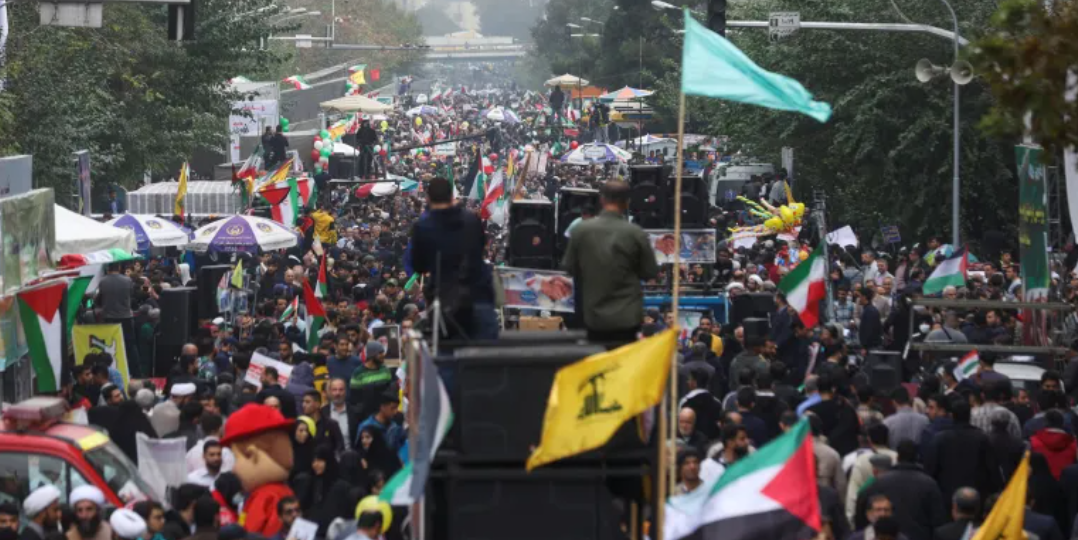
“None of us are free until Palestine is free”. “There is no peace without a free Palestine”. These are sentences many of us have heard countless times. We have seen them on banners, on social media, on the walls of universities, and on placards carried in demonstrations. Many of us have chanted them in crowds, sometimes with passion, sometimes almost automatically, as if they were simply part of the language of protest.
But slogans can easily become habits. Words repeated often enough can lose weight if we do not truly reflect on what they mean. For a long time, I heard these sentences the way many people do. I understood them intellectually. I sympathized with them. But I cannot honestly say that I fully grasped their meaning. Then something happened that changed how I understood those words.
A war reached my own country, Iran. Suddenly the images we used to see on distant screens began to appear around us. The sound of explosions was no longer something from the news. The fear and uncertainty that we once associated with other places became part of our daily reality. In those moments, the meaning of those slogans became clearer to me than ever before.
During the attacks, many places that should never be targets became targets. Schools were struck, including one in Minab. Hospitals were hit, such as, the Gandhi Hospital in Tehran. Media offices were attacked in cities like Sanandaj and Bandar Abbas. Residential buildings, homes where ordinary families lived their daily lives, were damaged or destroyed.
These were not military sites. They were places where people learned, healed, worked, and lived.
There is also environmental consequences. One of the most frightening moments came when the Shahran oil depot was bombed. The fire was so intense that the night sky glowed as bright as day. Flames and smoke filled the air. When the fire finally died down, the next morning felt strangely dark under the heavy smoke that covered the sky. The destruction was not only about buildings or infrastructure. It was about the air people breathe, the environment people depend on, and the future that communities hope to build.
A few days ago, I saw a photograph I cannot forget. It showed the small foot of a baby trapped under rubble — just a tiny foot, covered in dust, emerging from broken concrete. That image reminded me of many photographs I had seen before, from Gaza. For years, people around the world have seen similar images coming from Gaza: children under rubble, families searching through debris, neighborhoods reduced to ruins. Many people expressed sympathy, many shared the images online. But for some, it remained something distant — a tragedy happening somewhere else.
There were those who believed that Palestine was only a regional issue. Some thought it was simply a conflict between two sides, confined to one place. Others believed it a complicated political problem that did not concern them. But when you begin to see the same scenes closer to home, something changes in how you understand them.
You realize that the suffering of civilians in one place is not isolated from the rest of the world.
The destruction of homes, hospitals, and schools is not only a tragedy for one country. It is part of a larger pattern of how wars are fought and justified. What happens in one place can set a precedent for what happens elsewhere. History has shown this again and again.
We still remember the justifications used before the war in Iraq. Claims were made about weapons that were never found. Narratives were built to convince the world that war was necessary. The consequences of that war are still shaping the region today. When such actions occur without accountability, they send a message: that similar actions may be taken again.
Some months ago, there was also a strike against Qatar, justified by claims about the presence of certain groups. Whether one agrees with those claims or not, the question remains: who can guarantee that similar justifications will not be used in other places? Once the boundaries of acceptable action are expanded, they rarely return to where they were before.
This is why the idea that “none of us are free until Palestine is free” carries a deeper meaning than many people first realize. It is not only a statement about one land or one people. It is also a warning about a system of power in which certain lives are treated as expendable and certain places are considered acceptable sites of destruction.
If the bombing of hospitals, schools, and residential neighborhoods becomes normalized anywhere, it creates a dangerous standard for everywhere. And if the suffering of civilians in one region is ignored or minimized, it becomes easier for similar suffering to occur elsewhere.
Today, many people in Iran are experiencing fears that people in Gaza and Lebanon have known for years: the fear of sudden explosions, the uncertainty of whether buildings will still be standing tomorrow, the anxiety families feel when their loved ones are outside the home. Parents worry about their children going to school. Workers wonder whether their workplaces will still exist. Families wonder whether hospitals will be able to treat the injured. These are not abstract geopolitical questions. They are human realities.
War does not only destroy buildings. It also destroys a sense of safety. It reshapes the everyday lives of ordinary people.
Another contradiction that many people notice is the language used by powerful governments. The United States, for example, often speaks forcefully about defending human rights and women’s rights. Yet in many of the wars and attacks unfolding in this region, the victims are overwhelmingly civilians — women, children, and elderly people who have no role in political decisions or military operations. Their suffering forces us to ask difficult questions about consistency, accountability, and the true meaning of values that governments claim to defend.
When we look at these patterns across different conflicts, it becomes clear that the issues are interconnected. The struggles of people in Palestine, Lebanon, Iran, Iraq, and many other places cannot be understood in isolation from one another. They exist within a global system of alliances, power dynamics, military strategies, and political narratives.
Understanding this interconnectedness is what gave new meaning to those slogans for me. “None of us are free until Palestine is free” is not only about solidarity. It is about recognizing that injustice tolerated in one place can eventually affect many others. It is about understanding that the safety and dignity of civilians should not depend on geography, nationality, or political alliances. And it is about remembering that behind every headline, every statistic, and every political debate, there are human lives — lives that want the same basic things that people everywhere want: safety, dignity, and a future for their children.
Perhaps the real challenge for all of us is not simply repeating powerful words, but thinking carefully about what they demand from us. They demand attention. They demand empathy. They demand that we recognize the humanity of people whose experiences may seem distant from our own.
When we truly understand that connection, those slogans stop being just words. They become a reminder that the world is more interconnected than we often admit — and that the suffering of any community should concern us all. If injustice becomes acceptable somewhere, it rarely stays contained there. And if peace is meant anything real, it cannot be selective. It must apply to everyone.

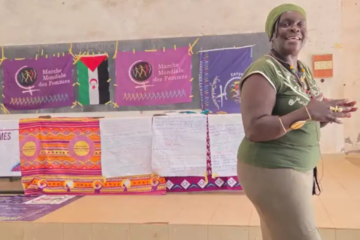
Elham Abedini is a researcher and writer based in Iran. This article is an edited version of her speech on the international webinar “Voices from the War on Land Day”, organized by the World March of Women in 2026 March 30, the Palestine’s Land Day.