Land concentration and patriarchy are products of the same historical system. Colonialism and capitalism organized the exploitation of land and bodies as tools of accumulation, and this logic persists in rural areas around the world. Today, women represent around 40% of the global agricultural workforce but hold only 15% of the land. They produce food, sustain communities, and support life while being systematically excluded from land ownership, political participation, and economic recognition. This is why the struggle for comprehensive popular agrarian reform is a feminist struggle.
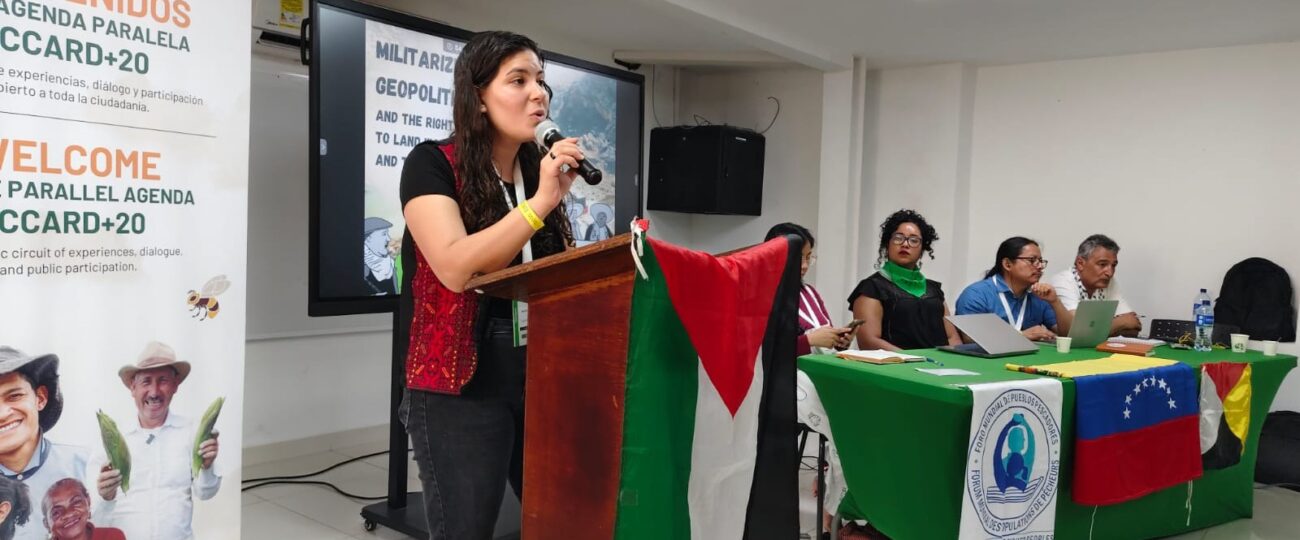
The 2nd International Conference on Agrarian Reform and Rural Development (ICARRD+20), held in Cartagena, Colombia, in February 2026, brought together peasant, fishing, Indigenous, and feminist movements from around the world to discuss land, food sovereignty, and collective rights. Twenty years after its first edition, the conference took place in a context amid the expansion of agribusiness, rural displacement, and violence in territories.
During the conference, Perla Álvarez, an activist with the Organization of Peasant and Indigenous Women (Conamuri), part of CLOC–La Via Campesina in Paraguay, and Raya Radwan, from the World March of Women (WMW) in Palestine, spoke with Pinar Yüksek, from the WMW International Secretariat. They spoke about the connections between the struggle for agrarian reform and agroecology and the struggle against patriarchy, women’s political participation and labor in rural areas, and the role of mechanisms such as the United Nations Declaration on the Rights of Peasants (UNDROP).
Land concentration and patriarchy have long been intertwined across rural history areas around the world. Why must the struggle for agrarian reform also be a feminist struggle? What changes when women take a central role in this process?
Perla: When we say we want a feminist agrarian reform, we are saying that we want women as protagonists — with power, with voice, with proposals and initiative. A feminist perspective is not only a matter for women; it is a proposal for a new society and new relations for all humanity. Some pit sexism against feminism, but they are not the same: sexism is the hegemony of male power over women and humanity, while feminism proposes egalitarian relations for all.
If we carry out agrarian reform from a feminist perspective, we guarantee relations of equality between women and men, across the full diversity of who we are as human beings, but we also ensure relations of complementarity with nature. The capitalist conception of land is to exploit it. A feminist agrarian reform seeks to recover a balanced and equitable relationship between human beings and nature. This would also mean restoring the health of the planet — and, in turn, our own physical and mental health.
Raya: Land concentration and patriarchy are products of the same historical system: colonialism, capitalism, and the control of land and bodies for profit. The same structures that dispossess peasants also dispossess women. For centuries, women have produced food, sustained rural life, and cared for communities while being denied land ownership, political power, and recognition. This exclusion is structural, not accidental. That is why an agrarian reform that is not feminist will inevitably reproduce inequality.
When women take center stage, agrarian reform shifts from redistribution of property to redistribution of power. Priorities move from profit and export agriculture toward life, food sovereignty, and collective well-being. Women’s leadership strengthens community organization and challenges violence, militarization, and exploitation in rural territories.
The Palestinian case clearly shows how land, colonialism, and patriarchy are interconnected. Palestinian rural women cultivate land under military occupation, face land confiscation, water control, and daily violence, yet continue to produce food and sustain their communities. They are not only farmers, they are defenders of territory and life. A feminist agrarian reform is not an addition to agrarian reform. It is what makes real transformation possible.
How can agrarian reform contribute to building more just relations between people, with nature, and among peoples themselves?
Perla: The feminist agrarian reform we propose is necessarily also socialist and transformative, one that moves beyond capitalist relations. Our horizon is socialist, feminist, and anti-patriarchal.
Equitable distribution of land already begins to create better living conditions. We would have healthy and happy children, teenagers growing without fear, and free women making decisions alongside their comrades. A feminist agrarian reform would also improve conditions in urban areas, in the face of rural displacement. With agrarian reform that allows people expelled from the countryside to return, or for urban populations to reconnect with land, urban conditions would also improve. That is why comprehensive agrarian reform is not only a rural project, it is a project for society as a whole.
This is not the same agrarian reform of the nineteenth or twentieth centuries. A new agrarian reform, with an agroecological model of production that recognizes seasonal consumption, means that we must unlearn, throughout the entire chain, ways of producing, distributing, and consuming.
It is not an easy task, because agribusiness has penetrated our minds. It has made us see land as a small plot to live on and produce from. It has fragmented our thinking. We must recover a territorial perspective — so the Indigenous and fishing peoples’ perspectives are essential. Peasant life is integral and follows the rhythms of territory and time: at one moment fishing, at another planting maize, harvesting cassava, gathering fruits and seeds. Nature guides this work, not the capitalist clock.
Raya: Feminist care economies and food sovereignty propose a radical alternative to the dominant development model based on extraction, monocultures, and corporate control of food systems. Agrarian reform helps rebuild relationships between people and nature by breaking the logic of land as a commodity. Land becomes territory, life, and collective responsibility. Through agroecology, community control of seeds and water, and local food systems, agrarian reform builds relationships based on cooperation rather than exploitation.
It also strengthens solidarity between peoples of the Global South who face similar patterns of land grabbing, environmental destruction, and rural displacement. In Palestine, food sovereignty is a form of resistance. When women continue farming, saving seeds, and sustaining local production under occupation, they are defending the right of a people to remain on their land. This is not only an agricultural project, it is a societal project centered on care, dignity, and collective survival.
Historically, access to land and land ownership have mainly been controlled by men. What are the main challenges to ensuring real equality in land rights while respecting collective and community forms of territorial organization?
Perla: Only when women come together can we recover the power that has been taken from us. Women have been denied the possibility of making decisions about what affects us. Others decide over our bodies, our lives, our territories, our families, and our production. Reclaiming the power to decide can only be guaranteed through organization.
What matters most is not necessarily a formal title, but ensuring land tenure: once you are on the land, it cannot be taken from you — not for financial reasons, not because of a separation or divorce, not because of conflicts. It is about the security to remain on the land to work, to live, and to care for it.
Raya: The main challenge is that inequality is structural. Even where laws recognize women’s rights, patriarchy continues to operate through institutions, markets, and social norms. Women still face barriers to credit, training, political participation, and protection from violence. Land rights cannot be separated from economic justice, social justice, and freedom from violence.
At the same time, feminist movements defend collective and community land systems against privatization and corporate land grabbing. Equality does not mean individualizing land. It means guaranteeing women’s full participation in collective decision-making and territorial governance. In colonial contexts like ours, these challenges are even deeper. Women resist both patriarchal barriers and colonial dispossession simultaneously. For Palestinian women, the struggle for land is a struggle for existence and for power, and feminist movements are transforming that struggle worldwide.
The United Nations Declaration on the Rights of Peasants (UNDROP) recognizes specific rights related to land, territory, participation, and non-discrimination. In addition, 2026 has been declared the International Year of Women Farmers by the Food and Agriculture Organization of the United Nations (FAO). How can these tools concretely strengthen rural women’s struggles and pressure States to promote more inclusive agrarian reforms?
Perla: The United Nations Declaration on the Rights of Peasants is a powerful tool, but it is also the result of collective thinking by the peasant movement. That is why, while it emerges from the demand for rights, it must return to communities through processes of political education. We need to work intensively on the collective appropriation of this tool. Once people take ownership of it, they can demand differentiated public policies from the State, specifically for women, as the declaration guarantees.
It is not only about land ownership rights. UNDROP includes a gender perspective: it recognizes the profound inequality between men and women in the distribution of care responsibilities, as well as in contributions to family, community, and national economies. Women’s work is not recognized in any of these. By recognizing this structural inequality, this tool contributes to building balance, equity, and justice for women.
The agrarian reform guaranteed by the declaration is comprehensive: it is not only about distributing or redistributing land, but about creating the conditions to remain in rural areas. Peasant production is agroecological, but agroecological transition requires financing. Soil health must be restored, which takes at least three years. This support must be sustained, dignified, and structured as public policy — not charity. What often happens is the design of welfare-dependent policies that create dependency rather than autonomy. UNDROP affirms, in several of its articles, women’s right to autonomy — to decide over their bodies, their production, and their environment.
When there are conflicts of interest, such as agribusiness, monocultures, and mining, projects affecting territories must go through consultation processes that include differentiated assessments of their impact on women. The impact on women is not the same as on men: it hits women’s bodies first, and then increases care work, through illnesses linked both to gendered conditions and to roles historically imposed by patriarchy.
Women’s participation must be present in the formulation, implementation, evaluation, and monitoring of policies. Agroecological technical assistance with a gender perspective is also needed, as well as training for government technicians. It must also be recognized that the participation of peasant and Indigenous women is not easy, given the overload of care work they carry — not only within families but also in communities. This requires creating spaces for participation within territories and at times that actually work for women. This can help ensure effective public policy within the framework of the declaration.
Peasant and popular feminism carry a deeply transformative vision. It recognizes that inequalities are not only about gender, but about an economic system that uses patriarchy to sustain inequality and accumulate capital. When we call ourselves feminists, we are saying: we want to break this system.

This interview was conducted in February 2026, in Spanish and English, during the 2ndInternational Conference on Agrarian Reform and Rural Development (ICARRD+20), in Cartagena, Colombia.