We are living through a historic turning point. The world as we know it is changing, and the tectonic plates of global geopolitics are shifting beneath our feet. To understand where we are and where we can go, we must first understand the forces shaping the international landscape — with the clarity needed to act. The United States, the hegemonic power of recent decades, is now taking a more realistic view of the challenges to the unipolarity it seeks to preserve.
Before 2025, the US strategy was one of maximum overreach. It intended to simultaneously weaken Russia through the conflict in Ukraine, intimidate China with tariff wars, preserve its hegemony in the Middle East through unconditional support for Israel, and protect its interests in Latin America through allied governments. An outsized ambition, premised on unlimited resources and a passive world in the face of its offensives.
The year 2025 demonstrated the unfeasibility of this undertaking. Russia was not weakened as expected. China faced the economic war with impressive resilience. Unconditional support for the massacre of the Palestinian people came at a cost that Washington strategists had not adequately calculated.
Faced with this reality, the posture adopted was one of tactical retreat. Not retreat out of conviction, but out of necessity. A more focused posture centered on the core needs of preserving hegemony. And that means reorganizing the map of priorities.
In Asia, the United States recognizes that, at this moment, it is not possible to counterbalance Chinese hegemony in its own region. Yes, economic agreements with Japan and South Korea continue. Yes, punitive tariffs against Vietnam and Malaysia continue. Yes, military bases in Diego Garcia and the Philippines are being strengthened, and the military presence in Australia is expanding. Yet the rapprochement between India and China, the consolidation of unity among China, North Korea, and Russia, as well as the economic strength of the ASEAN bloc, show that China will not be displaced from its central role in Asia at this moment. The empire was forced to accept this reality.
The African continent remains under dispute, but not as a fundamental priority. The United States is pursuing a strategy of political destabilization in the region — a strategy that conveniently enables unrestricted resource extraction. Where there is chaos, there is opportunity for plunder. At present, the only project on the African continent that directly opposes this strategy is the Alliance of Sahel States, which has important support from Russia and strategic relations with China and other powers. A beacon of resistance in the midst of the storm.
In Europe, Trumpism sees weak allies who, in Washington’s view, do not deserve all the imperial largesse to fund their defense. Trump’s White House also understands that China represents the main adversary, and that to confront China, its approach toward Russia will require seeking other means to achieve what it failed to accomplish through the conflict in Ukraine — means that do not necessarily require the full alignment of the North Atlantic Treaty Organization (NATO). This marks a significant shift in strategy: prioritizing the main enemy and seeking alternative paths to neutralize secondary adversaries.
In the Middle East, the United States preserved and gained spaces of influence, but in a deeply unstable way that did not guarantee the objectives sought by either the US or Israel. The integrity of the Israeli occupation of Palestine was preserved. Influence was gained in Syria and Lebanon. But, faced with the impossibility of overthrowing the Iranian government after the missile launches in 2025 and the attempt to provoke an insurrection at the beginning of 2026, they resorted to open warfare. The Iranian people and their government responded with resistance and unity to the assassination of Ayatollah Ali Khamenei, creating a scenario unfavorable to victory for the United States and Israel. Thus, the Middle East remains an open wound that does not heal, because the injustices have not been resolved, only temporarily repressed.
In this scenario of strategic readjustment, the empire’s three major needs are: to expand its sphere of influence wherever still possible; to contain the growth of the multipolar camp before it consolidates; and to accumulate strength for a military encirclement and economic isolation of China.
Latin America’s role in the geopolitical realignment
In this scenario of global reconfiguration, Latin America is once again emerging as a geopolitical priority for the United States. This is not simply Trump being erratic or unpredictable. Behind the aggressive rhetoric lies a strategic calculation that reflects the new consensus being built within the upper ranks of power.
It is true that the domination of a history that seeks to reproduce itself in the present, albeit in new forms. The Monroe Doctrine — that old maxim of “America for the Americans,” where “Americans” means only people from the United States — was never buried. It hibernates during periods of diminished imperial attention and resurfaces forcefully when the empire needs to consolidate its backyard.
It is also true that, in the ideological imagination of the United States, Latin America and the Caribbean are seen as a possession of the U.S. empire. A natural, unquestionable possession, part of the order of things. This colonial mentality never disappeared — it only modernized its vocabulary.
Yet what most favors the revival of the Monroe Doctrine on the continent is a practical fact: the United States already has instruments to exert influence, established political allies, and levers ready to be activated. It does not need to build from scratch. The ground has already been prepared over decades.
First, trade agreements were put in place, such as the one with Mexico, which make our economies dependent and vulnerable to pressure from Washington. Second, control was established through the International Monetary Fund (IMF), the World Bank, and external debt — instruments that discipline our governments and limit our economic sovereignty.
Third, there is the dominance of the international financial system based on the dollar, which allows the United States to impose sanctions and strangle entire economies. Venezuela and Cuba know the weight of these sanctions all too well.
Fourth, institutional spaces such as the Organization of American States (OAS) — that old tool of intervention — and the Lima Group, which have openly operated in the name of US strategy, are forums cloaked in multilateralism in order to legitimize unilateral policies.
Fifth, exercising control and direct control over the media and institutions that produce knowledge is fundamental in the battle of ideas. The empire does not dominate only through weapons and sanctions, but through narratives, through the ability to define what is true and what is false, what is democracy and what is dictatorship.
Sixth, the military bases and alliances spread across the continent are ready to be deployed when persuasion falls short. To operate these instruments, the United States has historically fostered a submissive right wing and a bourgeoisie that places its class interests above any national project. Both US parties — Democrats and Republicans — have fraternal ties with right-wing parties in the region. But the Republican Party in particular has directly cultivated the right wing in Argentina, Chile, Brazil, Mexico, Colombia, Cuba, and Venezuela. It is a continental network of ideological allies.
The middle-class diasporas of Cuba and Venezuela, in particular, have become instrumentalized allies of imperialism, based in the United States itself. From Miami to Houston, these communities provide domestic legitimacy for policies of aggression against their countries of origin.
Although they are not always direct allies of empire, social-democratic forces on the continent also often collaborate with imperialist strategy by isolating the left and proposing a moderate line that, in practice, does not challenge structures of domination. This is a delicate observation, but a necessary one.
Boric was, concretely, an ally of the United States. He actively campaigned against Maduro across the continent, taking on a controversial role, given that he was considered a progressive figure. That is exactly why his position was so harmful. The confusion sown by the hesitant positions of social democracy ends up serving as a foundation for imperialism.
When supposedly progressive figures legitimize the imperial narrative, the effect is devastating. Because if even the “progressives” agree that Venezuela is a dictatorship, then it must be true, right? That is the perverse logic that takes hold.
Imperialism does not function only through elaborate conspiracies, as though a stage were being set to serve its interests. We must not fall into simplistic theories that see Washington’s hand behind every event. Imperialism works in a more sophisticated way: it seeks opportunities in the same way the left seeks contradictions that open paths for our struggle. The empire seeks weaknesses and openings that allow intervention.
During the period of coups carried out through “lawfare” [the use of the legal system as a weapon] — as in Brazil, Argentina, and Ecuador — the United States took advantage of the capture of the judiciary by sectors of the elite, instrumentalizing it for its own interests. In the most recent period, the empire has taken advantage of weaknesses in the progressive and integrationist project we have been building in the region. We need to look at our own failures if we want to overcome them. One example is the lack of real commitment to regional integration — we talk a lot, but make little progress on concrete projects of infrastructure and productive complementarity.
Another example is the lack of economic projects capable of reindustrializing our countries. Through our developmentalist projects, we wanted to become emerging economies, but what we need is to become independent economies. Emerging within a system of dependence is not the same as achieving real autonomy.
And perhaps most importantly: progressive projects became channeled almost exclusively into institutional power, abandoning the building of popular organization in favor of creating electoral machines. We won elections, occupied palaces, but did not build deeply rooted popular power. As a result, the progressivism inaugurated in the first decade of the twenty-first century now lacks leading second-generation cadres.
We need to honestly face the electoral defeats suffered by the left in 2025 in Bolivia, Argentina, Honduras, and Chile, where a president who defends the Pinochet dictatorship has just taken office. The burnout of leaders who failed to renew themselves, the inability to respond to the population’s concrete demands, the lack of political education at the grassroots — all of this created the conditions for the right wing to advance. The empire took advantage of openings that we ourselves created.
If bringing down a project depends only on attacking its central figurehead, the task of imperialism becomes easier. This is what we saw with the defeat of the MAS in Bolivia, which fundamentally depended on the erosion of Evo.
And this is how we see that Venezuela and Cuba continue to resist: because they built organization beyond their individual leaders and parties. The Venezuelan Revolution was not overthrown, not even with the abduction of its president. Cuba has survived for more than six decades because it is rooted in the people, including through the worst crisis in its history caused by the recent oil embargo.
Multipolarity and the role of China
As we know well — even from Trump’s own statements — for the United States, economic relations between Latin America and China must be eliminated or, at the very least, severely weakened. Trade with China, Chinese investment in infrastructure, cooperation agreements — all of this is seen as an existential threat to US domination in its traditional sphere of influence.
Despite its limitations, BRICS is also viewed by the United States as a future threat that must be contained now, before it consolidates. The expansion of the bloc, discussions of alternatives to the dollar, and South-South cooperation mechanisms — all set off alarm bells in Washington.
This proves something important: multipolarity is emerging as a potentially counter-hegemonic force. The empire itself recognizes the threat and acts to neutralize it. When our enemy is worried about something, it is because that something has substance.
However, there is frustration within our ranks over the supposed lack of solidarity from the major counter-hegemonic forces during imperialist attacks. The left questioned — and criticized — why China and Russia do not intervene to defend Palestine, Iran, or Venezuela.
I do not believe this lack of intervention simply reveals the immaturity of the multipolar process. It reveals that this process still manifests as a possibility to be strengthened, not as a given and consolidated reality. Multipolarity is under construction, but under direct attack following the empire’s aggressions.
Most importantly, multipolarity is not a mechanism that will save our incomplete projects of transformation. No magical solution will fall from the sky to resolve our internal contradictions.
The political content of the emerging multipolarity depends on the success and advance of revolutions across all continents of the Global South. Multipolarity will be as progressive as the processes that make it up. If it becomes only a dispute among elites from different countries over spaces of accumulation, it will not serve us. If it is nourished by revolutions and projects of social transformation, it can become an instrument of liberation.
Put another way: the project of social transformation and Latin American revolution, as well as the project of regional integration, is not the task of China or BRICS. It is our task.
We cannot outsource our liberation. History shows that peoples who won their real independence did so through their own efforts, their own organization, and their own struggle. External allies help, open spaces, and may provide resources, but the fundamental struggle is always fought at home. At the same time, we cannot neglect the need for clarity about the opportunities that China and BRICS grant to nourish and strengthen our projects.
China offers financing alternatives that do not come with the conditionalities of the IMF. BRICS offers spaces for political coordination that are not controlled by Washington. South-South trade opens possibilities for diversification that reduce our vulnerability. These are tools that can be used strategically to strengthen our projects, as long as we have projects of our own to strengthen.
Urgency and hope
The scenario is not simple. The empire is readjusting to avoid collapse. Latin America is in its sights as a matter of strategic calculation. Multipolarity offers opportunities, not guarantees.
So what do we do in the face of this? First, we abandon any illusion. There will be no easy solution, no shortcut, no external savior. The liberation of our peoples will be the work of our peoples, or it will not be.
Second, we learn from our mistakes. Every opening we leave will be exploited by empire. Every cadre we fail to form, every community we fail to organize, every regional alliance we fail to consolidate represents a vulnerability.
Third, we build with what we have, where we are, now. Every grassroots organization strengthened, every process of political education, every bond of concrete solidarity among our peoples is a stone in the structure we want to build.
The moment is urgent because the empire does not wait. While we debate, Washington acts. While we hesitate, our adversaries advance. We do not have the luxury of infinite time.
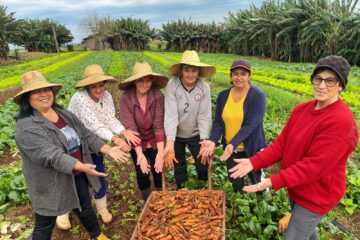
But this is also a moment of hope. Because the empire, despite its strength, is not invincible. Because Venezuela resists, because Cuba resists, and because the MST (Landless Workers’ Movement) continues occupying land and carrying out agrarian reform. Because Palestine continues to struggle, and because for now the gringos cannot take on China.
The road is long. The struggle is hard. But, as those who came before us said: the duty of every revolutionary is to make the revolution.
Stephanie Weatherbee is coordinator of the Secretariat of the International Peoples’ Assembly (IPA).