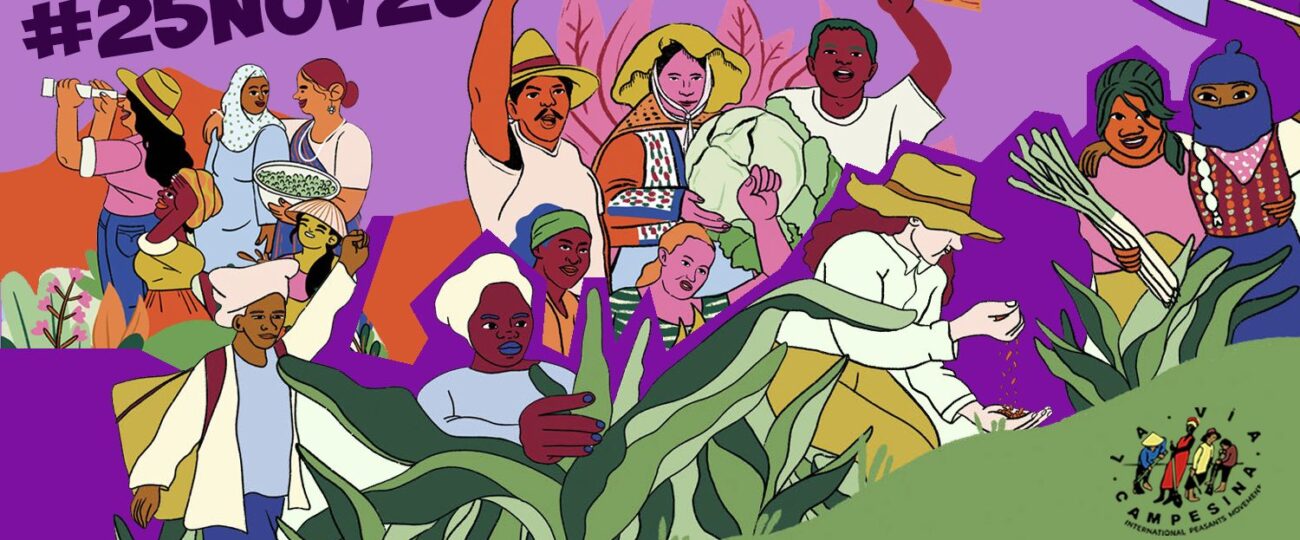
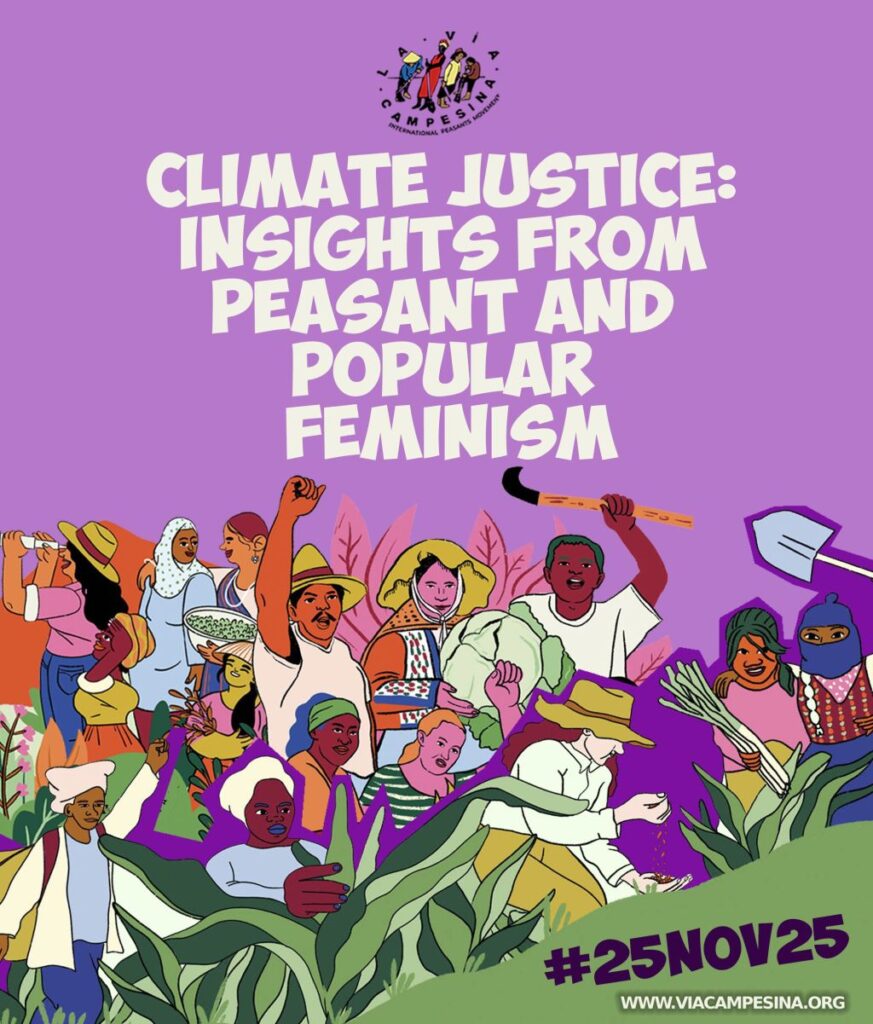
As part of the November 25th struggles, International Day for the Elimination of Violence against Women, La Vía Campesina (LVC) released the publication “Climate Justice: Insights from Peasant and Popular Feminism.” It includes five chapters and a glossary addressing the major challenges facing and pathways toward a just climate transition. La Vía Campesina affirms that “Peasant and Popular Feminism offers a transformative vision that highlights the role of peasant, Indigenous, fisherfolk, pastoralist, gatherer, seasonal, migrant and working women in food systems, caring for territories and nurturing life itself. Based on this collective reflection, we offer tangible proposals emerging from the territories to face different crises.”
The publication is freely available here in Portuguese, English, French, Spanish and Shona. Read below an excerpt from its third chapter, on the relationship between the struggle for climate justice, the impacts of the crisis on the territories, and feminist resistance in the countryside.
Relationship between Climate Justice and Peasant and Popular Feminism
For La Via Campesina, talking about social and climate justice implies a deep transformation of the economic, social and political system, as well as advancing reparations for ecological debt and historical injustices against the peasantry. To achieve this, it is essential to recognize that struggles in rural areas are not isolated; they respond to a single system of oppression: one that is capitalist, colonial, racist and patriarchal, and that exploits people, nature and women. There is no climate future without women. After a climate crisis, gender inequality and the invisible burden on women is an alarming reality.
Women from riverine communities, forests, cities and the countryside carry the weight of crises, but also have the strength of solutions. All of us continue to march and organize against oppressions for land, bread and climate justice.
Through the development of our framework for a peasant and popular feminism, we seek to ensure not just our involvement and action, but also environmental and social justice. Peasant, Indigenous, fisher, migrant, pastoralist, seasonal, waged, and Black women and diversities—we all have a fundamental role in driving transformations. From agroecology to energy transition, from the streets and villages, women face capital, corporations, and false solutions daily.
We not only resist but also build and sustain real alternatives to mitigate the effects of climate change in our communities and territories. We do this by defending Food Sovereignty, promoting Peasant Agroecology, and fighting for historic rights to education, reproductive health and housing, all for a dignified life.
These actions are the pillars of a feminist proposal with its own distinct identity (peasant and popular). It emerges from the reality of living in rural areas and from the experiences of women and diversities within popular classes, with the aim of promoting the well-being of our peasant communities who feed humanity and care for nature. This approach prioritizes care, life and the right of communities to make free decisions regarding their territories and how they live in the world (LVC, 2020).
The consequences of climate change prevail in most countries, mainly in the Global South, impacting those who produce everything and yet own little: workers, families and communities living in socially vulnerable areas within cities and in the countryside (LVC, 2023).
However, not all people are affected equally. Peasant communities and families, women, children, diversities in the countryside, and vulnerable groups suffer the harshest consequences. Despite being guardians of seeds, ancestral knowledge and sustainable practices, we continue to be excluded from decision-making spaces and public policy benefits.
The effects of the climate crisis on the lives of women put food security at risk, exacerbate poverty, displace communities and deepen structural inequalities. Therefore, integrating our voices, knowledge and leadership in climate struggle strategies is an urgent need to advance towards true climate justice.
While climate changes are part of a global crisis, their impacts are local, have names and surnames and a face that is predominantly female. While the world debates environmental policies, it is the women from the peripheries, rural fields, waters, forests and jungles, along with our communities, who face the worst effects of a collapsing planet.
Impact of the Climate Crisis on the Lives of Peasant Women and Diversities
Environmental Racism and Greater Vulnerability
■ The UN points out that women are 14 times more exposed to the risks of climate disasters such as heavy rains or typhoons and face greater obstacles in accessing humanitarian aid.
■ Disaster response and the benefits of recovery policies are disproportionately distributed in favor of wealthy, white communities over Black, Indigenous, peasant and working-class communities, among others.
Unpaid Workload
■ Women perform at least two and a half times more unpaid domestic and care work than men. During climate disasters, these burdens intensify even more.
Poverty and Food Insecurity
■ Climate change exacerbates poverty and food insecurity. When there is less food available or when prices rise due to droughts, floods, or other climate disasters, peasant families, especially women and girls, struggle to feed themselves, making them more vulnerable to hunger and malnutrition.
■ If urgent measures are not taken, the UN warns that by 2050, there will be 158 million more women and girls in poverty due to climate change, and another 236 million will face food insecurity.
Unequal Access to Resources
■ Women experience limited access to resources such as land, seeds, credit, education and technology. They are also often excluded from economic compensation when they lose land due to climate disasters. Damage to agricultural production (an activity many are involved in) is rarely compensated fairly.
Climate or Environmental Displaced / Refugees
■ When agricultural production is affected, many people and communities are forced to migrate to cities or abroad, where women and diversities are exposed to precarious, informal or domestic work.
■ In situations of vulnerability, displacement, climate refuge and forced migration, older people, women and children are more vulnerable to multiple types of violence and abuse.
The Role of Peasant Women and Diversities in the Climate Struggle
We, the women and diversities from peasant, fishing, pastoral, Indigenous, Quilombola and original peoples’ backgrounds—including the landless, migrants and agricultural workers—challenge and stand against the processes driving the climate crisis through the many forms of action and resistance we develop in our territories and communities. Some of these initiatives include the following:
- We promote our rights, lead, and demand active participation in decision-making.
- We are the first line of defense and care for nature, its goods and territories. We are the ones who directly protect natural resources and take care of our communities.
- We possess invaluable ancestral knowledge, skills and resilience to combat the effects of climate change.
- We lead initiatives in agroecology, Food Sovereignty, peasant rights, internationalist cooperation and solidarity, all crucial for tackling the climate crisis and fostering social justice.
Elements and Foundations of Climate Justice from the Perspective of Popular Peasant Feminism
DEFENSE OF TERRITORY AS A SPACE FOR LIFE
Rejection of land grabbing, the unjust concentration of resources, the extractivist model, the commodification of nature, and the exploitation of common goods.
LEADERSHIP OF PEASANT WOMEN AND DIVERSITIES
Recognition of rural women and diversities as key players in the fight against climate change, as they are guardians of seeds, ancestral knowledge and sustainable agroecological practices.
RECOGNITION OF STRUCTURAL INEQUALITIES AND INTERSECTIONALITY
Social class, ethnicity and gender directly influence how the effects of climate change are experienced, creating unequal impacts. Women, peasant diversities and other historically marginalized groups face the worst consequences.
STRUGGLE AGAINST THE CAPITALIST, COLONIAL, RACIST AND PATRIARCHAL SYSTEM
The fight against the environmental and climate crisis is a structural struggle, as it is a direct consequence of a capitalist, colonial and patriarchal system. In this context, rural women and diversities face multiple forms of violence.
FOOD SOVEREIGNTY, AGROECOLOGY AND PEASANT RIGHTS
Promotion of sustainable food systems based on Peasant Agroecology. Defense and full recognition of peasant rights. Rejection of the dominant agri-food model, as well as the false solutions promoted by the so-called “Green Economy,” which deepen inequality and perpetuate extractivism.
SOCIAL AND CLIMATE JUSTICE AS A COMMON STRUGGLE
Climate justice cannot be achieved without a profound transformation of the economic, social and political system that sustains current inequalities. It also involves the recognition and reparation of ecological debt and historical injustices committed against rural communities. Because without social justice, there is no climate justice. And without Popular Peasant Feminism as our goal for struggle and change, there is no social justice.