We are living in a time of multiple crises that overlap and feed off one another. Imperialism advances, conservatism reorganizes itself, and racism and sexism become more intense. In this context, it is our rights, our bodies, and our territories that are on the front lines enduring the attack. Transnational corporations, in alliance with neoliberal governments, are reshaping an extractivist logic that destroys our commons, threatens our agri-food systems, and displaces us from where we live, produce, and care for life. Yet we remain steadfast, organized, and waging the struggle.
It is we—peasant women, Indigenous women, Black women, Quilombola women1Quilombolas are residents of quilombos, communities originally established as a place of resistance and refuge for Black people who were enslaved during Brazil’s slavery period., fisherwomen, pastoralists, and family farmers—who are on the front lines defending our territories. We are the ones who feed the peoples, preserve biodiversity, care for human and non-human life, and build agroecology in our everyday lives. We represent about 40 percent of the global agricultural workforce, yet we own only 15 percent of the land. In many countries, we do not even have the right to have our names on a land ownership document.
This is the result of a system that combines capitalism, patriarchy, racism, and colonialism. It keeps us at the bottom, producing, caring, and sustaining, without ever having our contribution recognized, appreciated, or rewarded. This is why, when we speak of agrarian reform, we are speaking of much more than a logic of land redistribution. We are speaking of a political project to change society.
The Agrarian Reform We Demand
We have built our collective vision as the World March of Women, in alliance with La Via Campesina, Friends of the Earth, and grassroots movements fighting for a socialist, feminist, and agroecological world. This is a living vision, built through dialogue between diverse women from different biomes and regions, with different practices and forms of knowledge. Together we say: the agrarian reform we demand must be grounded in the grassroots, it must be comprehensive and it must be feminist.
It must be grounded in the grassroots because it must listen to and include all peoples in their diversity. Fisherwomen and women pastoralists have just as much to say as peasant women. Indigenous women, Quilombola women, Black women, and women of African descent carry ancestral knowledge and innovative practices that must be recognized, not erased. Grassroots agrarian reform is not one that comes from the top down with ready-made answers. It is born from real dialogue with those who live in the territories.
It must be comprehensive because land alone is not enough. We need food sovereignty, agroecology, and social, environmental, and climate justice. Comprehensive agrarian reform is a process of democratizing access to land that is deeply linked to how we produce, how we eat, and how we are connected to nature. It also incorporates the recognition of our eco-dependence, acknowledging that we are nature. This shift in perspective is a fundamental part of the change we pursue.
It must be feminist because, without feminism, any agrarian reform will be incomplete. Feminist economy provides us a broader view of work: it recognizes and values domestic and care work, challenges the gendered and racial division of labor, and addresses the burden that falls on women’s bodies. It helps us understand that care cannot be the sole responsibility of women. The kitchen, a central place for food sovereignty, must belong to everyone.
What We Mean by Grassroots Feminism
When we say that our struggle is feminist, we are talking about a grassroots, anti-capitalist, anti-racist, anti-LGBTphobic, and internationalist feminism. A feminism that recognizes that we are not all one woman: we are diverse. We have different races, colors, bodies, sexual orientations, ages, and we come from different regions and territories.
This feminism understands that fighting patriarchy is not just a task shouldered by women. It is a struggle for all people and all communities. This is why we demand that all our spaces—whether in production, supply, trade, or political decision-making—be spaces of respect and effective inclusion, free from violence and harassment, with a genuine sharing of responsibilities.
A feminist agrarian reform means that women must be present and hold real power in all sectors. Women’s contributions extend beyond actions considered “social” or related to care, but also include production, trade, and decision-making spaces. This means advocating for joint land titling and prioritizing access for women, including recognizing same-sex couples. It means specific agroecological technical assistance, access to credit, and productive support for women in agrarian reform settlements, family farmers, peasant women, Indigenous women, and Quilombola women.
What We Have Learned From the Struggle
History teaches us that rights are secured through collective struggle. In Brazil, some examples include the Red April campaign conducted in Brazil by the Landless Workers’ Movement (MST), Grito da Terra, and the Margaridas’ March, organized by the Brazilian National Confederation of Agricultural Workers (Confederação Nacional dos Trabalhadores na Agricultura—CONTAG). The historic action by the women of the Peasant Women’s Movement (Movimento de Mulheres Camponesas—MMC) and La Via Campesina against green deserts and Aracruz Celulose marked its 20th anniversary and is also noteworthy. These moments in the struggle show us that, through grassroots organization and mass actions, we have secured the formulation of public policies.
We have also learned that spaces for participation and social control are fundamental. We want to help shape public policies for rural, water, and forest communities and areas. This is why we need to strengthen bodies, which in Brazil include the National Council for Sustainable and Solidarity-Based Rural Development (Conselho Nacional de Desenvolvimento Rural Sustentável e Solidário—CONDRAF), the National Council for Food and Nutritional Security (Conselho Nacional de Segurança Alimentar e Nutricional—CONSEA), and the National Committee on Agroecology and Organic Production (Comissão Nacional de Agroecologia e Produção Orgânica—CNAPO). We must demand that national statistics provide data disaggregated by gender, race, generation, and diversity. Without this, we cannot even see the gaps, let alone address them.
Agrarian Reform Is Territorial and Internationalist
We cannot speak of agrarian reform without speaking of territory. For fisherfolks, there is no separation between land and water. For Indigenous and pastoralist peoples, territories include forests, rivers, mangroves, and grazing routes. These are spaces of life, collective governance, and rights. Agrarian reform, therefore, is territorial reform.
This is an internationalist struggle—because land concentration and violence in the territories are global phenomena. Because rural women are the least likely to hold land titles worldwide. Because agribusiness and transnational corporations do not respect borders. Therefore, our solidarity must also transcend them.
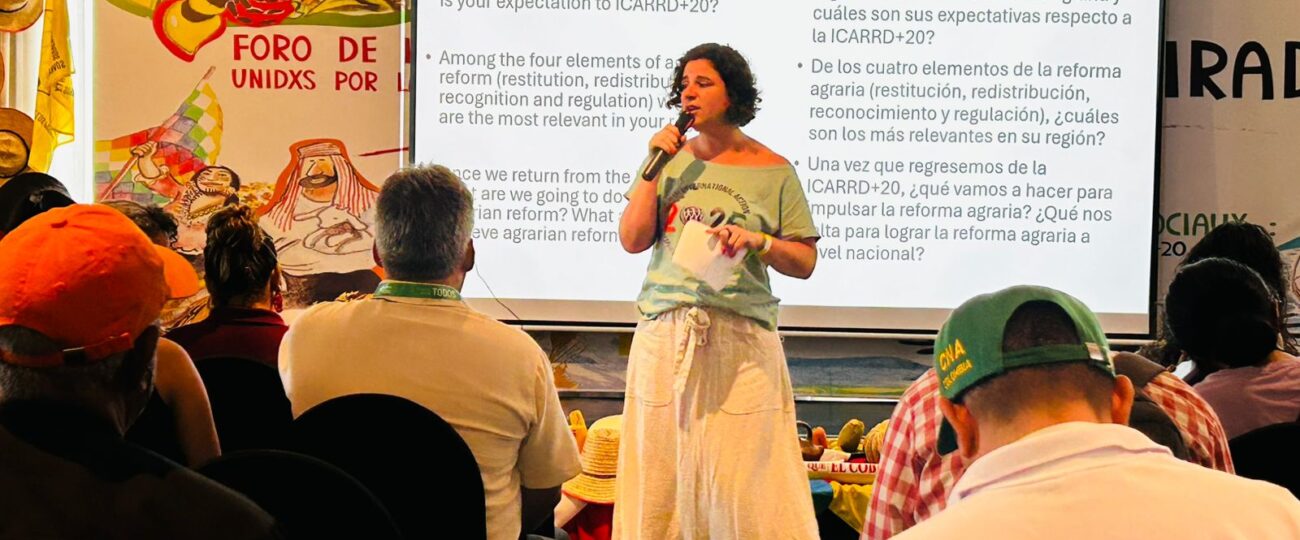
The International Conference on Agrarian Reform and Rural Development (ICARRD+20), held in Cartagena in February 2026, was an important moment when movements came together. We left the conference reaffirming our unity and clearly stating that we will not accept any rollback of the rights we have already secured. We will not accept the whitewashing of Indigenous peoples’ rights under the vague concept of “local communities,” nor any declaration that does not place food sovereignty, agroecology, and women’s rights at the center of agrarian reform.
We Will Keep Marching
Sisters, the anti-capitalist and internationalist feminism we build tells us that another world is not only possible—rural women are already building it. In productive backyards, in preserved seeds, at agroecological markets, in occupations, in marches, in committees, and in assemblies. We are not waiting for the land to come to us. We are fighting for it collectively, politically, integrated with all the movements and struggles of rural, forest, water peoples.
This is why we continue to say, together: territory is not a commodity. Land is not for speculation. Women are not disposable labor. We march against capitalist exploitation and patriarchal violence. We march for collective rights to land, food sovereignty, and a feminist economy centered on life. We demand a comprehensive grassroots feminist agrarian reform now!
Sarah Luiza de Souza Moreira is an activist with the World March of Women in Brazil and a member of the Brazilian National Agroecology Platform (Articulação Nacional de Agroecologia—ANA).