Across the Americas, women are migrating under increasingly harsh conditions. In their territories of origin, they are pushed out by economic blockades and violence. They shoulder care work before, during, and after the journey, only to arrive in countries that further precarize their work and tighten anti-immigration policies. Daniella Inojosa, from the Venezuelan feminist organization Tinta Violeta, a member organization of the World March of Women (WMW) in Venezuela, identifies the root of this persecution. As she explains, “Borders are an invention. These lines do not exist on the land. Nature did not draw them; power did, to decide which bodies may move freely and which are persecuted. No woman can be illegal anywhere on this Earth.”
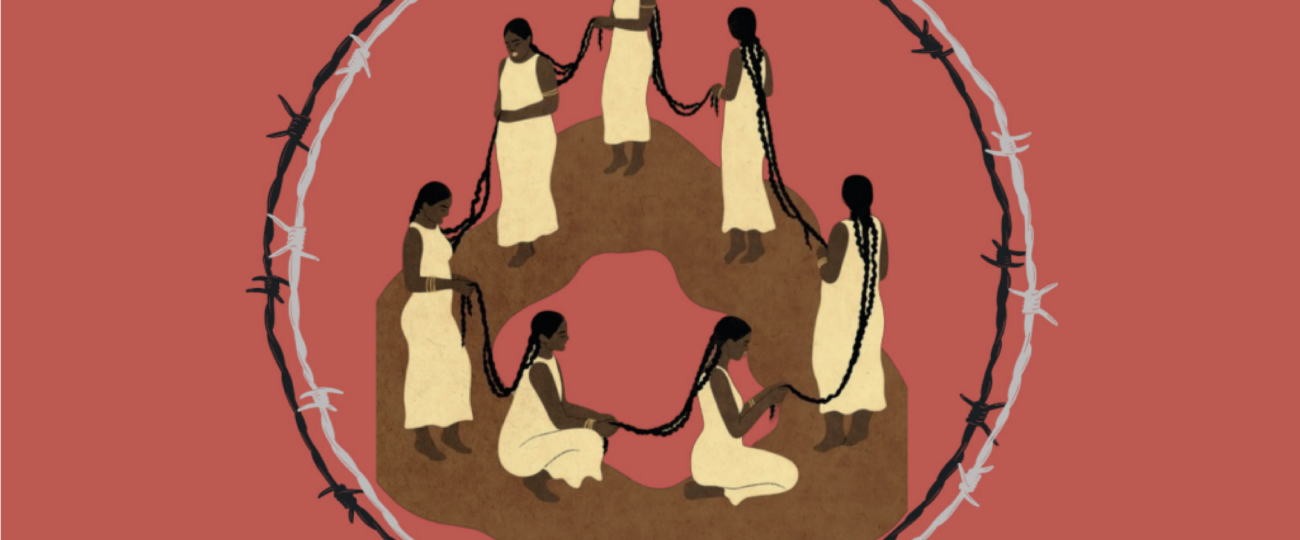
The book Our Path: Texts on Migrant Women (Nuestro camino: textossobremujeresmigrantes) emerges from this context. Its texts bring together collective processes of reflection and creation on migration. The book is organized into three chapters: “Living the Path”, featuring life testimonies and records from virtual reflection spaces; “Thinking the Path”, which brings together essays; and “Singing the Path”, composed of short stories, poetry, and illustrations. The publication was coordinated by Norma Cacho and Alejandra Laprea, members of the WMW International Committee, in collaboration with the Trade Union Confederation of the Americas (TUCA-CSA), the Chilean organization Migrantas, and support from We Social Movements (WSM) and Rede Inspir. The full book was launched on June 18, 2026, and is available for download in Spanish on the World March of Women’s website.
At the launch event, Norma Cacho explained what moved the March to produce the book: “One of the first conclusions we reached was that we should not speak of a ‘migration crisis,’ but rather highlight that we are living through a broader, structural crisis that forces people to migrate under extremely adverse conditions. Women bear the brunt of these effects while also sustaining care work in the places where they settle.” Beyond acknowledging the violence faced by migrant women, the book seeks “to make visible the forms of resistance, the proposals, and the political visions that migrant women build wherever they are, from the Global South to the Global North,” Norma says.
Alejandra Laprea reaffirmed the political commitment behind the publication:
Migration is not the problem. The real problem is the conditions that force us to migrate, the conditions imposed on us when we do migrate, and the conditions we encounter in destination countries, which make our lives precarious and fuel hate speech. Migration is our right, sister, and our struggle is for the right to migrate with dignity.
Below we publish Grassroots Feminists, Migrant and Diasporic Women, a poem by Venezuelan poet Lilia Ferrer-Morillo, who lives in Argentina. Through a litany written in the first-person plural, she names the conditions imposed upon migrant women and transforms them into collective organization and mobilization.
Grassroots Feminists, Migrant and Diasporic Women
Lilia Ferrer-Morillo
We, migrants, Black women, Indigenous women, poor women, displaced women, refugees, the persecuted, survivors of trafficking, the harassed, the undocumented, caregivers, ass-wipers, foreigners,
We, stateless in the very land that gave birth to us, from which we are uprooted and driven away, far from home, straight into the jaws of the shark,
We, from the slums and their miseries, marginalized by the system, illiterate despite our degrees and every apostille demanded by The Hague, and despite all the bureaucracies created to devalue any stamp that does not come from the Global North,
We, sudacas, from the dehumanized South, the world’s backyard, erased from the canon and from its supremacist, white-centered, heteropatriarchal aesthetics and morality, governed by global messianic capitalism,
We, racialized women, tracked by biometric policing technologies that examine our bones and genealogies until they find the mitochondrial DNA that geolocates us in the South of the South of the world’s peripheries and their colonial scars,
We, foreigners, marked by electoral coercion and clandestine abortions, excluded from the statistics published the next day in sensationalist, immediate, treacherous, blood-soaked headlines that criminalize us even after death,
We, exiled by threats intended to forcibly strip away our gender identity. There is no going back when identity and dignity are in such grave danger,
We, who sustain and generate profits for the real estate market, which enriches itself through our labor, our sweat, and our absence from our own homes. An asymmetric housing market that deregulates at the top while enslaving those at the bottom,
We, diasporic women, displaced, condemned to uprootedness by a system that forces us to move from place to place, to move away from our origins and our communal and kinship ties, turning us into outcasts, nomads, and wanderers in our own land,
We, devalued and precarized workers, subjected to subordinate labor and care work, accused of being freeloaders even though we work twelve-hour days with a bed to sleep in, but no living wage,
We, migrants, refugees, stateless women of the Great Motherland, proud feminists of historical, counter-hegemonic, plurinational, diverse resistances and revolutions, tireless fighters, we declare:
Tomorrow we strike to show that if we stop working, the Global North comes to a halt!