Amid one of the most complex economic moments faced in recent decades, the Cuban state is relying on its ability to reorganize, prioritize, and sustain essential public policies. This is no small feat: in times of scarcity, when uncertainty weighs heavily on households and vulnerability multiplies, the commitment to expand and strengthen care systems reveals a political will that places life at the center. It is a decision that speaks both to the urgency of the present and to the historical commitment of a project that, even in difficult times, chooses to care.
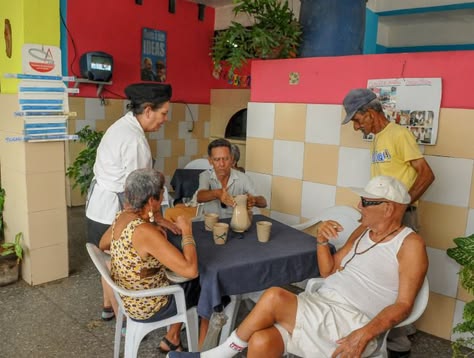
Resolutions 8/2025 of the Ministry of Domestic Trade (Ministerio de Comercio Interior—MINCIN) and 41/2025 of the Ministry of Labor and Social Security (Ministerio de Trabajo y Seguridad Social—MTSS), published in the Official Gazette, mark a turning point in Cuban social policy for care. Both reorganize the Family Care System (Sistema de Atención a la Familia—SAF) and create Community Meal Homes, a new model that brings food care into domestic spheres that centralize production for communities in rural, suburban, or hard-to-reach areas.
This is a measure that promotes one of the most sensitive programs in the country at a time when vulnerability has become more complex and widespread. The SAF, created during the hardest years of the Special Period (1990s), was born as an emergency response to secure basic meals for the elderly, people with disabilities, and families who were unable to cook. Over time, it became a permanent structure as the country’s situation of vulnerability evolved.
Where SAF-related requests increased, the effects of population aging, migration, and economic precariousness were also evident. Meanwhile, the program was plagued by structural problems: deteriorating facilities, insufficient resources, and weak institutional coordination. These resolutions aim to correct these distortions and adapt them to a country that has undergone profound changes in its demographics and community dynamics in recent decades.
Rapid aging—more than 22 percent of the population is 60 years of age or older—is one of the factors putting the most pressure on the SAF. The loneliness experienced by many older adults, the feminization of longevity, and migration have created a scenario in which more and more older people are living without family support.
Women with low pensions, chronic illnesses, and physical limitations make up most of this demographic. The resolutions recognize this reality and advocate for a more flexible and accessible model that can serve those who cannot travel or live in areas traditional institutions do not reach.
Resolution 8/2025 of the Ministry of Domestic Trade redefines the responsibilities of the SAF’s meal centers: expert-validated menus, appropriate hygienic-sanitary conditions, control records, systematic oversight, and coordination with local governments. It also diversifies sourcing—from local production, processing centers, donations, confiscations—to ensure stability in a complex economic context.
Resolution 41/2025 of the MTSS, in turn, introduces Community Meal Homes, a modality that allows individuals—primarily women without formal employment—to provide the service from their homes.
The decision recognizes the historical role of women in care networks and formalizes work that has been invisible for decades. The homes serve up to ten people, with a daily intake that must cover at least 30 percent of the recommended nutritional intake. Home delivery, which is free and mandatory for those who cannot travel, underscores the ethical dimension of this model.
Rurality and territorial isolation are key elements in this reorganization. In many rural communities, food vulnerability is not only explained by poverty, but also by distance, difficult roads, scarce transportation, and scattered services.
Traditional social policy does not always reach these areas in a timely manner. Community homes allow for intervention in these micro-territories with a more flexible and humane approach. This is a way to address historical inequalities, including reduced access to services, institutional presence, and infrastructure. Social policy becomes territorialized, decentralized, and more responsive to the unique characteristics of each community.
The cost of care—economic, human, and structural—pervades this entire transformation. Providing meals, following up, cooking, distributing, repairing, and overseeing comes at a considerable cost amid financial tensions and external constraints.
It is also an investment: every meal served is a way to prevent deeper inequalities, costly illnesses, and social disruption that is difficult to repair. Care, when viewed earnestly, is a form of prevention, cohesion, and life.
At the heart of these transformations lies an ethical question: what does it mean for the state to provide care? Care, understood as public policy, is a statement of values.
Vulnerability is not a personal failure, but a human condition. Dignity is not negotiable; protection cannot be postponed. Care is a social pact with the affirmation that every person’s life matters, regardless of their age, health, or economic situation.
Considering care as public policy in Cuba means recognizing a tradition that runs through the entire history of the socialist project: the conviction that human life is a collective good.
In a world where neoliberalism has privatized care, turning it into a luxury or an individual burden, Cuba insists that care is a right and a shared duty.
Community Meal Homes embody this ethic: they are not only a logistical solution, but also a moral commitment. They are proof that public policy can be accessible, sensitive, and deeply human.
Ultimately, everything that these resolutions reorganize points to the same idea: care as a political destiny and action. From an ethical standpoint, they affirm that the protection of the most vulnerable is non-negotiable.
From an economic perspective, they reveal that care is an investment in social cohesion. From a gender perspective, they recognize the historical role of women in their architecture. From a territorial perspective, they understand that vulnerability is not the same everywhere and that policy must adapt to the real geography of life. And from a socialist perspective, they reaffirm the founding principle that human dignity is a collective right.
That is why the reorganization of the Family Care System and the creation of Community Meal Homes are not just administrative reforms. They are an affirmation of the future.
A commitment to a country that, even in times of hardship, chooses to care, that recognizes that dignity is in cooking, following up, delivering meals; it is in the hands of women, adapted to each territory, and funded by collective effort. Cuba understands that care is not an expense, but a form of ethical resistance. A form of justice, of hope.
Because care—in its most human, political, and deeply socialist dimension—remains one of the strongest ways of saying: here, no one is left alone.
Marilys Zayas Shuman is a member of the World March of Women Cuba. She is the editor of Mujeres magazine, where this article was originally published.