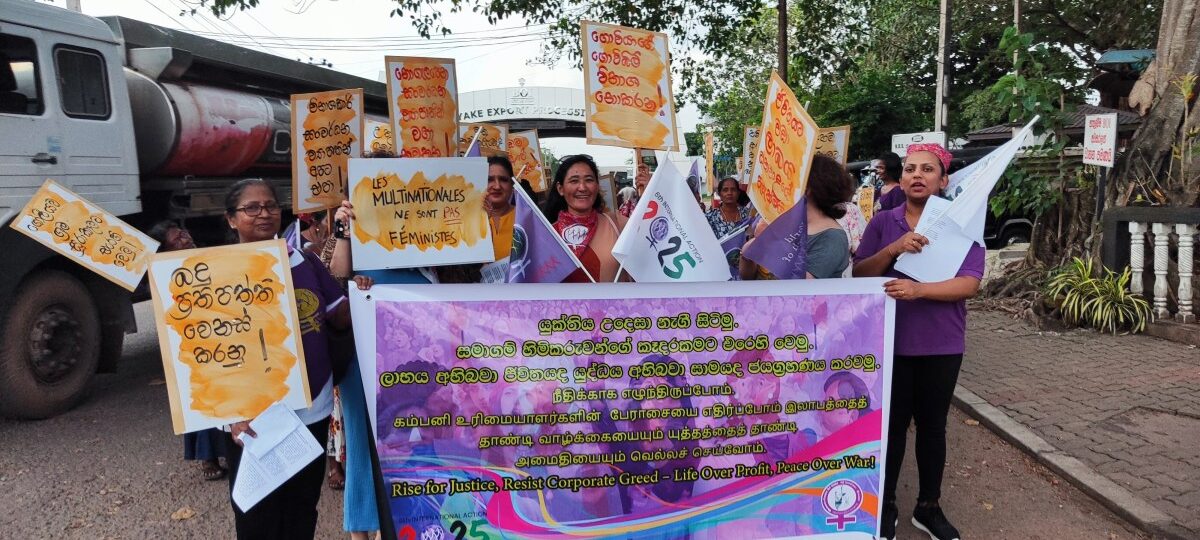
The Women’s Center is a feminist organization that is a partner of the World March of Women in Sri Lanka. The organization was founded in 1982 out of the struggle of women workers at a garment factory in Ekala, near the Katunayake free trade zone south of the capital of the country. From the outset, the organization has been committed to confronting corporate power and defending the rights of women workers. Currently, more than 5,000 members are active throughout the country and structure their work around four pillars: awareness raising, knowledge sharing, political advocacy, and movement building at the local, national, and international levels.
A collective feminist victory marked the recent struggle of these workers. On October 11, 2025, two workers from Lanka Garments (JB Apparel) in the Koggala Export Processing Zone suffered intimidation, harassment, prolonged detention, and were forced to submit letters of resignation for intending to participate in a training activity on gender equality and labor rights organized by the Women’s Center. Falsely accused of attempting to form a union and threatened with police action, they and other workers faced a climate of fear within the factory, in clear violation of the right to freedom of association.
Thanks to the feminist organization, legal intervention, and strong national and international solidarity, the case was brought before the Department of Labor, which recognized the injustice. Through conciliation, the company agreed to unconditionally reinstate the two workers, restoring their jobs, rights, and back pay. This victory reaffirms that retaliation and forced dismissals are illegal and demonstrates that the collective resistance of Sri Lankan women is central to confronting patriarchal structures and abuses in the garment sector.
In an interview given during the 3rd Nyéléni Forum, Gayani Gomez, from the Women’s Center, told us about the history of her organization and the work of MMMWMW women in the country. Read the interview below:
Tell us about your movement and the history of building feminist perspectives that connect the local political context in Sri Lanka to the international struggles.
The Sri Lankan context is highly patriarchal, so being part of an international feminist movement is always challenging. We are the local and national coordination body of the World March of Women in the country, and we work with apparel and plantation sector workers. Internationally, we are involved in the global supply chain, connecting our struggle to the global movement.
We are a country in the Global South, and under globalization. We face key challenges: patriarchy, fundamentalism, and militarization. We also endured 30 years of civil war. Women contribute enormously to the economy, yet they carry the burden of care work, plantation harvesting, debt, and poverty wages. We are still demanding a proper living wage for women in the corporate sector. Transnational corporations work for profit, profit over profit, while these workers earn less than minimum wage.
As an organization rooted at the grassroots level, our work over the past 42 years has centered on four areas: capacity building, because workers and women must be aware of their rights; psychosocial support, because most of them are survivors of gender-based violence and require strong counseling; advocacy; and movement building. If we do not build grassroots-level movements, the issues of women’s leadership and representation will never be addressed at a higher level. That is precisely why grassroots organizing is central to everything we do.
Could you give us some concrete examples of struggles from your sector?
One recent example is our fight against the EmploymentEmployees’ Provident Fund (EPF) robbery. Under the International Monetary Fund (IMF) conditions, the workers’ social security was set to be deducted as part of domestic debt restructuring. Workers protested and fought. They spoke up in the factories, and their peers spread the word among colleagues. People mobilized because this was not going to affect one family in isolation. It was a disaster for the entire apparel sector, and beyond that, for the whole corporate sector. We have managed to bring this to a public level. We fought the same battle in 2011, under previous governments.
Another case dates to 2007. A doctor raped a worker from the apparel sector, killed her, and threw her body from an upper floor of the hospital. The only witness was a member of the general cleaning staff. She faced enormous pressure to stay silent: doctors hold very high social standing, and this woman was just an apparel sector worker. We filed a fundamental rights case and took the case all the way through. Justice was served for this woman. As human rights defenders, we do not advocate for the death penalty, so I won’t go into the sentencing, but the important thing is that she received justice.
And after the COVID-19 pandemic and the economic crisis that followed, workers here were not even receiving their basic wages. We launched a major campaign with the support of international solidarity: the Pay Your Workers campaign, targeting transnational corporations and international brands like H&M, Nike, Primark, Victoria’s Secret. We held posters across the world. We targeted brand ambassadors directly — for Adidas, we targeted Lionel Messi. When Messi was in Indonesia, we were there holding banners and asking: “Messi, why are you supporting this brand? They are stealing wages.” During the pandemic, the corporate sector profited enormously, and workers paid the price. The Pay Your Workers campaign is still ongoing across the globe.
As you mentioned just now, your organization is fighting corporate power across very different areas, yet the struggle is the same locally and internationally. How does that fight against corporate power work in your context?
On the 24th of April, 2025, we held a major protest in Sri Lanka with the World March of Women in solidarity with apparel sector workers and to mark the anniversary of the Rana Plaza tragedy in Bangladesh, a disaster that killed and displaced over 10,000 lives. It was a significant moment for Sri Lanka because we are now advocating for the agreement to be extended to our country. An agreement that is no longer only about fire and building safety, it has broader implications.
When we talk about corporate power in my sector, garment brands are that power. They exploit workers in Sri Lanka while projecting an ethical image in the Global North. They promote clean clothes, but they are producing dirty clothes.
Workers are not receiving a living wage. They do not have proper living standards or nutritious food. Our research found that more than 66% of women apparel sector workers in Sri Lanka suffer from anemia and malnutrition, and their children face the same reality because a living wage never arrives. The living wage is at the core of all of this. When corporations capture food, seeds, and land, they leave communities entirely dependent. In my sector specifically, plantation workers have no right to the land. Though we come from different sectors and different parts of the world, I believe our struggles are the same.
But women are resisting by organizing at the base, creating alternative economies, sharing cooperatives, and building transnational solidarity. That’s why we also need to talk about the circular economy. Most corporate powers have co-opted this concept in the apparel and food sectors, particularly through greenwashing. Brands promote recycling and reuse campaigns while workers continue to face poverty wages and toxic environments. Through genuine circular practices, rooted in grassroots communities, women workers are already repairing, sharing, and reusing, not as a political statement, but as a condition of survival. In the plantations, women also sustain seed saving.
The whole world is now talking about just transition. But the question is: where is the just transition? That is the central conflict with the strategies transnational corporations are now using in response to the EU Corporate Sustainability Due Diligence Directive and mandatory human rights due diligence legislation. Since these regulations are coming into force in the Global North, brands are relocating their headquarters to African countries, specifically to evade accountability and responsibility toward the workers who produce for them in the Global South.
At the same time, brands are spending thousands of dollars on brand audits, yet ground-level realities are never properly revealed. The problem runs deep: even middle management, even the factories themselves, do not tell the truth during these audits. There is a communication gap, and it is not accidental. Corporations are actively deploying strategies to circumvent accountability. They sit in positions of power while workers at the grassroots level continue to bear the full weight of the consequences.