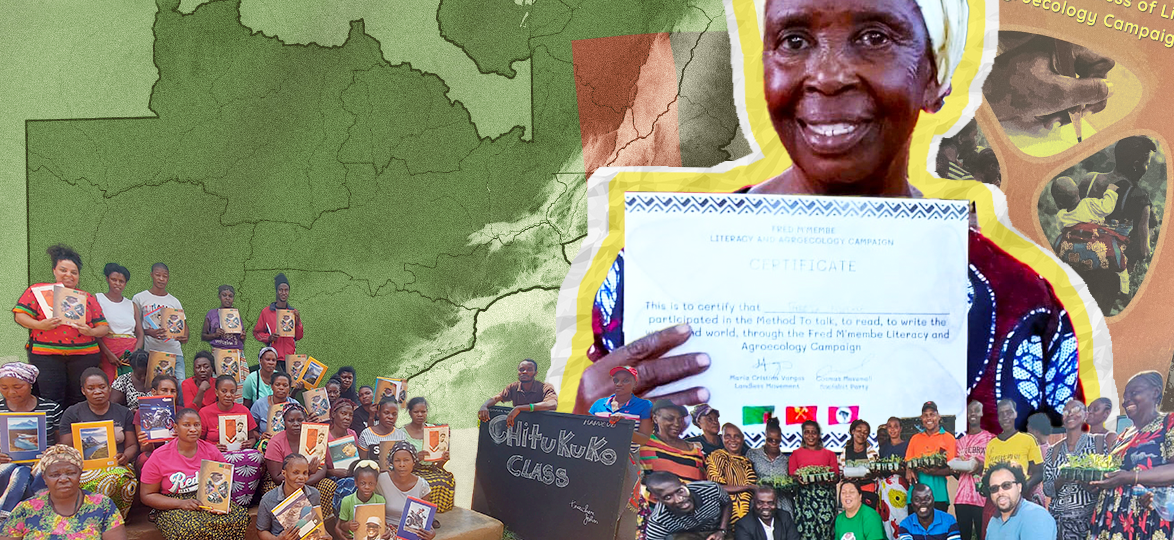
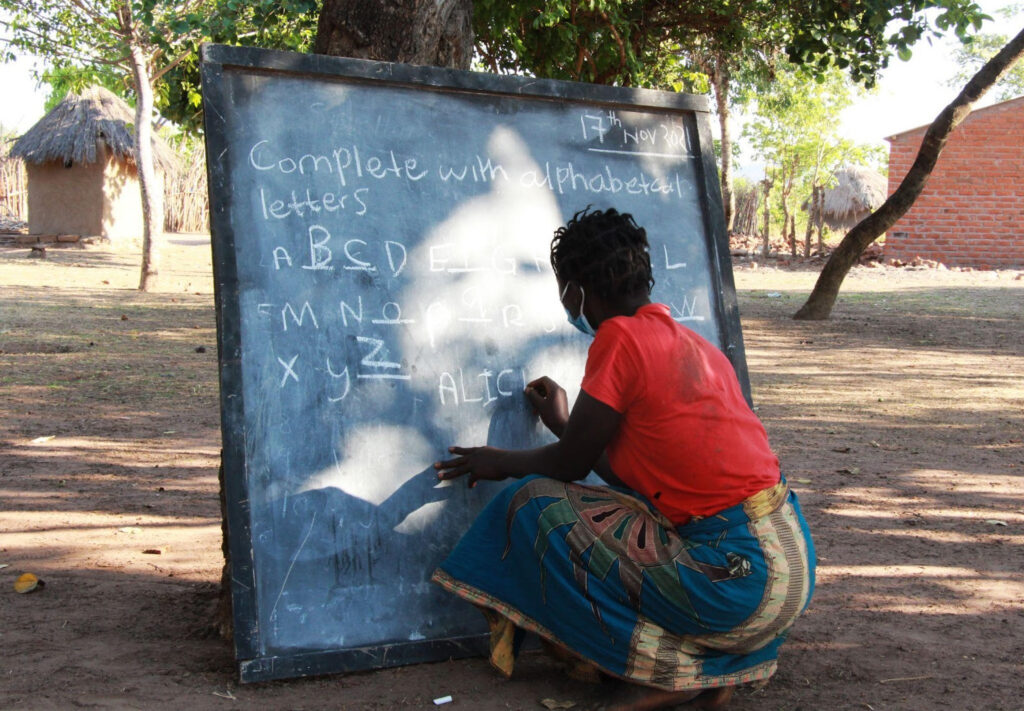
The Literacy and Agroecology Campaign, carried out in Zambia by the Samora Machel Internationalist Brigade in partnership with the Socialist Party of Zambia, was born out of the conviction that it is not enough to teach people how to read and write letters; it is necessary to read and write the world.
Zambia is a country of enormous linguistic diversity, home to more than 70 local languages and dialects, most of which belong to the Bantu language family. Among them, seven are recognized as official regional languages: Bemba, Nyanja, Tonga, Lozi, Lunda, Luvale, and Kaonde, and are widely used in everyday life, on community radio stations, and in primary schools in rural areas of the country. The Zambian population is largely multilingual and can switch between the language of the community, the language of the province, and English, a colonial relic.
Despite its wealth of indigenous languages, the emphasis on English literacy dates back to the British colonial period, when the language was imposed as an instrument of administration and control, becoming a symbol of social prestige and access to power. Post-independence, English continued to be the official language of the state and functioned as the medium of instruction in formal education. Similarly, proficiency in English was mandated for employment, official documentation, and national examinations. Making illiteracy in English not only a linguistic limitation, but also a political and social barrier, deprives a large part of the population of their rights and opportunities.
A significant portion of Zambia’s population—55.3%, or more than half, cannot read or write in English. Women, particularly those in rural areas, make up the majority of this percentage. Gender and generational inequalities weigh heavily on Zambia’s educational reality. According to the 2018 Zambia Demographic and Health Survey (ZDHS), only 48% of women aged 15 to 49 have completed secondary education or higher, compared to 58% of men, a difference that reflects how women’s access to formal education remains limited by historical, cultural, and economic barriers.
The country does not have a fully public education system. Students who enroll in school complete the state-funded primary years of basic education, up to grades 6 or 7, and are then required to pay different fees and costs, making it impossible for a huge portion of the population to continue studying. Added to these barriers is the issue of infrastructure itself. Many schools in the country are located far from homes, causing pupils to travel lengthy distances to school.
The reality for women is considerably more difficult when we consider the gendered division of labor. Issues of early marriage and childbirth to domestic responsibilities, and a lack of financial resources to finish their education are reasons that hinder the access to education for women. According to records, Zambian women have an average of 5 to 6 children. In this circumstance, many women are forced to stop their education when they become moms and must take care of the home and children.
In many rural and remote communities, girls drop out of school to care for younger siblings, among house chores such as fetching water, or working on family farms, selling vegetables, and making them rarely able to return to their education. For older people, however, the lack of education stems from another source: their generations were educated under a colonial system that excluded Africans from schools or restricted their education to basic training for manual labor. Many grew up believing that studying “was not for them,” and still carry the symbolic weight of this exclusion today.
The Literacy and Agroecology campaign is a direct response to this reality. It is an opportunity for women to reclaim the voice that was denied them, and for older people to regain the dignity of understanding the written world that was always imposed on them. The centrality of English reproduces linguistic and territorial inequalities. It is in this context that the Literacy and Agroecology Campaign sought to recognize local languages as a starting point for learning, affirming that true literacy is not just reading English, but being able to read the world and transform it.
Inspired by the Cuban Yosípuedo method, Paulo Freire’s popular education pedagogy, and the literacy practices of the Landless Workers’ Movement (MST) in Brazil, the campaign creates its own path, called “to talk to read to write the words and the world.” This method is forged during the interactions between educators and learners, in the concrete reality of rural, urban, and peripheral communities in Zambia.
In rural areas, most of the students are also farmers, men and women whose hands bear the marks of working in the fields. Therefore, training in literacy and agroecology has a double value: learning to read and write means, at the same time, understanding the world in which they live and improving production and living conditions. In urban areas, some students live on the margins, without formal employment, while others work as traders or live in makeshift homes. Their reality is vastly diverse and complex. In addition to their desire to learn to read and write, they bring with them the need to find answers to their living conditions. Thus, alongside words and notebooks, demands for food, health, water, housing, and dignity enter the classroom.
The goal goes beyond teaching people to read and write: it is to make Zambia a territory free of illiteracy. It is to train critical, conscious, and organized people, capable of deciphering the world so that, together, they can transform it. The campaign is free of charge. This is a central principle of the project, which views education as a right, not a privilege. In a country where many families live on less than two dollars a day, free access ensures that no one is left out because they cannot afford school fees, teaching materials, or transportation. In several communities, bicycles were even distributed to make it easier for educators to get to their classrooms.
The campaign was designed to reach the entire country of Zambia, prioritizing regions with the highest illiteracy rates in both rural and urban areas. From 2021 to the present, the campaign has taught more than 5,000 students to read and write, thereby breaking the cycle of illiteracy. In the first phase, 2,130 students participated in rural areas of the Eastern Province and Western Province, and in the second phase, the reach expanded to the urban areas of Lusaka, Copperbelt, and Central Province.
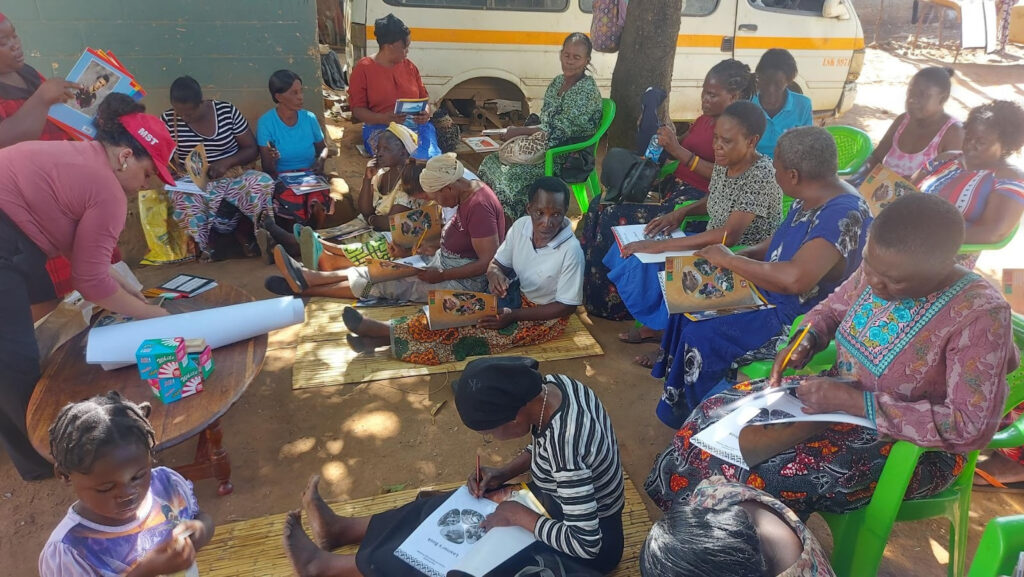
The campaign’s educators and local coordinators are volunteers. They are tasked with mobilizing and identifying pupils within their communities, collaborating with traditional leaders, churches, and party members to set up venues for classes. Prior to commencing their work in the communities, these educators receive comprehensive political and pedagogical training that thoroughly explores the “to talk to read to write the words and the world” methodology and the legacy of Paulo Freire, examining popular education from both theoretical and practical viewpoints.
Educators are trained to tailor their instruction to the distinct circumstances of each locale: rural, urban, or peripheral populations. The technique advocates for an active and dialogical teaching, wherein the literacy process originates from words and themes produced by the students, words that articulate their experiences, labor, aspirations, and the communal issues faced by their communities. As Paulo Freire taught, it is from the vocabulary of the people that critical consciousness and the desire for transformation are awakened.
The materials used in the campaign include literacy workbooks, educator manuals, and practical guides to Agroecology. Each class combines reading, writing, and discussion on topics related to everyday life: health, nutrition, housing, the environment, and community organization. Literacy, thus, is not reduced to a technical act of decoding letters, but becomes a practice of liberation and reorganization of collective life.
The structural conditions pose a challenge: reaching the most remote areas, securing materials, transportation, and financial support to keep the process moving forward. Despite this, the team remains committed to the belief that literacy is a liberating act.
The Pedagogy of Agroecology
Alongside literacy in words comes literacy in the land. That is why agroecology is not thought of as an ancillary activity, but as a structural part of the process, uniting the learning of letters with the cultivation of food, the preservation of seeds, the memory of communities, and the right to a dignified life. A 2019 report on “Land Governance in Zambia” notes that in terms of classification, 15-20% of the land is held under statutory tenure, while 80% is still regulated under customary tenure. Over half of the population resides in rural regions and is significantly impacted by the systemic social issues created by capitalism. Included in this discussion is climate change, as its temperature fluctuations and alterations in rainfall patterns can significantly impact the livelihoods of this population.
The pedagogy of agroecology is expressed in everyday classroom activities and in training planning. Some questions guide the process: How can agroecological practices be incorporated into educators’ planning? How does the agroecology team participate in educator training? How can the campaign calendar be integrated into field dynamics, considering harvest and dry seasons?
Among various agroecological practices carried out in the communities, which include but are not limited to: rescue and cataloging of medicinal plants; creation of community murals with information on biodiversity and health; construction of community gardens and nurseries, used as learning spaces for reading, writing, and counting; screening of videos and discussion groups on healthy eating and food sovereignty.
In communities, words and practices come together; writing takes on the same meaning as planting, watering, and harvesting. For example, when learning to read and write about the soil, students also discover how to prepare natural fertilizers, such as tea manure, a biofertilizer made from animal manure and locally available organic materials, which improves productivity and reduces dependence on chemicals.
Similarly, in the area of public health, learning to read and write intersects with knowledge about “superfoods”—such as peanuts, sorghum, moringa, and local corn—which combat malnutrition and strengthen the body with natural nutrients. Classes become a space where scientific knowledge and traditional knowledge meet: learning to read the name of a plant is also recognizing its healing power; writing a recipe is recording a collective memory.
In this pedagogy, literacy and agroecology go hand in hand, cultivating not only knowledge of words but also a deep understanding of how to live in harmony with the land and the community. Learning, here, is an act of resistance and hope, because those who learn to read the world are also capable of transforming it.
The Campaign as the Living Seed of African liberation
Literacy here is an act of liberation, a process of dialogue between popular knowledge and political knowledge, between words and life. The campaign becomes a great meeting place, where conversations are woven, questions arise, and the collective dream of a people who are learning to write their own history with their own hands is recreated. More than an educational project, it is a practice of organization and hope. Each reading circle, each outdoor class, each word learned is also a seed of popular power. The campaign strengthens communities’ ability to reflect, plan, and decide their own destiny, and it is in this journey that the awareness is forged that Zambia’s future can be built from the bottom up, from the ground where the masses tread.
Just as Amilcar Cabral wrote to Paulo Freire, stating that education must be born from the bowels of the people and restore to the peasant the dignity stolen by colonization, here too the campaign becomes a seed. In villages and neighborhoods, literacy becomes an act of resistance, reaffirming that Zambia’s future can only be built with firm roots in its own history, culture, and capacity to reinvent itself.
The method is called “to talk to read to write the words and the world,” because here it is about talking to dream, writing to cultivate, and reading to liberate. A path that is, at the same time, a tribute to and continuation of the struggles of Cabral, Freire, and so many African peoples who have always known that words, like seeds, only flourish when they find fertile soil.
Article originally published on Roots.
Elisabet Cerqueira is a member of the MST – Landless Rural Workers Movement and coordinator of the Samora Machel Internationalist Brigade in Zambia.