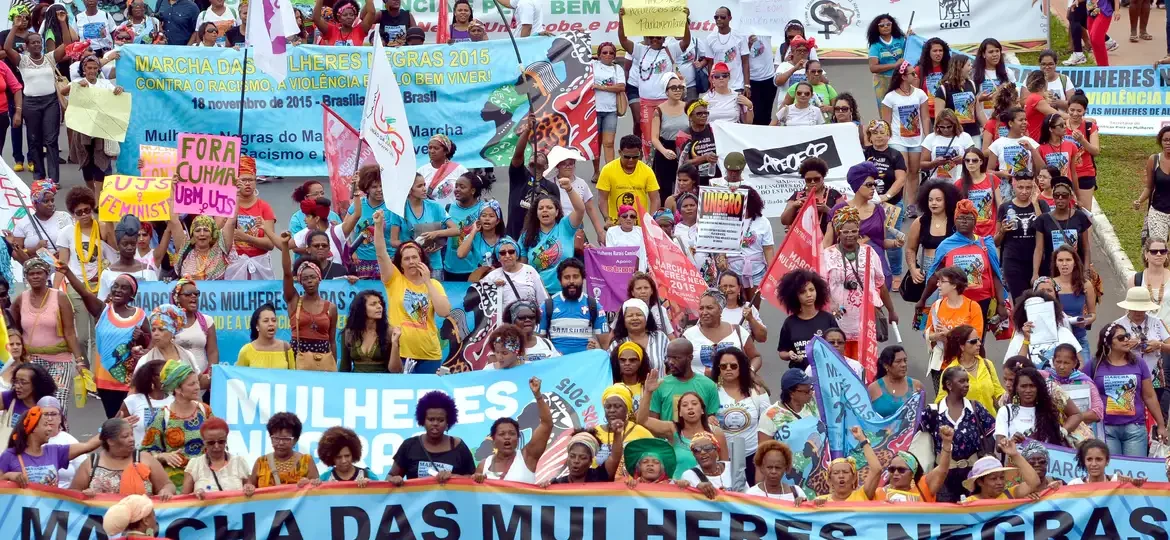
The 2nd Black Women’s National March for Reparation and Good Living took place in Brasília, the Brazilian capital, on November 25th, ten years after the first edition of the march. Black women from different territories across the country and abroad took to the streets carrying the power of their struggle, bringing their denunciations and demands and showing the forms of resistance and alternatives built from their territories in cities, on urban outskirts, in the countryside, in farms, and forests.
This mass mobilization exposed that Black women are the ones at the bottom sustaining the capitalist, racist, and patriarchal model. It exposed the sexual and racial division of labor, which organizes labor in Brazilian society and subjects Black women to the most precarious, lowest-paying jobs. It was more than a demonstration: it was the expression of grounded strength, evidence that women are like the waters—when they meet, rivers break out. Thousands of Black bodies painted the Esplanade [a road surrounded by government buildings] with colors of an ancestral culture that is alive and pulsing.
Occupying the heart of the political power is more than a symbolic act. It affirms that no project for a country will be built without them—and certainly not against them. Black women have historically had their bodies violated, exploited, objectified, and they marched to mark the streets as their territory of power and ancestry. Each step on the pavement of Brasília challenged the heritage of the master’s house, reclaiming the memory of Dandara, Aqualtune, Maria Felipa, and Negra Zeferina, affirming the power of life against necropolitics.
The mobilization process of the Black Women’s March has also allowed us to expose that there is a battle over projects when we talk about reparation and bem-viver [buen vivir—good living]. We, Black women organized in grassroots movements, make reparation and good living material as a grassroots project for the country. Our agendas—against racism and violence, for the end of Black genocide, for employment, income, and the official recognition and protection of Indigenous lands—are the backbone of an alternative to neoliberalism, a project that is centered around life, dignity, and social justice. It is the affirmation that the solution for the crisis will not come from those who have created it—but rather from grassroots organizing and the ancestral wisdom of the peoples who have always resisted.
The massive presence of Black women on the streets is a powerful reminder that Brazil has an outstanding debt with its Black people. Paying this debt is not about doing them a favor—it is about justice.
The struggle for good living translates the political project that Black women set up. This is a project that is grounded in building other forms of existence, conditions of life, and dignity.
Today’s feminist and anti-racist struggle requires that we raise the banner of historical reparation as a key pillar. It is not just about apologies or symbolic actions, but about demanding a radical transformation of the country’s economic, political, and social structures. Reparation is expressed across three fronts that cannot be separated from one another, as they are directly connected to the agendas promoted by Black women who marched in Brasília. They are presented below:
Economic and Institutional Reparation
Slavery was the basis of capital accumulation in Brazil. An investigation by the Federal Public Prosecutor’s Office revealed that institutions like the state-controlled bank Banco do Brasil have directly reaped profits from trafficking and exploiting enslaved people. The abolition of slavery in 1888 in the country represented a transition in the exploitation model, in which Black people were freed yet left landless, homeless, with no access to education or any kind of compensation. The debt, therefore, is material and measurable.
Proposals including Constitutional Amendment Bill 27/24, called the “Reparation Bill,” are fundamental as they move the discussion from the field of ethics to the field of legal and financial accountability. As the social scientist Tássia Mendonça argues, actions in the realm of representation are not enough: “We want access to credit. We want to know how much has Banco do Brasil profited from Black people and how much it went without investing in this part of the population.” Economic reparation requires massive compensation and investment to change the cycle of impoverishment and vulnerability historically imposed on Black people.
Land Reparation: Land as the Root of Dignity
Land in Brazil is an issue that cannot be disconnected from race. The country’s 1850 Land Law was strategically passed before abolition, ensuring the concentration of property in the hands of the white elite, turning the latifúndios [Brazilian plantations] into a racist project of exclusion. Black people, who are the majority in rural areas, are the ones who own less land. Popular Agrarian Reform emerges as a fundamental act of reparation. Struggling for land means struggling for economic autonomy, food sovereignty, and the dignity of Black people.
Land reparation requires the compulsory purchase of unproductive latifúndios, the immediate tilting of all Quilombola lands, and the access to credit and technology so that communities can thrive. It is about breaking the backbone of the exclusionary project that was imposed on us since the colonial invasion.
Intersectional Reparation: Black Women at the Center of Decision-Making
The struggle for reparation must necessarily be conducted through the lens of intersectionality, acknowledging that Black women carry the combined weight of racism and patriarchy—two fundamental links structuring capitalism. The survey “Brazil’s DNA” conducted in the University of São Paulo shows that most Brazilians are descendants of Europeans from their fathers’ side and of Africans and Indigenous peoples from their mothers’ side. This exposes the history of sexual violence that marks the formation of our country.
Reparation, therefore, must be especially focused on policies ranging from education to health care, housing, land, the socialization of housework and care work, and income generation for Black women. Moreover, Black women must be sitting at the decision-making tables. They are the ones who can ensure that policies including affirmative action in education and Bolsa Família [Brazil’s conditional cash transfer program] are protected from conservative attacks and also that new policies are designed based on their experiences and needs. Reparation is also about appreciating the memory and leadership of historical fighters, reclaiming their wisdom and their centrality in building resistance.
The Future Is Ancestral and Resistance Is Black, Indigenous, and Coming From the Grassroots
The challenge we face is the ideological resistance that aims to delegitimize reparation, treating it as a “privilege” or “reverse racism.” We must be firm in our response: reparation is the possibility of correcting a historical injustice that prevents Brazil from being a true democracy.
Black women marching, with their symbolic and material power, show the pathway toward building good living as part of this political project of change. And they teach us that, in face of the crisis of capitalism and the advances of misogynistic and racist neoliberalism, the only way out of it is to further grassroots organizing, empowering resistance on the streets and fighting relentlessly for a project for the country that is based on historical reparation and good living. Change in Brazil will be spearheaded by Black women—otherwise it won’t happen. The future we desire relies on our ability to turn this historical debt into radical action of reparation, building a country where good living is ultimately a right for everyone—and not a privilege for a few. This is why we organize grassroots anti-racist feminism and we march until we are all free!

Bernadete Esperança Monteiro is a member of the national coordinating board of the World March of Women Brazil. Maria Rosineide Pereira is a co-coordinator of the Land, Race, and Class Collective of Brazil’s Landless Workers’ Movement (MST).