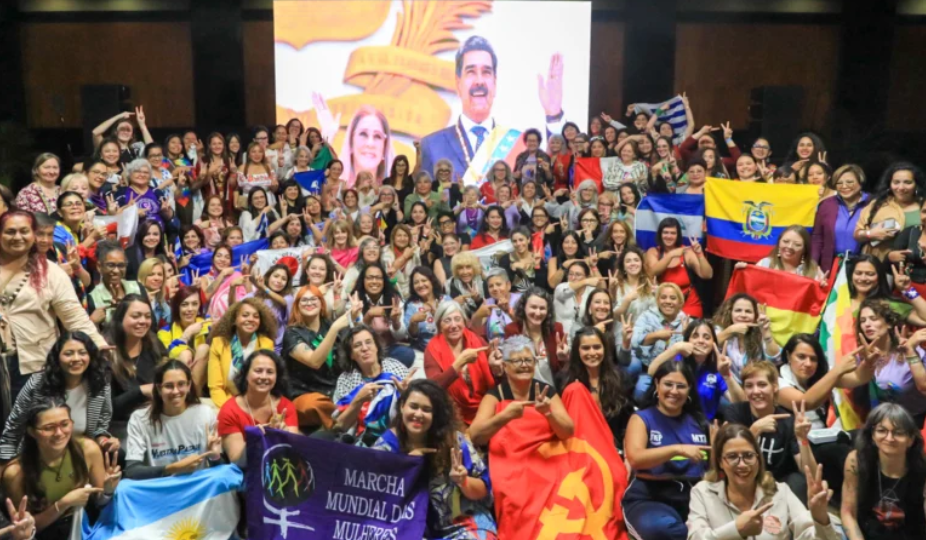
Approximately 120 women from social movements, collectives, and left-wing parties from 22 countries across Latin America and Europe gathered in the first meeting of the Cilia Flores International Women’s Brigades for Peace, held in Venezuela from March 6th to 8th, 2026. The World March of Women (WMW) was present with sisters from Argentina, Brazil, Cuba, El Salvador, and Venezuela.
The central objectives of the meeting were to demand the release of the First Combatant Cilia Flores and President Nicolás Maduro, to denounce the brutal impact of sanctions and the blockade on the lives of Venezuelan women, and to build a global network of feminist solidarity for peace and sovereignty. This moment was also an act of solidarity, cooperation, and reaffirmation of the values of social justice, peace, and unity among peoples that sustain the Bolivarian revolutionary project.
The opening of the meeting, on the evening of March 6th, included speeches by the Minister of Women, Yelitze Santaella; the Minister of Science and Technology, Gabriela Jiménez; parliamentarians; and members of different bodies of the United Socialist Party of Venezuela (PSUV) and other Venezuelan political institutions. Information was shared about the political trajectory of lawyer Cilia Flores, her strategic leadership in providing legal counsel to Hugo Chávez after the 1992 military uprising, her election as a national deputy, and her role as the first woman to lead the National Assembly and to serve as Attorney General. Chávez called Flores the “lawyer of the revolution.”
Another key point highlighted was the impact of 13 years of blockade and economic sanctions imposed by US imperialism against Venezuela, which resulted in the deaths of thousands of children, adults, and elderly people due to lack of access to basic vaccines, medicines such as insulin, and food. At the center of it all lies the dispute over Venezuelan territory, which holds not only oil but also rare-earth minerals and energy sources essential for the installation of data centers by tech corporations. Despite all of this, Venezuela continues to resist and deepen its sovereignty and independence. In the science and technology field, women account for 52% of participation and currently lead 1,117 scientific projects and scientific research.
The importance of unity and resistance of the Venezuelan people in the face of adversity, as well as dialogue to protect life and the Bolivarian Revolution, was affirmed. In this sense, popular consultations and women’s gatherings grounded in solidarity, cooperation, and dialogue are fundamental. Popular consultations are a model of direct and participatory democracy developed across 5,336 community circuits, where every three months, communities debate and prioritize projects to address their main needs. On Sunday, March 8th, the first national popular consultation since the attacks of January 3rd, 2026, took place.
Testimonies About the Attacks
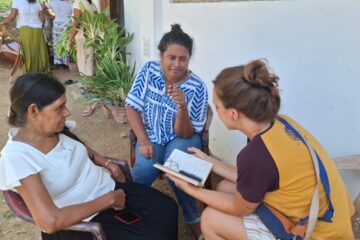
On Saturday, March 7th, the second day of the meeting, the program included visits to the La Soublette block in the Rómulo Gallegos sector, Catia La Mar parish, in the state of La Guaira, and to the community of Fuerte Tiuna, in the Heroinas de la Patria commune.
The first location, La Soublette, was one of those hit by US missiles that destroyed dozens of homes, killing two women and injuring 14 people. We heard testimonies from local women leaders, who make up nearly 80% of the community council. “That day was very painful. We woke up to the sound of airplanes — something horrifying. People came out and helped others get out. One older woman, Rosa Helena, died from the impact of a missile that struck where she was sleeping. Others suffered fractures. But here we are, standing in struggle, and we must remain strong. We are always free and sovereign. Venezuela is a country open to all people of the world, but come to work, to struggle, and to live with us in holy peace — not to run us over and take advantage of our resources,” said Delfina García, a community leader who called on all women to participate in the popular consultation.
Elpidia Moreno, from the WMW of Cuba, denounced the sanctions against her country and affirmed that women continue to resist and create, drawing on the example of Fidel: “When we speak of Cuban dignity, we must refer to the Cubans who fell on January 3 on Venezuelan soil. They gave their lives so that Venezuela, Cuba, and the Americas may continue to live. We are certain that Cuba and Venezuela are not alone; we have international solidarity.”
The commune Heroinas de la Patria, in Fuerte Tiuna, is where US helicopters landed to abduct Maduro and Cilia Flores. The area is home to 1,000 families and 3,557 inhabitants, including 254 elderly people. There are 82 neurodivergent children or children with disabilities. At the time of the meeting, there were five pregnant women and 15 nursing babies. The commune consists of 36 apartment towers that were originally intended for military personnel but, by decision of Hugo Chávez, became housing for civilians as well. Residents shared what it was like to wake up to the sound and lights of helicopters and missile launches.
“On January 3, I was not here, but I was here. My son managed to send me a video and told me, ‘I love you.’ He is a twin and said: ‘I was born accompanied, and I will die alone,’” said Melitza Peña, coordinator of the communal self-governance room. Over the phone, she instructed a neighbor to get the key to the health clinic so people could shelter there, as it was considered safer. On January 4, at 7 a.m., she was already back in the territory, visiting homes and neighbors. The attack left the population traumatized. There is an ongoing concern about moving forward without reliving the painful episode. “We are here, and we continue working as a free homeland that has the name of a woman,” Melitza affirmed.
Tamara Saavedra recounted that she was at home with her family when, after initially thinking it might be an earthquake or the end of the world, her husband said, “It’s not shaking, Christ is not coming. We are being invaded — it’s a bombing.” While trying to calm their dogs and children, a second bombing occurred. “We hugged our children and said goodbye. We told them the most important thing was that they knew we loved them from the day they were born until that moment, which we thought would be the last. I saw the terror in my children; I saw the terror in my neighbors.” She concluded: “Those who survived here in this community after January 3 were truly born again. Use this time to show sisterhood and unite.”
The Venezuelan government sent psychologists to support the community in dealing with trauma and panic. “Any noise makes people run to the windows. Light, for me, is fatal. To the international community and to Venezuelans abroad, I ask only for a call for peace. Venezuela is a country used to living in peace. No matter where we are, we are sisters, and Venezuela recognizes that the president, wherever he is, is a hero. For me, this is when Venezuela truly begins, and our revolution moves forward,” said Samaga Monzón.
“I felt the bomb explode and the lights go out. I woke my daughter and, to calm her, told her we were in a game. It’s an indescribable feeling not knowing whether a bomb will fall or not,” said Elena Muñoz. “Many neighbors have left; the next day, I took a taxi and saw a truck full of dead bodies. It was horrible.”
Eusenis Fernández, from the national movement of Mothers Caregivers of People with Disabilities, managed to take her daughter to her sister’s home and return to the Fuerte Tiuna community. She said her sister asked why she had to return. “We, as leaders, have a revolutionary commitment to our communities and cannot abandon the community’s struggle,” she replied.
“These testimonies reveal that this people is brave, supportive, and determined to remain free, sovereign, and independent. These are testimonies that come from within, because this is how we build the Bolivarian Revolution, step by step, enduring and resisting everything,” said deputy Desirée Santos Amaral of the PSUV. “Imperialism cannot stand free peoples who dream and seek independence. Our legacy is immense, inherited from our liberators. That is why we cannot renounce this independence, this sovereignty, and this homeland. We will never do so, and we will not surrender. They kidnapped our leaders, but soon another brave woman took charge and demanded, ‘show us proof of life.’ Tell me, if that is not courage.”
March 8th: Action Plan, Maduro’s Letter, and Communal Consultations
Sunday, March 8th, International Day of Women’s Struggle, began with the presentation and discussion of the action plan for the international campaign for the release of Cilia Flores. Nicolás Maduro Guerra, son of the president, then presented a letter from his father addressed to all women, highlighting their importance in the Bolivarian revolutionary process and in communal consultations. Maduro Guerra emphasized that the Bolivarian process did not begin with Chávez, but more than 500 years ago, with resistance to colonization by Indigenous peoples and enslaved Africans.
In the afternoon of March 8th, we accompanied a consultation process in the Socialist Commune El Despertar del Onoto, which has 15,860 inhabitants and 5,190 families, organized into 13 communal councils. Each commune selects seven priority projects, of which the two most voted receive funding for immediate implementation, often with community participation. Projects not selected can be resubmitted in future consultations.
March 8th concluded with a visit to the Promenade of the Heroines of the Homeland in Caracas, a monument inaugurated on March 8th, 2025, honoring 12 women fundamental to Venezuelan and Latin American independence: Apacuana, Luisa Cáceres de Arismendi, Cecilia Mujica, Eulalia Buroz, Josefa Camejo, Marta Cumbalé, Josefa Joaquina Sánchez, Barbarita de la Torre, Juana Ramírez “La Avanzadora,” Ana María Campos, Manuela Sáenz, and Bartolina Sisa.
International Solidarity
“Here we remember that speaking about our pain is important, but speaking about our hope is essential to keep moving forward,” said Estefane Silva, from the WMW of Brazil. “The project of the US empire is to weaken us, destroy us, and divide us, but our response is unity and international solidarity. We deeply admire the Bolivarian Revolution because, from the beginning, women’s struggle has been at its center. We learned from comrade Nalu Faria that there is no socialism without feminism.” Estefane affirmed the historic commitment to defend the Venezuelan revolution “until the US empire comes down.”
“It was my first time as an international brigadistafor peace, and it was very important. Personally, I had never been to Venezuela, and this experience allowed me to gain a different perspective: I encountered the dignity and patriotism of the Venezuelan people, and it changed my understanding,” said Nadia Trinchero from Argentina. “For us in Argentina, where we have a neofascist in power, it was very important to be filled with these values so we can continue the struggle with even greater strength.”
“Many Salvadoran women identify with what Venezuela and other countries are experiencing,” said Estela Hernández, from the WMW of El Salvador. According to her, “the brigades can become a regional cause, not an isolated one. It is humanizing to come together, to live with other women, to think differently, to feel that we are doing something to change the narrative — to experience this energy, the slogans, the marches, and the struggles that strengthen our knowledge in different trenches of struggle.”
“In the face of inaction, silence, and even applause that the bombing of Caracas received from governments across the continent, nothing was more comforting than the embrace of the sisters who participated in the first meeting of the Brigade,” said Venezuelan Alejandra Laprea, representative of the Americas on the WMW International Committee. “For us, it is very important to know that we are not alone, that we have the support of fraternal and feminist internationalism.”
She concluded: “now, back home, this delegation has the responsibility to bring more women into the brigade, amplify the voices of the women they met in Caracas, break the silence of the media, and tell the world to free Cilia Flores and Nicolás Maduro, to end aggression and military threats against Venezuela, to end the blockades and economic wars against Cuba and Venezuela, and to affirm that the Caribbean and Our America are territories for building true peace.”
Alessandra Ceregatti and Estefane Silva are activists of the World March of Women in Brazil.