Javier Milei took office as president of Argentina in December 2023 promising to put an end to inflation, which had surpassed 200% a year. Nearly three years later, inflation stands at around 33% annually, but that does not mean the economy is working for ordinary people. The price of stabilizing inflation is being paid by wage workers, pensioners, and informal workers. To prop up the value of the peso, the government has taken on debt from the International Monetary Fund (IMF) and has come to depend on the goodwill of the United States under Donald Trump.
Capire spoke with three Argentine activists about how this economic program shapes women’s lives and how they are organizing to resist it. Florencia Abregu is part of the coordination team of ALBA Movimientos, a network of grassroots movements from Latin America and the Caribbean. Mercedes Cabezas is a national leader of the Association of State Workers (ATE), a public-sector union affiliated with the Autonomous Workers’ Central of Argentina (CTA Autónoma), and is also part of the World March of Women. Alicia Coca is a health worker, a delegate of the World March of Women in Argentina, and secretary-general of Commune 9 of CTA Autónoma in Buenos Aires.
Care Work
Argentina’s economy is stagnant. Alicia Coca explains that gross domestic product (GDP), the total value of everything produced in the country, fell by 0.6% in the second quarter of 2026 and fell again in July. This decline is largely due to lower investment and reduced consumption among working-class communities. She notes that more than 370,000 people have lost formal employment under Milei’s government.
At home, recession means more hours of work. With wages and pensions frozen, families need more income. “With the contraction of the formal economy and the freezing of wages and pensions, social reproduction and care work have grown exponentially, placing a disproportionate burden on women, their lives, and their time,” Alicia Coca explains.
Government spending cuts deprive families, and women in particular, of public services that were essential to the sharing of domestic and care responsibilities. When health care and education lose funding, these responsibilities are pushed back into households. Alicia notes that for women health workers, the double shift has already become a triple or even quadruple shift. In neighborhoods, women organize among themselves to care for the children of those who leave home to take on changas, or odd jobs. These networks help prevent single mothers from becoming completely isolated.
State withdrawal under the Milei government has specifically targeted the public infrastructure and policies that supported women, such as the Acompañar program, which guaranteed an income to women who reported violence and needed to leave their homes, as well as the Ministry of Women itself, which was abolished. Florencia Abregu says the cuts have also affected sexual and reproductive health. “Today, the health centers closest to us in the neighborhoods have no condoms, no contraceptives, no medicines, and no prevention campaigns,” she says.
For Florencia, the dismantling of these policies has led to an increase in attempted femicides and femicides. In Argentina, a woman is killed roughly every 35 hours. When there is not enough money to meet the most basic needs and the community fabric begins to unravel, patriarchal violence finds more room to spread.
Work and Income
Recently, the employment rate rose from 44% to 45%. Alicia Coca explains that this increase was driven entirely by women aged 30 to 64. With the destruction of formal jobs in industry and construction, sectors where men make up the majority of workers, household incomes have fallen. Women who previously performed only unpaid domestic work have begun working for themselves in the informal economy. “The main activities they are taking on, broadly speaking, include preparing food at home to sell locally, offering personal services such as hairdressing and at-home manicures, reselling personal items through online platforms and social media, and working through passenger transport and delivery platforms,” Alicia explains.
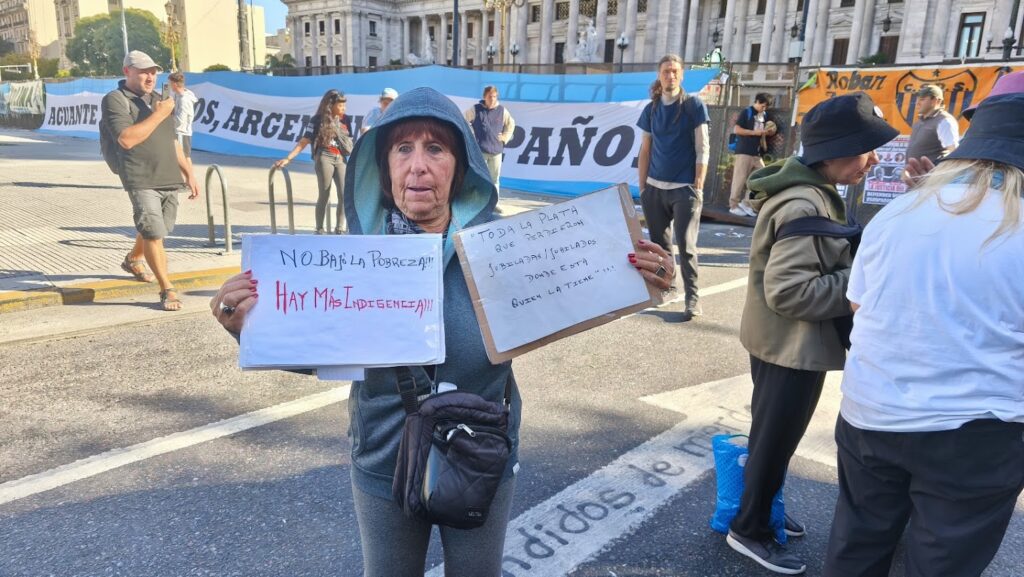
For Alicia, this increase in women’s work reflects the deterioration of informal work and does nothing to reduce gender inequalities in the labor market. This is work without the right to vacation, sick leave, accident insurance, or other basic rights. But formal employment has not guaranteed a decent life either. Mercedes Cabezas says that workers employed by the national government have lost 40% of their wages since Milei took office. A person with 23 years of service earns an average of 480,000 pesos. The basic food basket for one adult costs 580,000 pesos.
To make it to the end of the month, families go into debt. An ATE survey shows that 87% of its members are in debt. Mercedes describes how these debts accumulate: “What ends up happening is that our workers first take on debt with a bank, then with a credit company, then with a digital lending platform, and finally through informal loans that are even more precarious, with collection practices that often involve coercion.”
Austerity affects women throughout their lives, from the youngest to the oldest. The government eliminated the pension moratorium, which allowed people to retire even if they had not made contributions for all the years normally required. “This kind of measure protected women workers who, during their working years, performed unpaid reproductive labor or worked in the informal economy,” Alicia Coca explains.
Every Wednesday, pensioners protest outside the National Congress in Buenos Aires. They demand a minimum pension, the reinstatement of the pension moratorium, and restored funding for PAMI, the health care system for pensioners.
Who Pays for the External Debt?
In April 2025, Milei’s government secured a new USD 20 billion loan from the IMF,
and more than half of that amount was spent to prop up the Argentine peso. In October of the same year, the US Treasury bought pesos and opened a credit line with Argentina’s Central Bank. Trump made this support conditional on Milei’s party winning the legislative elections that month.
Argentine grassroots feminism reads these figures through the lens of their direct impact on women’s lives. Alicia explains: “For the grassroots feminism we are part of, processes of external indebtedness and financial subordination are not simply macroeconomic indicators: they have a direct gendered impact. With our longstanding slogan, ‘we want to be alive, free, and debt-free,’ we explain that fiscal austerity plans aimed at paying the external debt lead directly to cuts in public services, infrastructure, and, above all, care policies.”
National debt and household debt are tools of the same capitalist and patriarchal system. IMF demands hollow out budgets for health care, education, and policies to address violence, increasing precarity and pushing women into debt. For Alicia, debt serves a political function: “Debt operates as a political tool that seeks to discipline bodies, our bodies, privatize hunger, and force women workers to focus on daily survival instead of being able to make plans and imagine a future for ourselves and our children.”
The economic attack comes together with a cultural one. In January 2025, at the World Economic Forum in Davos, Milei questioned the very concept of femicide. Activists from CTA Autónoma understand the attacks on feminism, sexual dissidence, and legal abortion as a smokescreen. The government treats organizations as internal enemies and gives greater prominence to so-called “culture war” issues in order to divert attention from falling wages and layoffs. Florencia Abregu points out that this offensive is also seen under other far-right governments across the continent.
Subordination to Washington also has terrriorial consequences. Decree 70 of 2023 overturned the law limiting land purchases by foreigners, opening the country up to the acquisition of territories containing strategic resources such as water, as well as land in border areas. Trade union, feminist, peasant, and youth movements took to the streets under the slogan la patria no se vende, “the homeland is not for sale.”
The dispute also extends to the mountainous provinces, where lithium extraction and the mining of other critical minerals are expanding. For the activists, these are the peoples’ commons, not commodities. The same grassroots and internationalist solidarity leads Argentine feminists to denounce Milei’s government’s alignment with the United States and Israel, which are responsible for the genocide in Palestine.
Resistance in the Kitchens and the Streets
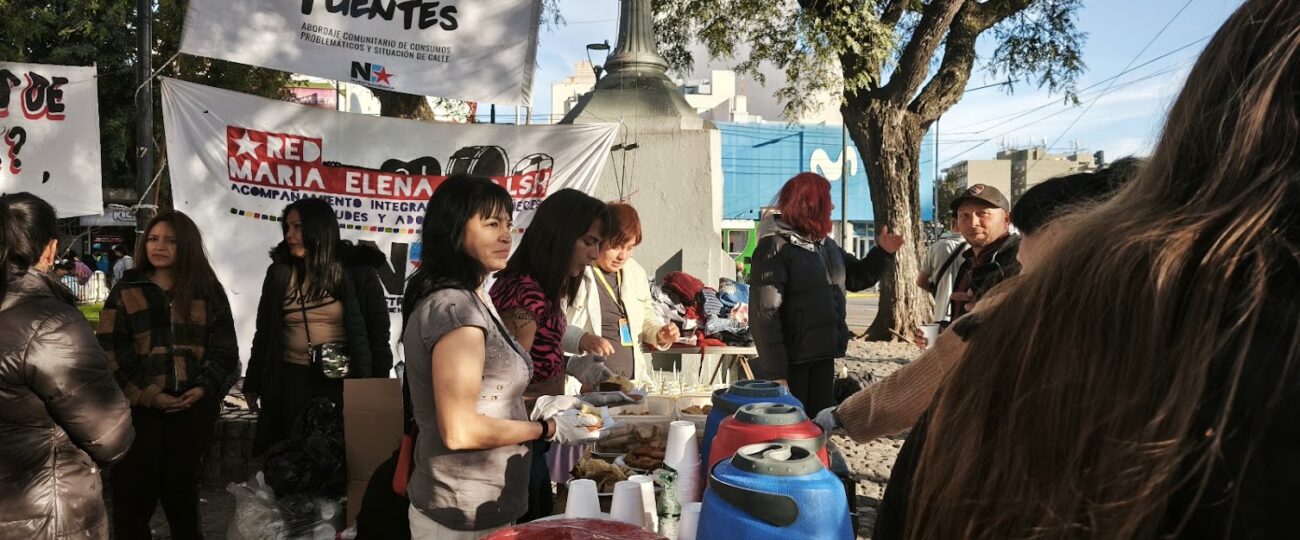
Community kitchens are the first line of resistance in this struggle. There, cooks prepare guisos estirados, stews stretched to make twice as many servings, using donations from local shops and small-scale producers. Who comes to these kitchens has changed: today, entire families of employed workers eat there because their wages are no longer enough to cover the basic food basket.
Among the many cuts made by the government was the Potenciar Trabajo program, which provided an income to people working in cooperatives and community kitchens. Organizations have responded by demanding that collective care be recognized as work. Through its neighborhood organizing arm, the National Territorial Federation (FeNaT), CTA Autónoma is fighting for the passage of the Community Cooks Law. “Feeding thousands of people is essential work that has gone without proper recognition for many years. This work should not be treated as volunteer labor, but as part of the work and care that sustain our neighborhoods,” Alicia explains.
The crisis is also reviving responses that Argentina has historically developed in times of crisis. Feminist economy networks organize community markets and exchanges of clothing and food that do not necessarily require money, sometimes using community currencies created by the communities themselves.
The people who sustain life in the neighborhoods are also taking to the streets, and they are the first to face direct attacks from the government. Figures on repression during the government’s first 1,000 days were compiled by an anti-repression monitor run by CTA Autónoma and human rights organizations. A total of 147 protests were met with repression, 5,141 people were injured, and 762 were detained. Another 520 people are facing criminal charges for protesting. There were also 125 raids and eviction operations, primarily targeting social movements and Indigenous peoples.
None of this has demobilized the movement. In October this year, the organizations took part in the 39th Plurinational Gathering of Women and Dissidences in Córdoba, and they remain in the streets under the slogans el hambre es un crimen and Milei es hambre: hunger is a crime, Milei is hunger.
For Florencia Abregu, organizations will never replace the role of the state. But the task now is to strengthen every space where comrades organize. As she puts it: “This has to do, in part, with reclaiming grassroots feminism and nurturing every seed of organization where comrades can find a space to organize, struggle, and build a feminism that is not academic, that is not theoretical, but is built through practice.”
Before the runoff in Brazil’s presidential election, when Flávio Bolsonaro’s campaign was holding up Milei’s government as a model, Florencia issued a warning: the challenge for grassroots movements and organizations is to defend their territories against the advance of the far right. In Brazil, this advance was confronted through grassroots defense of Lula’s government and his election to a fourth term. For Argentina, Mercedes Cabezas points to a way forward: a political project based on sovereignty and feminism, one that redistributes wealth and breaks with the capitalism that is crushing the people today.