Brazil’s women’s movement engaged with this year’s presidential election in the country asserting that this would not be just any election, neither for the Brazilian people nor for Latin America and the Caribbean. We have been facing a deeply misogynistic and internationally coordinated far right, while the United States has been blatantly interfering on and mounting an offensive against our continent.
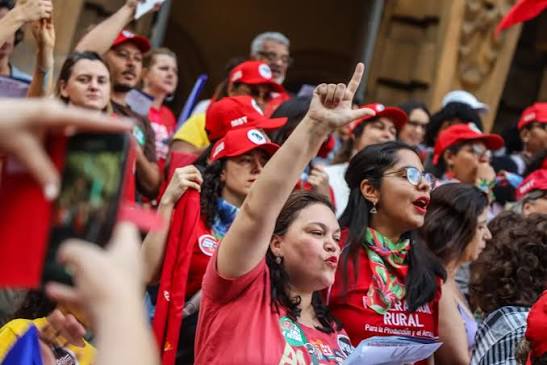
The people’s victory in the runoff was beautiful and historic. We turned the tide with the power of intergenerational, people-centered mobilization. It was the youth who rose up and fought back, employing a diverse range of coordination and mobilization strategies that broke with the traditions of left-wing organizations. It was the elderly and those living far from their polling places who reduced voter abstention.
In the streets and on social media, we built synergy and a cycle of feedback that must guide the strength we have accumulated for the battles that follow this victory of ours. Sharing content and fostering the conversation online went hand in hand with the everyday work of “door-to-door” canvassing, setting up street stalls to talk to people, leafleting, and holding marches and rallies across the country. We learned how to use social media, but we also came to understand how Big Tech companiesoperate. We re-elected Luiz Inácio Lula da Silva and, in the process, we were able to push Congress to finally pass a bill to reduce the working week from six to five days, a historic win that will ensure that nearly 15 million Brazilian formal workers have an extra day off a week without pay cuts. Not only that, but we also got the president to sign a provisional decree to ban online gambling operations in the country. The whole world watched us, and we showed that defeating Donald Trump is possible.
Fascism and Violence
Celebrating our victory must not mean downplaying what the other side was and is: fascism.
Hatred of those who are different and violence as a method are pillars of the fascism of our time, forged at the heart of decaying imperialism. This is the framework for understanding misogyny and its escalation through hate networks on Big Tech platforms. During the election campaign, this translated into open political violence against left-wing women candidates, who faced systematic threats of sexual violence and death, as well as attacks on activists. The study “Political and Electoral Violence in Brazil” found 134 reported incidents of political violence during the 50-day first-round campaign. Even though women accounted for only 34.85 percent of the candidates, they made up nearly 60 percent of the victims.
In the second round, we defeated a far-right movement that, unlike in other Latin American countries, is organized as a party with a political identity, a platform, and the capacity for coordination. Proving what grassroots feminism has long argued (“it’s not enough to be a woman…”), women from the Liberal Party (PL, the party of the Bolsonaros) were elected regardless of openly opposing women’s right to vote.
They represent a tactical shift in how the far right engages with and speaks about politics to the majority of the population: now, more than ever, it is women who are advocating the anti-feminist and conservative agenda. With a strong digital presence, their agenda aims to delegitimize any progress or policy that can benefit women, from social policies to measures to combat violence against women. They unashamedly attack feminism in all its forms and advocate for an anti-people economic program.
Challenges for Organized Women
We must understand this movement and its central role within the far right to confront this balance of power. Fortunately, well-positioned women are spearheading a renewal of the left in the Brazilian Congress, as they articulate the intertwining of feminism and the fight against racism with a working-class agenda, including the struggle for social policies and national sovereignty.
It is time to overcome the denial of feminism as a collective political subject and to recognize its agenda as key to structure the vision of the country we want to build. We have the next four years to build momentum and advance this project, in both form and substance.
One challenge now is to understand how the strength and energy of mobilization can effectively become a new way of governing and engaging in politics. For Lula’s fourth term, we need an approach that goes beyond the current instruments and mechanisms of social participation in relation to the state, which today do not empower the people. Far beyond councils and conferences, participation must go hand in hand with mobilization. Without people’s strength, we will not be able to secure the political conditions needed to implement the measures for change that got Lula elected.
Feminist Agenda
In the World March of Women, we understand that we must channel the energy of people’s mobilizations to organize and build strength for structural transformations. At least two areas are fundamental for women’s struggle in the upcoming Lula administration.
The first is the effective implementation of a National Care Policy, including the universal provision of daycare centers, community kitchens, and communal laundries, as well as care centers and policies for the elderly. Lula’s third term has rebuilt policies for women and established a care policy. Lula’s fourth term must take a leap beyond pilot projects and prioritize care in the budget.
The second pillar is digital sovereignty, which, from our feminist standpoint, combines the fight against misogyny with the challenge to Big Tech. Sovereignty will remain mere rhetoric unless Big Tech is regulated and its power over our communication and the infrastructure of our lives is dismantled. Data on the Brazilian population and territory must truly belong to us and serve our project for the country. We must invest in developing artificial intelligence models designed to solve the problems people face in their everyday lives, as part of a digital transformation of the state anchored in sovereign digital infrastructure and sovereignty over our critical minerals.
These two pillars are intrinsically linked to the economy we want: a life free of debt, with work that secures our rights and time for rest and leisure. Against financial capital speculation, we are committed to the real economy, to care, and to meeting the people’s basic needs as the cornerstone of economic transformation.
It was not the financial market’s program that won this election. The youth, women, and older adults elected the program of Farmácia Popular, which offers free medication to the population; a program of investment in health and education, of free public transportation, of healthy food, and of sovereignty. It is this program that we must uphold through organization and mobilization over the next four years.
Tica Moreno is a member of the National Coordinating Board of the World March of Women in Brazil and a member of the Capire team.