On October 4, 2026, Brazil went to the polls for the first round of the general elections to choose the president, governors, senators and deputies.The far right performed strongly at the polls. Flávio Bolsonaro, a senator and son of former president Jair Bolsonaro, finished first with 47% of valid votes, against Lula’s 45%. The Liberal Party (PL), the Bolsonaro family’s party, elected 121 federal deputies, the largest single-party caucus since the 1988 Constitution, and will hold 29 seats in the Senate beginning in 2027. In São Paulo, Governor Tarcísio de Freitas, a Bolsonaro ally, was reelected in the first round. Lula and Flávio Bolsonaro will face each other again in the runoff on October 25. To understand what is at stake, we turn to this analysis by Lourdes Simões, from the World March of Women in Brazil. Lourdes offers a historical overview and an analysis of what the country has experienced since 2016.

Between 2016 and 2022, we went through a process of dismantling. It began with Michel Temer, who assumed the presidency after the coup that removed President Dilma Rousseff from office in 2016, and immediately pursued structural reforms, including pension and labor reforms. On March 8, 2017, our message in the streets was the defense of retirement rights and opposition to the pension reform. Their strategy was to prepare the Brazilian state to implement changes that would shape the future.
The Bolsonaro government’s strategy was not merely to create local and temporary setbacks: it was designed with the future in mind. In Brazil, deputies and senators can allocate part of the federal budget through what are known as parliamentary budget amendments, generally directing funds toward public works and services in their electoral bases. Since 2015, a growing share of these amendments has become mandatory, meaning the government is required to fund them. Under Bolsonaro, this process deepened with the so-called secret budget, a mechanism that distributed billions of reais to allied members of Congress without transparency about who had earmarked the funds or where they were going. The Federal Supreme Court (STF) declared the secret budget unconstitutional at the end of 2022, but Congress retained significant power over the budget. It was a siren song that many on the left also gave in to, and today Brazil faces a paradox. Parliamentary amendments now account for around one quarter of the funds the government can allocate freely, with no requirement that they be linked to the executive branch’s planning priorities.
Under the Lula government, this model has been challenged and questioned. There have been attempts to establish protocols linking the parliamentary budget amendments to government priorities, but they remain largely detached from government priorities. This is why the challenges today are much greater than in the past. This is not simply a dispute over ideas: there is an institutionalized budget within Congress that gives staying power to the ideas that take hold there. Through these amendments, members of Congress channel resources to their electoral bases and enter elections with an advantage. It is no coincidence that the far right made gains in these elections, electing more senators and deputies. At this moment, the last line of defense is the runoff in the presidential election.
Since 2023, we have been going through a process of reconstruction, and it has not been simple. It was only in February 2023 that President Lula was able to issue the decree reorganizing the ministries. Everything had been dismantled. Bolsonaro did not need an organized institutional structure because he had a parallel power structure built with Congress, especially with the so-called Centrão, a political bloc that generally supports whichever government is in power in exchange for positions and resources. Through parliamentary amendments, he could do everything.
He dismantled the ministries and placed military officers in key positions. It was a degree of institutional capture unlike anything we had ever seen, a destruction of everything we had built. We talk a lot about public policies, but they are implemented through institutions, and it was precisely those institutions that were dismantled.
What we managed to move forward with during this period was reconstruction. But it was a very slow reconstruction. We resumed policies, but we were not starting from where we had been in 2014 and 2015. When the transition team assessed what had happened, it was devastating. We realized that simply reinstating a policy was not enough: implementing any policy requires objective conditions. And that is much more difficult, because it required rebuilding the entire structure.
The Ministry of Women, formerly the Secretariat for Women’s Public Policies (SPM), was reestablished, and the Ministries of Racial Equality and Indigenous Peoples were created, because this is who the Brazilian people are. The government needs to reflect the Brazilian people, and it did not. We rebuilt ministries and important policies in health, education, social assistance, the environment, and every other area, especially those affecting women. This perspective does not interest the far right, which defends the interests of capital, big business, and major corporations.
Women’s Achievements and Struggles Under the Lula Government
The 2022 elections were marked by intense polarization around women. The idea that women can earn less than men and that men are the heads of households, violence, rape, the way Bolsonaro treated women: all of this had a major impact on that election and contributed to women accounting for 53% of Lula’s votes.
The policies that were implemented were the right ones: equal pay, the National Care Policy, and joint work with the health sector to address violence against women and women’s health problems. The rebuilding of social participation and civil society’s presence within government was also very significant. Councils were reestablished, the social participation council was created, and dialogue was opened with organized civil society and even with groups that are not formally organized.
There is an important criticism to be made here. After Lula’s victory in 2022, the capacity of social movements as a whole to coordinate politically, including, to some extent, the women’s movement, grew stronger. Trade union federations created their own forum and began discussing among themselves, and the same happened with the different fronts. A strong element of coordination was missing because a sense spread that, with the victory, the government would solve everything. That is not true. Popular pressure is essential.
Women have one particular characteristic: we remained more organized because we have a calendar of struggles that pushes us and helps us sustain mobilization beyond the issues currently on the agendas. From 2023 to 2026, whenever it was necessary to take to the streets, women did so. One example was the Criança Não É Mãe [Children Are Not Mothers] campaign, which was an intense moment of mobilization. Another is the current struggle against femicide.
Women have always been on the front lines, and we have remained there. We continue to struggle intensely, even if those struggles are fragmented. The movements have not stopped fighting, but the strength of our struggle depends on coming together and unifying our efforts. Moving forward will require much more organization, coordination, and strength than in the past, because the crisis in Brazil has deepened.
What Is at Stake for Women’s Lives
What is at stake in these elections is whether we will see the same process of rollback, only with much greater intensity. Between 2016 and 2022, there was a process of dismantling, and I believe it will happen again, even more intensely, if Lula does not win the runoff.
Brazil’s elections concern not only Brazil, but the entire world, because sovereignty is the central issue. We are the ones defending a sovereign Brazil. The other side, the far right, does not defend sovereignty. Quite the opposite. The recolonization of the Americas is on the agenda, and that is what Trump is seeking.
Oil, along with rare minerals, is once again in the eye of the storm in the international geopolitical dispute: who controls these resources. The major disputes revolve around this, and this is one of the reasons we say the United States has its eyes on Brazil. What is at stake in the debate over sovereignty is what kind of country we want to become in the future.
For women, this weighs even more heavily because we know that whenever there is a setback of any kind, we are the first to pay the price. And among us, Black women are the first, as we saw during the pandemic.
One of the things we have been saying among ourselves as women is that these elections challenged us, and continue to challenge us now in the runoff, to emerge from this process much more organized and coordinated than we were in 2022. We cannot simply finish the election, go home, and think the game has been settled. It was not settled then, and it is not settled now. It is even more complex today.
Even with a victory in the runoff, that complexity will remain because Lula lacks support in Congress and because we need to rebuild relationships among ourselves and renew our dialogue with women. This election showed that we are having difficulty listening to women’s demands, and in order to have a dialogue, we first need to listen.
The National Care Policy has this potential because it addresses precisely the sphere where women are: the sustainability of life. Women are the ones who do this work, which is the most burdensome. The sexual division of labor is the basis of capitalist exploitation.
The challenge is to move forward and to go further. In the field of care, for example, childcare and basic education need to be universal policies, because they can give women autonomy and ease the burden they carry. Together with ending the 6×1 work schedule, without wage cuts and with shorter working hours, this would give women more time for themselves: time to think about everyday life, dream of other possibilities, study, organize their lives, and spend time with their loved ones. Access to childcare is a right of children, but it also gives women autonomy. Women are able to break cycles of violence when they have the conditions to do so.
How Women Are Organizing for the Runoff
I am speaking here from my experience on the ground. In São Paulo, women’s organizing across the state took on a very positive dynamic through last year’s National Women’s Conference. In addition to March 8, when we organize and come together, we have other national dates, such as November 25, September 28, and Julho das Pretas [Black Women’s July]. This calendar helps us sustain our organizing.
Last year’s conference was very intense. It engaged more than 250,000 women across Brazil and brought together more than 5,000 at the national gathering. This strengthened organizing in the states and municipalities because it was built from the bottom up.
That organizing continued, sustained by the year’s struggles and by the issues on the conference agenda in August. Through this process, we identified and confronted local policies that deny women’s rights, while developing alternatives. That is what happened in São Paulo: the idea of denouncing Tarcísio as an enemy of women emerged when we had to fight tooth and nail to ensure that the state conference would actually take place.
In Rio Grande do Sul, women also had to force the government to hold the conference. Similar confrontations took place in other states, with women from civil society playing a particularly important role in ensuring both the conferences themselves and the necessary conditions for participating in the National Conference.
This process also has a methodological dimension: it teaches us how to confront a state that seeks to deny rights. And that strengthens the struggle. There is direct struggle, but there are also struggles within institutional frameworks, when those spaces are used effectively.
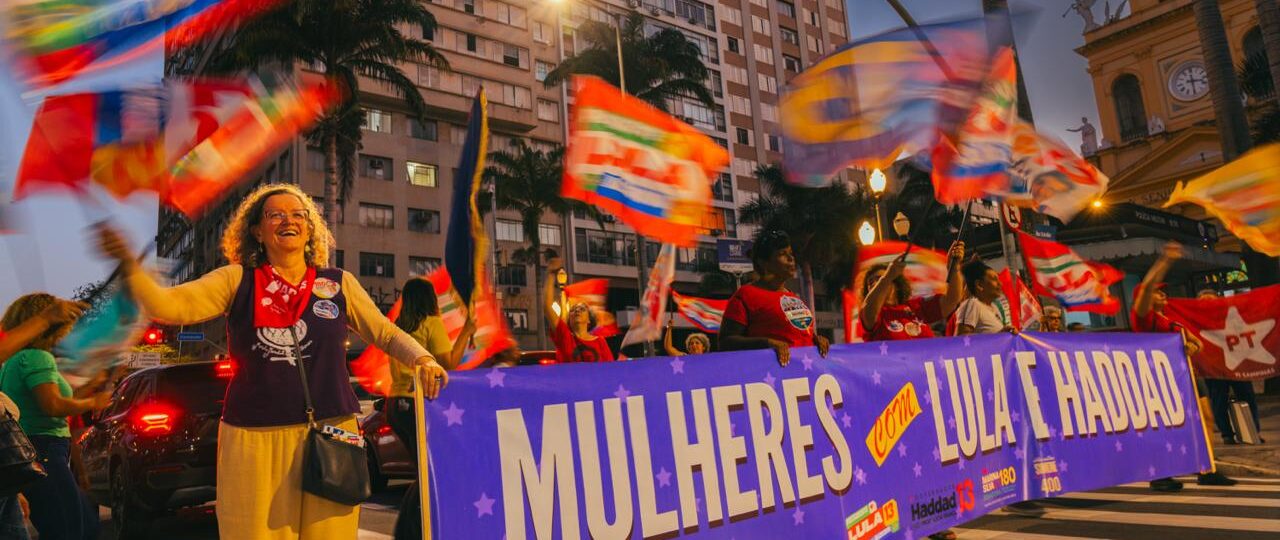
Now, in the runoff, the Women with Lula Front, which is already organized nationally, needs to intensify mobilization and organize actions that can reach women we have not yet reached. This coordination was strengthened by the PT’s national gathering, by organizing among other parties on the left, and by the social movements themselves.
The Brazil We Want
We want a Brazil that moves forward in reducing inequality because there is no way to expand women’s rights without reducing inequality. There simply is not.
There is no way to redistribute income without taxing those at the top, without taxing the super-rich, and without challenging the Central Bank. We need to advance people’s rights, but people also need to understand, through a democratic process of dialogue, what we are doing.
We have created thousands of inclusion policies in this country, in the budget, health care, education, housing, and many other areas. Even so, we still have overdue economic tasks, and agrarian reform is one of them.
These policies reached a certain number of people, but those people do not realize that they benefited because there was a change in government. We need to go further with policies of inclusion and rights for women, Indigenous peoples, traditional communities, Black people, and the LGBT community. But we need a different understanding: this is not about delivering something to these people. That idea of delivery is disastrous. It is about including them, and they have an important role to play in sustaining that inclusion.
Politics must be seen as an achievement of those who take part in it, generating a sense of belonging and a willingness to defend it. Today, we do not have that sense of ownership over public policies, nor do we defend them as achievements of our own.
That is why one of the challenges for the Brazil we want lies in how we communicate with people. Rigid, formulaic communication is a thing of the past. Today there are other channels, and they need to reach people in different ways. Communication is where the far right wins because its message is easier: it is the discourse of saying no, of contradiction, of accusation. You did not do this; you did not do that. Defending what has actually been done is more difficult.
We need to rethink our communication in order to move toward the Brazil we want: a country with more rights, a better quality of life, less inequality, greater sovereignty, and more democracy. All of this deepens democracy, as long as people feel that they are part of the process rather than supporting actors. Defending rights has everything to do with the process through which those rights are secured. Nothing is given to us; everything is won through struggle.
Lourdes A. Simões (Lourdinha) is an activist with the World March of Women (WMW) in Campinas, in the state of São Paulo, Brazil.