Reparations is a topic that is very important in our struggles, and today we are going to understand why it matters. We know that everybody deserves a good life, like we say in Latin America. It doesn’t mean that flashy life where I have to drive a big car and live in a lavish building. We are talking about a good life where everybody can get good food and good living, where there is justice. Good life cannot exist when some people are living in dignity while others are really struggling to survive every day.
We want to talk about reparations because they are not supposed to be acts of charity. They must be deliberate acts of justice.
We are living in a capitalist world where so much is dictated by this system. But grassroots feminist movements always remind us, and we work in collaboration with allies in social movement spaces, that another world is possible. Indeed, but only if we start acting towards that world that we want. What is our alternative? How are we going to make it possible? Our world must be built on care, on equality, and on our collective freedom.
In the face of growing anti-feminism, with so many fascist and conservative groups, it is very important for grassroots feminists to continue organizing. Our response must not simply be about resistance. We are resisting a lot against the neoliberal system of oppression that surrounds our lives, but it must also be courageous. It is courageous work to imagine and build this good life that we are all working towards and that everybody deserves.
For us, reparations are for a good life. The African philosophy of ubuntu teaches us that “I am because you are”, and we are because everybody is. It is very similar to the buen vivir philosophies from Latin America.
Reparation for us means restoring dignity, what has been lost, and redistributing the power they took away from us. It means repairing our relationships and the systems that have been there, investing in care, peace, and community well-being.
A lot of agents are talking about reparations recently. Our states and many governments that continue doing harm are talking about reparations. The question we need to start asking ourselves is: Reparation for who? Determined by whom? We must also help to define what justice and good life mean to the feminist movement and to the people who have been oppressed.
Grassroots feminism and reparations are deeply connected because they both seek transformative systems. We want to transform and dismantle those systems that are suffocating us and making our lives so difficult every day. We are seeking our own alternatives built on a feminist economy, on creating our own justice systems, the ones with which we can break the injustice and inequality that is widely happening around the world.
Our praxis
We must understand what is happening, because if we don’t, it will be so difficult to name it, to fight it, and to address it. Then, we must understand why this is happening. We can think it is all of a sudden, but some of it has been a long, prolonged history and struggle. And then we need to think about what we must do together.
As feminists, we know that we will talk, but we also need to theorize what we are talking about. I remember what Nalu Faria always reminded us: theory and practice are what will make our feminist and socialist movements strong, and so we cannot separate them. We will continue learning from our ancestors and from the people who are already there.Grassroots feminist movements base and starts its resistance in care and transformation. We lead these communities because they are our own communities, from the ground.
We are experiencing a lot of injustice every day, and I will speak especially from the African sisters, from my own experience. From the moment a child is born, there is a label, and that label is a struggle and a chain that you carry with you every day of your life until the day you exit this world.
So the conversation on reparation today invites us all to address past harms. There are a lot of historical injustices that we need to start addressing. It invites us to talk about the current injustices that we are seeing and what we are doing about them. And it also helps us to imagine that good world that we want.
The challengers we face
The issue of reparation is a sensitive one: the moment you start talking about reparation and the injustices that happened, you will be a target. We are seeing a lot of harmful narratives that portray us as such. There are a lot of anti-feminist wars happening around the world. The anti-feminism we are seeing is more than opposition to women. People sit down and tell you, “women, there are so many gains that women already have”, “you are talking too much about women”, “you are doing so many things”, “what is happening?” That is one thing that we should always remember: people are using some achievements to justify the harm that still exists, and we cannot allow them to do that.
The civic space has shrunk a lot, and this is where our feminist voices are. This is where our collective voices come together and where we strategize. We cry together, we laugh together, and we think about how we craft our alternatives together.
We are seeing a lot of attacks on gender justice advocates. We are seeing a lot of human rights defenders being arrested every day. Femicides and women disappearing are not new news anymore. It is happening every day.
Our movements as grassroots feminists matter a lot to fight against this system. We are doing whatever we can to find our spaces and to bring our collective efforts, and this gives us a lot of hope. Our stories are built on solidarity, political consciousness, and our collective power, and we cannot get this separately.
And what must be done? Our collaborative movements must come together: our allies, our sisters, connecting and talking about these issues and building alternatives. We must continue to build our solidarity across movements and generations. And we need to shift power to those who are adversely affected.
___
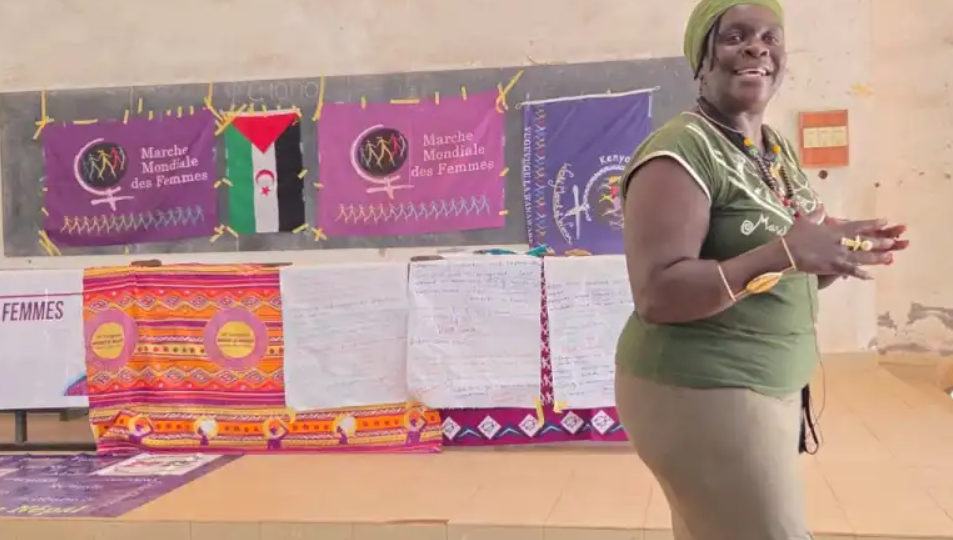
Sophie Dowlar is a member of the World March of Women (WMW) in Kenya, and the coordinator of the African edition of the Berta Cáceres International Feminist Organizing School (Afro-IFOS). This text is an edition of her public speech at the webinar “Grassroots Anti-Racist Feminism for Reparation and Good Living,” organized by the WMW, Capire, and ALBA Movements, on 26 July 2026.