While green capitalism continues to deepen the causes of the environmental crisis, organized peoples resist and defend their territories through collective practices to protect and recover the commons. There are many experiences of alternatives and resistance grounded in feminist economy, food sovereignty, and agroecology.
Some of these experiences, from Brazil and Palestine, came together in a webinar organized by Capire and the World March of Women: the “Plant trees, produce healthy food” plan of the Landless Workers’ Movement (MST), the “Living Caatinga through women’s hands” campaign of the 8th of March Feminist Center (CF8), in alliance with SOF Sempreviva Feminist Organization and the Pastoral Land Commission (CPT), and the central role of olive trees in the Palestinian people’s resistance to the colonial occupation of their territory by Israel.
A Semi-Arid Region Full of Life
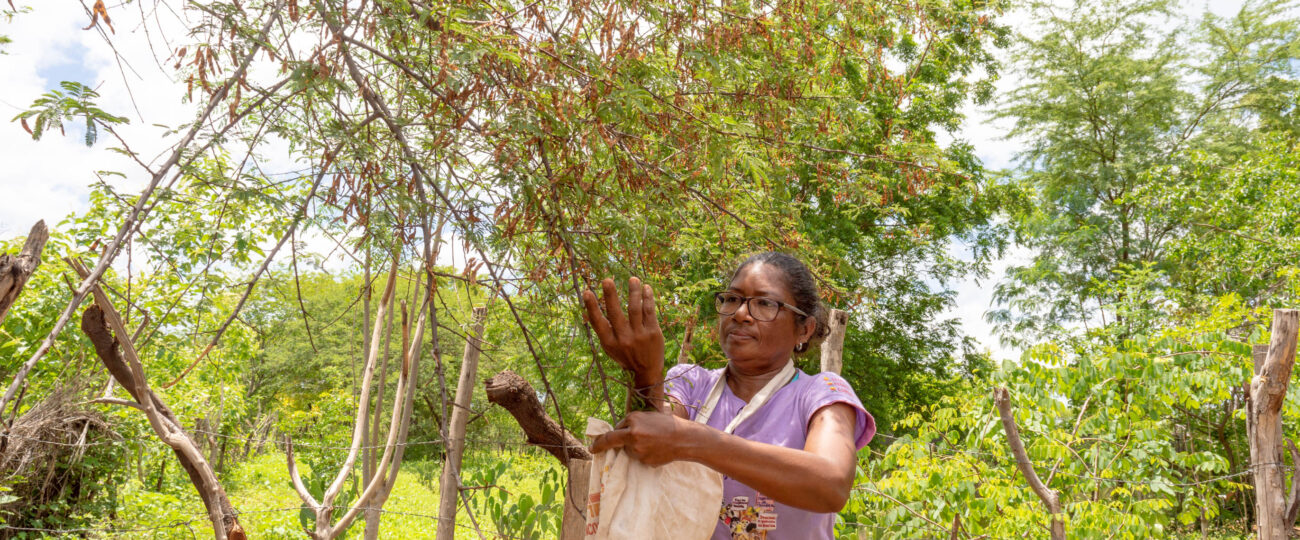
The Brazilian semi-arid region, a territory of more than one million square kilometers spanning states in the Northeast and part of Minas Gerais, is home to a biome known as the Caatinga — a dry forest ecosystem. Contrary to the collective imagination that portrays this landscape as desert-like, there is abundant life in this territory. Ivi Aliana, from CF8, reflected on the need to give visibility to this biome by highlighting its characteristics and biodiversity through the people who live in it.
A biome is not a box. Solving the problem of one biome does not mean that other environmental problems are solved. We need to understand that life in the Amazon depends on life in the Caatinga. We, as women, have learned that things must be interconnected — that is why our struggle is internationalist.”
Ivi Aliana
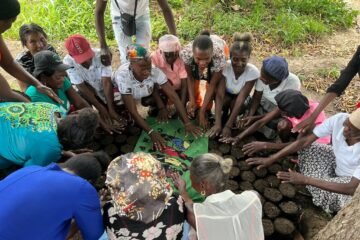
Building on a project that already supported women’s production in their home gardens, the “Living Caatinga through women’s hands” campaign brought together 20 groups that produced more than 400 seedlings of native Caatinga plants and a diversity of food crops. “We wanted to broaden the understanding of the importance of a living, standing, and agroforested Caatinga for women’s permanence in these territories,” Ivi explains. The project develops agroforestry practices in home gardens, promotes beekeeping, and preserves native seeds.
A Forest You Can Eat
Barbara Loureiro, from the MST, recalled that reforesting through home gardens is a historical practice built by rural peoples, which is at the genesis of the Landless Workers’ Movement. The national plan “Plant trees, produce healthy food,” launched in 2020 to plant 100 million trees by 2030, brings together the struggle for popular agrarian reform — a central political agenda of the movement — with the challenge of producing healthy food and caring for nature through tree planting.
The trees introduced as elements of greater diversity and to increase climate resilience must also enable the diversification of food production. There are multiple agroecological production chains organized around tree planting: cocoa, honey, fruits, nuts, and agroforestry systems. For this, an entire organizational process of seed production chains and seedling nurseries is essential to ensure autonomy in planting.
Barbara Loureiro
The plan also positions itself as a space for the battle of ideas, as the environmental agenda is today a field in dispute, marked by false solutions that seek to obscure the structural causes of the crisis. “It is not about planting trees in any way. Agribusiness also talks about reforestation, but does so through monoculture, eucalyptus, and pine, reproducing the same model that destroys territories and lives,” she explained.
From an agroecological perspective, the MST articulates political and technical education, communication strategies, and an educational and environmental praxis. The organizational dimension of the plan is also central, built through landless families, agroecology schools, youth environmental brigades, and forest fire brigades, increasingly necessary in the face of the climate crisis.
In this process, Barbara highlighted the central role of women in the MST, present both in denouncing the impacts of the crisis on territories and in building alternatives in relation to nature, through the care of seeds, the organization of seedling nurseries, and the collective construction of a new environmental consciousness in the territories of popular agrarian reform.
Olive Trees and Palestinian Resistance
In Palestine, the environmental struggle is not separate from the struggle for popular liberation. For Rasha Abu Dayyeh from Friends of the Earth Palestine (Pengon), forests, water, and soil are part of the same history of resistance. Olive tree cultivation, its fruits, and the products derived from it have been part of Palestinian agricultural culture for hundreds of years. This culture, however, has been destroyed by the Zionist occupation. Centuries-old trees have been burned, and those that still stand are increasingly confined to territories controlled by the Zionist occupation.
each woman who plants a new seed, who tends to the soil, who insists on returning to her field, despite the soldiers and the settlers, is building and rebuilding the forest of resistance. […] For us, the olive tree is not only an agricultural crop, it’s a symbol of belonging, a form of resistance and a declaration that we’re still here.”
Rasha Abu Dayyeh
Rasha points out that women carry the histories and knowledge of land and seeds, and are therefore at the center of resistance and the creation of biodiversity and care for the future: “in Gaza, women still are leading very small initiatives to plant herbs and vegetables in the destroyed lands. Some of our women engineers have started small initiatives of planting some vegetables and so on near their tents. They try to reuse the water, even that the water available in Gaza nowadays is polluted”.
Research conducted by Friends of the Earth Palestine has identified high concentrations of phosphorus in water and food. Even so, in the West Bank, women’s cooperatives are recovering local varieties of wheat and thyme, as well as olive oil production.
At the same time, the language of green transition and climate solutions has been appropriated and manipulated by transnational corporations and Zionist occupying powers that encroach on the territory. Under the guise of renewable energy, Palestinian lands are confiscated for solar projects to which the Palestinian population itself has no access. In the name of water innovation, springs and aquifers are controlled by companies such as Mekorot.
While the protection of nature is proclaimed, forests are turned into military zones and valleys into waste dumps for settlements. This is what Rasha calls green colonialism, “when the same system that destroys our land pretends to save it.” There is no climate justice without liberation, as there can be no environmental sustainability under occupation, nor ecological restoration without justice for peoples and for the land.