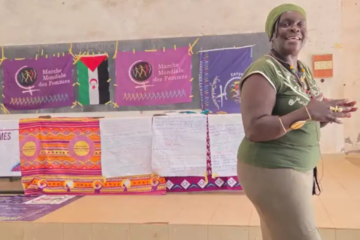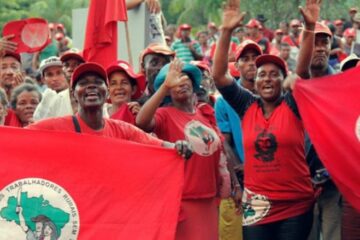
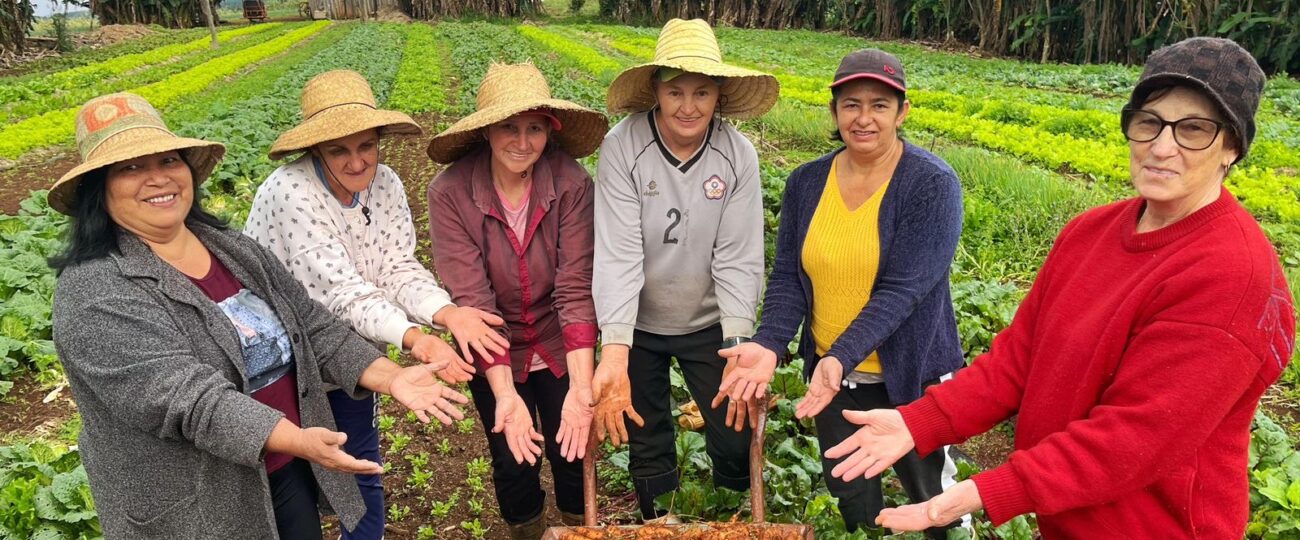
Grassroots feminist women know that there can be no food sovereignty without women’s autonomy, just as there can be no social justice without land redistribution and secured access to the commons for the sustainability of life. Defending the land means defending the possibility of existing with dignity, deciding what to grow, what to eat, how to live, and who occupies the territory. In this sense, agrarian reform is not just a policy—it is a feminist struggle that challenges the foundations of the patriarchal, colonial, and capitalist power that organizes the exploitation of land, nature, and women’s labor.
In rural areas, women represent roughly 40 percent of the agricultural workforce, yet they own only 15 percent of the land. They affirm the need for comprehensive and popular agrarian reform to change the economy and social relations between people and between people, land, and nature. This struggle confronts agribusiness, the financialization of life, and violence in the territories, while building alternatives based on agroecology and care. As they continuously wage this struggle, women from different international grassroots movements are preparing for the Forum of Peoples and Social Movements, held on February 22nd and 23rd, and the Second International Conference on Agrarian Reform and Rural Development (ICARRD+20) held from February 24th to 28th, 2026, both in Cartagena, Colombia. These events will take place 20 years after the Food and Agriculture Organization of the United Nations (FAO) held its first conference, held in 2006 in Brazil.
Nury Martínez, a member of the International Planning Committee for Food Sovereignty (IPC) and the National Unitary Agricultural Trade Union Federation (FENSUAGRO)—a member of La Via Campesina in Colombia—explains that this new conference comes at a critical moment. The current context of land grabbing, displacement, ecological destruction, and violence in the territories has been leading to growing hunger and poverty across rural, fishing, Indigenous, Afro-descendants, and pastoralist communities. “This is having a huge impact on the territories, not only because of the destruction of the land itself, but also because of the destruction of culture, dignity, food sovereignty, and everything that comes with the loss of biodiversity, which increases global warming,” she argues.
Amid this scenario, La Via Campesina has filed a proposal with the International Planning Committee for Food Sovereignty (ICP) to have a second edition of the Conference, to be held in Colombia with the support of allied governments, including Brazil. As Nury says, “the issue of land has to do with everything that involves caring for the planet. For us, it not only includes access to land, but also to territory, and the social role of producing food for the people. We consider this to be quite important, given that Colombia has a progressive government that has placed the issue of land, food, and peasant or rural communities at the center of its agenda.”
Since the preparations of and during the 3rd Nyéléni Global Forum, social movements have placed the issue of land and agrarian reform at the forefront of the struggle for food sovereignty, an agenda for a collective struggle that will celebrate its 30th anniversary in 2026. This is why the Conference is part of the common agenda different movements are pushing as they understand the centrality of the struggle for food. This moment integrates the agrarian agenda with the issue of food production and distribution and the role of society at large in this system, from rural to urban communities. “If we consider that everything on the agendas of grassroots movements concerns the issue of food, that also means placing the industrial agri-food system that is destroying the climate and the land at the center of the conversation. If there is no redistribution of land, if small-scale production, which cares for biodiversity and produces healthy food, continues to be ignored, global crises will remain unsolved. We believe that we are part of the solution,” Nury says.
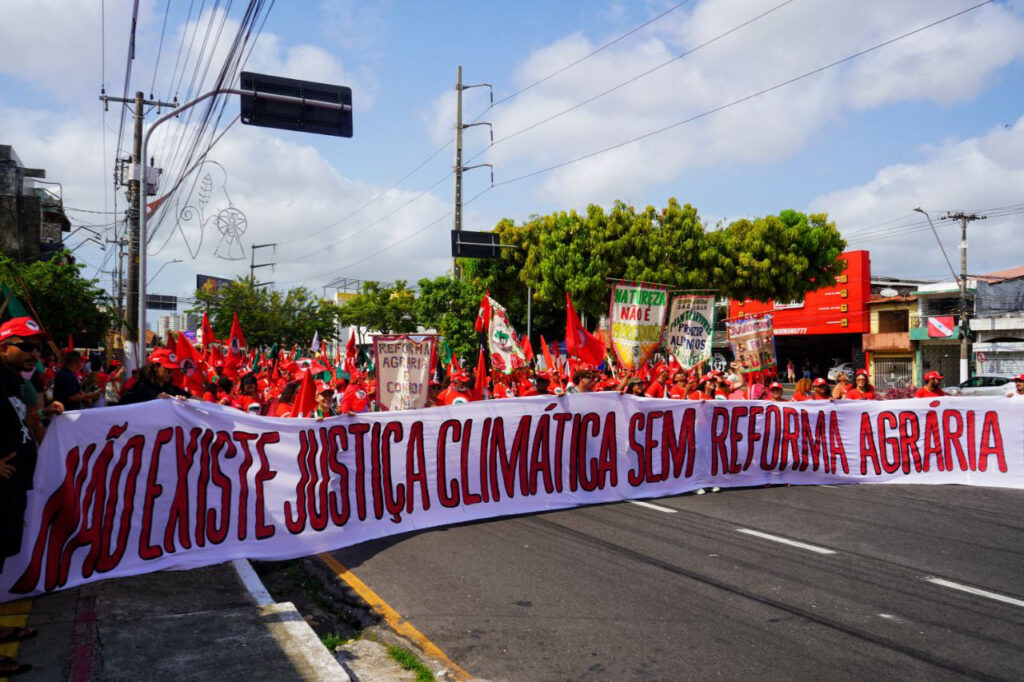
This event also takes place in the International Year of the Woman Farmer, established by FAO. With the aim of raising awareness about women’s role in the countryside and their contributions to agri-food systems, 2026 will serve as a platform for policymaking specifically targeting this group. This action aims to recognize the contribution of rural women to food security, poverty eradication, and gender equality.
From a feminist perspective, the women of the World March of Women argue that agrarian reform is a fundamental step towards building social justice, equality, and respect. Access to land must go hand in hand with better living conditions, housing, and the production of healthy food with quality of life and well-being for everyone in rural, forest, and waterside areas.
Sarah Luiza de S. Moreira, with the WMW Brazil, says this struggle is a fundamental part of the grassroots feminism that the movement is building. “For us, comprehensive agrarian reform also aims to build a more just and egalitarian society, with people’s participation and respect for nature, women’s bodies, and women’s lives. Feminism and agroecology are fundamental steps for us to build a more just society, with sustainability for human and non-human life,” she argues.
Women farmers, from rural, forest, and waterside areas, are the foundation of the struggle for food sovereignty. Together, they are paving the way for comprehensive agrarian reform that provides land to live on and the necessary elements to produce healthy food and good living. “This is what can secure access to health through food for everyone. Also, comprehensive agrarian reform is part of our strategy to combat large landholdings and strengthen agroecology,” Sarah Luiza argues.
The contribution of grassroots, anti-capitalist, anti-racist, and anti-LGBTphobic feminism includes ensuring women access to land and conditions for living and producing. Around the world, women still have the least access to land titles and other rights. In several countries, they do not even have the right to own land, which makes the struggle for agrarian reform an internationalist feminist struggle.
As Sarah explains, “when we talk about comprehensive agrarian reform, which includes feminist and agroecological perspectives, we are talking about a project for society that strives for better living conditions for the entire population. It is not something that only concerns those who will have access to land, but the entire population who will have access to healthy food on their tables. [This means] sharing this project for society, which includes education, a more egalitarian and more just life—life that does not overburden or lead to so much poverty [not only in the countryside but] also in the cities.”
From this comprehensive perspective, different grassroots movements argue that this struggle is not limited to land. As Nadini Orchid Nembhard, co-chair of the World Forum of Fisher Peoples (WFFP), explains, “from the perspective of the global fisherfolk movement, agrarian reform must explicitly include coastal, marine, riverine, and inland water territories, recognizing that for small-scale fisherfolk and Indigenous Peoples, land and water are inseparable. Agrarian reform is therefore understood as territorial reform.”
Nadini says that the central agenda of fisherfolks at the Conference is focused on advancing the recognition, protection, and redistribution of customary tenure rights and the right to territories. “This includes secure collective rights over coastal lands, shorelines, mangroves, fishing grounds, rivers, lakes, and associated commons that sustain livelihoods, cultures, food systems, and ecosystem stewardship,” she explains.
La Via Campesina has played a key role in the relationship with the Colombian government for the Conference preparations. Higher participation of social, rural, Indigenous, pastoralist, and fisherfolk movements in this space is therefore expected. Nury says that, while all the global networks that make up the ICP will attend the Conference, there is a focus on youth and women’s groups. “The role of the youth in terms of access to land and territory, as well as in food production, means the recognition that the youth must remain in the countryside, because the future of the countryside and food production is in the hands of the youth. If they don’t have access to land, it will be difficult for them to stay in the countryside, and they will not have opportunities.”
With regard to women, there are struggles and alternatives being developed acknowledging how land concentration directly affects them and how they organize and already produce life in their territories. “We are not waiting for this land to come to us—we are fighting for it collectively, politically, in integration with all the movements and collective struggles of the peoples of rural, forest, and waterside territories,” Sarah states.
Like Sarah, Nadini advocates the role of fishing communities in this collective struggle. “We affirm that coastal and inland fishing communities are part of the agrarian reform struggle, resisting displacement caused by industrial aquaculture, port expansion, tourism, conservation enclosures, and extractive industries, and demanding redistribution and secure collective tenure over land, waters, and territories where dispossession has occurred.”