In the current social construction, women feed and care for the world! We are fierce, strong and carry the struggle for justice.
We highlight the systemic oppression that shapes women’s health, considering women all of those who identify as such — including trans gendered, non binary and gender fluid people.
Systemic issues
The end of capitalism will not be the end of patriarchy, but the end of patriarchy will be the end of capitalism. Today’s global colonial capitalist economies depend on the reproductive labour of women, their unpaid and underpaid care within their families and their communities, including their contributions to health systems, food provision and agricultural production. Women own a small fraction of fertile land yet are responsible for producing, growing and feeding families, communities and nations.
Economic Exploitation of Women and Gender-Diverse People
Women perform at least three-quarters of the world’s unpaid care work, which is essential for the functioning of capitalist economies. This burden has serious consequences for their mental health and well being. Without it, waged labour and global markets would collapse. This labour is gendered, racialised, classed and caste-based: migrant women, women of colour, and of historically oppressed castes often fill the lowest-paid and lowest valued roles in care, domestic, agricultural and industrial sectors, under precarious and unsafe conditions.
We call for socially and financially recognition of women’s labour, and the ensurance of women’s rights to the access and owning of land and other resources, the owning of production, financial autonomy, and education to ensure their economic and political independence.
Addressing Systemic Gender Based Violence
Violence against women is prevalent and inherent in all patriarchal societies. Women and girl-children suffer from system violence leading to femicide, female genital mutilation, forced marriage, forced sterilization and hysterectomies, obstetric violence, unethical clinical trials, lack of access to family planning and no access safe abortion, rape and sexual assault — all of which results in life long trauma.
Women and girls in rural areas, poor urban areas, women of colour, migrant women, marginalized class or oppressed caste, including indigenous women, are affected disproportionally. We stand in strong solidarity with the women of Sudan, Congo, Palestine, and others living through war zones, who continue to resist violence and genocide. This violence undermines women’s right to health and also our ability to participate in food sovereignty movements, as survival and safety become constant struggles.
We must recognize and end structural gender based violence, humanize women and gender diverse individuals, protect their human rights, including access to healthcare, abortion and family planning, and provide the social foundation to enable all of us to break free from cycles of violence.
Struggle for Health
The health of women and gender-diverse peoples is not only determined by biological differences but by structural inequalities embedded in our economies and health systems. Current medical research, prevention, and treatment are shaped by male-centred norms that systematically ignore and undervalue the needs of female bodies.
Anemia, malnutrition, obesity, and micronutrient deficiencies continue to rise or stagnate, disproportionately impacting women due to both biology and social conditions. Auto-immune diseases affect women in far greater numbers, yet research into their causes and treatments remains underfunded. Many illnesses, such as cardiovascular disease, manifest differently in women’s bodies, but these differences are poorly understood, leading to misdiagnosis, underdiagnosis, inadequate treatment, and avoidable deaths. Mental health issues often become life-long burdens from this pervasive systemic inequality that affects us from womb to death.
These inequities are compounded by the global food system. Dominated by agro-industrial corporations, it prioritises profit over nutrition, flooding communities with processed, low-quality foods that fuel chronic illness. Women are doubly burdened: as primary caregivers and food providers, we sustain families and communities, yet are we ourselves denied adequate nutrition and time to care for their own health.
To fight that we must develop feminist, decentralised, community-led health systems that centre women, girls and gender-diverse people as both providers and decision-makers. Consider and address differences and needs of the female body — including prevention, diagnosis, treatment, care and research. We must rebuild health and food systems on the basis of food sovereignty and bodily autonomy, supporting ecological, local food production and protecting breastfeeding, nutritional knowledge, and care work.
Transforming the World Through Women
Transforming the world through women and gender-diverse people begins with recognizing that our labor is systematically exploited to sustain the food system. Yet it is precisely us who lead its transformation: dismantling global trade markets and entrenched hierarchies, replacing them with cooperatively owned food production, local ecological practices, and communities powered by renewable energy. This also means breaking structural power imbalance in land, economics, healthcare, education, and rebuilding every sector on principles of justice. It means socially and financially recognizing the unseen women’s labor and care work, socially reorganizing care.
Transformation is not only about dismantling, it is about building new worlds. Another world is not only possible, and she is on her way.
Women and gender-diverse people bring generations of knowledge in seed keeping, agroecology, and community health. We bring practices of care and solidarity, resistance and creativity that prove alternatives are already alive. Our visions of justice unite food sovereignty, climate action, and the right to health.
The end of women’s oppression is the end of inequitable food systems. The fight for health and food sovereignty is one, and we, women and gender-diverse people are already leading it.
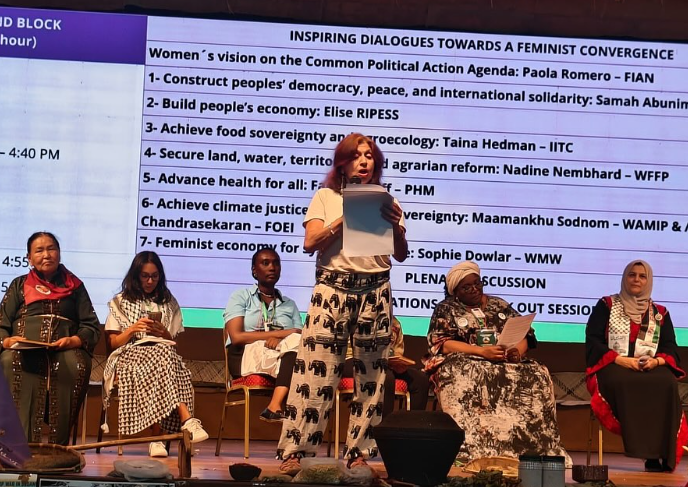
Farah Shroff is part of the People’s Health Movement in Canada. This article is an edit of her speech during the Women’s Assembly in the 3º Nyéléni Global Forum.